Sde Dov, Tel Aviv: New Projects and Apartments for Sale
What Sde Dov is: Tel Aviv's new seafront quarter
The Sde Dov quarter is a new district of homes, offices, shops, hotels and public buildings in north Tel Aviv-Yafo, on the land of the former Dov Hoz airport. It is not one more stand-alone project but the largest and most sensitive reserve of city land left on the Tel Aviv coast. The plan brings together apartments for sale, affordable and special housing, offices, hotels, parks, walking and cycling paths and a link to the Green Line of the light rail. For a buyer or an investor, Sde Dov is a rare opportunity and a demanding purchase: apartments sold off plan, surroundings still being developed, high prices, long contracts and, in the resort-style compounds, possibly high management fees. Sde Dov apartment prices, with the price per m² by compound and by room count, have their own page.
Location
The Sde Dov quarter on the map: the projects, the beach and the neighbourhood
On the north Tel Aviv shoreline, from the Eshkol neighbourhood in the south to the north of the quarter: the projects on sale and under construction, the future Green Line stations, the beaches and parks, and the schools and kindergartens around the quarter.
Illustrative map. Quarter boundary from the Sde Dov quarter plan; locations from OpenStreetMap and the Tel Aviv-Yafo municipality; projects by their plots, updated 7 October 2026. © OpenStreetMap contributors
The map is not available right now. These are the places it shows:
All the projects and places on the map
Projects
- Rainbow: A 39-floor tower and 9-floor boutique buildings · 459 apartments
- DIMRI YAMA: A 40-floor tower, a 16-floor mid-rise and two 9-floor buildings · 458 apartments
- ASHIRA: A 35-floor tower and 3 more buildings · 406 apartments
- UTOPIA: 4 buildings around a shared courtyard · 337 apartments
- ZOHI: 230 apartments
- Shikun & Binui: 324 apartments for long-term rent · a 38-floor tower and two 8-floor buildings
- GINDI VOGUE: A 45-floor tower and 3 towers of 20 floors · 708 apartments
- FIRST: A 45-floor tower and 3 boutique buildings of 9 floors · 350 apartments
- Mediterranean Towers: Senior living · up to 300 housing units
Schools and kindergartens
Schools: Aran School, Kochav HaTzafon School, Nofei Yam School, Ironi Kaf Dalet Amos Oz
Kindergartens: Abba Kovner 16, Yehuda Burla 2, Yehuda Amichai 1, Isaac Bashevis Singer 1, Isaac Bashevis Singer 7
Parks
Beaches: Northern Dog Beach, Tel Baruch Beach
Promenades: Yarkon Estuary Promenade
Parks: Kaf Gimel Yordei HaSira Memorial Garden, Jilber Garden, Kochav HaTzafon Garden, Lamed HaYeruka, Reading Beach Park
Shopping
Supermarkets: Shufersal Express (2)
Transport
Future Green Line stations: Einstein, Zohara Levitov, Levi Eshkol, Nofei Yam, Propes, Reading
History: from Dov Hoz airfield to a new quarter
Sde Dov was the everyday name of Dov Hoz airport, named after Dov Hoz, one of the pioneers of Hebrew aviation. The airfield was inaugurated on 23 September 1938 and in its early years served the Tel Aviv-Haifa-Beirut air line. For decades it was part of north Tel Aviv, yet it also kept the city from building a continuous coastline, extending its streets, laying transport links and growing a complete urban quarter.
The airport closed on 1 July 2019, and the site was fully cleared early in 2020. The move from a working airfield to land open for planning was a rare shift: a large, continuous and valuable strip of coast, in a high-demand area, passed from aviation and security use into a broad urban planning process. So Sde Dov is not only a story about apartment prices but about a structural change in north Tel Aviv.
In planning terms, the closure opened the way to extend the city toward the sea, connect north Tel Aviv with its shoreline, add public uses and create a quarter built less around the private car and more around walking, cycling and public transport. For a buyer, the same transition brings uncertainty: the quarter is being built in stages, its parts are at different levels of progress, and in the first years of occupancy the gap between the marketing renderings and a living neighborhood can be significant.
The history of the site also explains the economic weight of the land. This is not marginal land on the edge of a city, but a coastal area kept closed to homes and shops for many years. When land like this is released, it draws major developers, purchasing groups, investors, buyers living abroad and families looking for a new home in the north of the city. That scarcity pushes prices up, but it does not remove the need for careful legal, planning and financial checks.
Land and location: about 1,300 dunam on the north Tel Aviv coast
The Sde Dov quarter covers about 1,300 dunam (the Israeli land unit: 1 dunam = 1,000 m²) along the sea in north Tel Aviv. Its edges are Tzukei Aviv and Propes Street to the north; Nofei Yam, Plan L and Levi Eshkol Street to the east; Kochav HaTzafon, the Reading compound and Shai Agnon Street to the south; and the beach and the promenade to the west. It has a coastal front of about 2 km and sits close to Yarkon Park, the established neighborhoods of North Tel Aviv, the shoreline and the main traffic routes.
The location brings together three drivers of demand that rarely meet: the sea, closeness to the heart of Tel Aviv, and enough land to plan a whole quarter rather than a single building. For buyers, that means the potential for a neighborhood with parks, local shops, public institutions and transport links. For investors, it means a luxury real estate product, but also dependence on the pace of public development and on the quarter turning from a building site into a place to live.
The boundaries also explain the differences between projects. A project close to the beach is not the same as one facing the inner quarter, and a project in Eshkol is not the same as one in the Centre or the North. Even when every project is marketed under the Sde Dov name, check the exact lot, the detailed plan, the access roads, the distance to public services, exposure to the noise of future works and the development stages next door.
A buyer new to the area may treat the quarter as a single address. In practice it is a large area built in stages, with differences between streets, frontages, building heights and the position relative to the parks and to the Green Line. So the question is not whether a project is in the quarter, but exactly where its lot sits within it.
The master plan: 16,000 apartments for 40,000 residents
The master plan for the Sde Dov quarter describes a mixed-use quarter of about 16,000 apartments for about 40,000 residents. Alongside the homes it plans public space, offices, retail, hotels, parks, a link to the Green Line of the light rail, and a layout that favors pedestrians, cyclists and public transport over total reliance on the private car.
The key figures show that the quarter is not planned as a closed residential enclave but as a new piece of the city. Under the plan approved in 2020, it includes about 500,000 m² of public buildings, about 125,000 m² of hotels and about 365 dunam of parks and public gardens. Of the 16,000 apartments, about 2,400 are set aside for affordable housing at a reduced price and about 4,500 for special housing, including student dormitories, assisted living and rental housing.
| Topic | Planning figure | What it means for the buyer |
|---|---|---|
| Apartments | About 16,000 apartments | A large quarter, not a single project; the pace of occupancy may shape quality of life in the first years. |
| Expected population | About 40,000 residents | Check schools, health care, community facilities, shops and city services. |
| Affordable housing | About 2,400 apartments at a reduced price | A social element of the plan, but not every apartment in the quarter will be sold on affordable-housing terms. |
| Special housing | About 4,500 special-housing units | Check whether a nearby building is planned for rental, dormitories, assisted living or another use. |
| Public buildings | About 500,000 m² of public buildings | Critical to turning the quarter from a building site into a working neighborhood. |
| Hotels | About 125,000 m² of hotels | May strengthen retail and tourism, but check crowding, traffic and the character of the street. |
| Parks | About 365 dunam of parks | A quality-of-life advantage, subject to when they are actually built and developed. |
| Public transport | The Green Line of the light rail runs through the quarter | Potential access, but check the timetables, the actual stations and the impact of the works. |
Read these figures with care. A large number of apartments does not, on its own, guarantee a good neighborhood, and planned public space is not the same as developed, ready public space. So when you assess a project in Sde Dov, separate three levels: the master plan, the detailed plan of the compound, and the building permit of the specific project.
The gap between these levels matters most when you buy off plan. A developer can market the experience of a future quarter, but the buyer signs a contract with a specific company, for a specific apartment, in a specific building, with a specific specification and a specific delivery date. The master plan gives the background; it does not replace a review of the sale contract, the building permit, the guarantees, the specification, the apartment plans and the bylaws of the future condominium.
Three compounds: Eshkol, the Centre and the North
The Sde Dov quarter is divided into three main compounds: the Eshkol compound in the south-east, the Centre of the quarter, and the North. The division is more than a technicality. It shapes the timing of progress, the mix of uses, the character of the building, the level of uncertainty and the first living environment that buyers will find.
| Compound | Housing | Retail | Employment | Hotels | Where it stands |
|---|---|---|---|---|---|
| Eshkol | About 4,800 apartments | About 45,000 m² of retail | About 145,000 m² of employment space | No separate figure | The most advanced of the compounds, on the former runway |
| The Centre | About 7,100 to 7,128 apartments | About 60,000 m² of retail | About 155,000 m² of employment space | About 800 hotel rooms | A major compound on a large scale, with a central influence on the character of the whole quarter |
| The North | About 4,000 apartments | About 20,000 m² of retail | About 30,000 m² of employment space | About 1,150 hotel rooms | The northern part of the quarter, with an important link to the city limits and the northern coastline |
Eshkol is the compound that moved first, in sales and in projects on the ground. It lies in the south-east of the quarter, on the line of the former runway, so it is the natural entry point for buyers looking at the projects on sale today. Even within Eshkol, though, lots differ: in how close they are to the main roads, in their exposure to the future park, and between high-rise towers and lower buildings.
The Centre is a broader component, with more housing and a substantial mix of uses. It is expected to shape the urban heart of the quarter: its shops, offices, hotels and traffic. If you are buying in the Centre, look beyond the apartment itself: check the ground-floor uses, how close the building is to hotels, retail or offices, and what that means for traffic and upkeep.
The North is expected to complete the urban fabric up to the city limits. Here the emphasis is not only on homes but also on hotels, public space, parks and the connection to north Tel Aviv. For buyers living abroad and for investors, the northern parts of the quarter may look attractive for their closeness to the beach and to open space, but check the timetables, the status of the plans and the services available at the time of occupancy.
In February and March 2025, eight land tenders closed for the construction of 6,666 apartments, more than 40% of the apartments planned in the quarter. That points to a strong pace of sales, but it does not mean every apartment will be built or occupied at the same time. For a buyer, there is a real difference between winning a land tender, receiving a permit, starting work, the frame, the finishing, the occupancy permit and the actual handover of the keys.
Projects on sale in Sde Dov
The projects on sale in Sde Dov speak a similar language of luxury living, the beach, parks, amenities and services, but each one sits on a different lot, is run by a different developer and rests on its own permit, specification, main contractor and timetable. So the name of the quarter or of the developer is not enough: check the legal and commercial details of each project on its own.
| Project | Developer | Key features |
|---|---|---|
| Rainbow Tel Aviv | Israel Canada | A tower of 39 to 40 floors and boutique buildings, 459 apartments (480 in the land tender), contractor Ashtrom, the last stage expected to be handed over in 2030 |
| FIRST BY HAGAG | Hagag Group | A 45-floor luxury tower and three 9-floor boutique buildings, 350 apartments, on one of the most expensive plots of land in Israel |
| ASHIRA BY AVISROR | Avisror Moshe & Sons | 406 apartments in four buildings, including a 35-floor tower, with a mix of apartment types and a full package of services |
| DIMRI YAMA | Y.H. Dimri | 458 apartments in a 40-floor tower, a 16-floor mid-rise and two 9-floor buildings, designed by architect Rani Ziss with interiors by Kelly Hoppen |
| ZOHI | The project's developers, as named in its marketing (Levinstein, Mivne and Allied) | About 230 apartments, modern Bauhaus and low-rise building compared with the rest of the quarter |
| GINDI VOGUE | Gindi Holdings | 708 apartments on two lots in the Centre, including a 45-floor tower and three 20-floor towers |
| UTOPIA | Nahmias Group | 337 apartments in four buildings around a shared courtyard, in the Eshkol compound |
Rainbow Tel Aviv
Israel Canada's Rainbow Tel Aviv is one of the standout projects in the Eshkol compound: a tower of 39 to 40 floors and boutique buildings, 459 apartments by the developer's count (the land tender spoke of 480). The main contractor is Ashtrom, chosen in January 2026, and the apartments will be handed over in stages, the last expected in 2030. Here, check the difference between the marketing material and the permit documents, the extent of the common areas, the expected management fees and how changes to the specification are handled.
FIRST BY HAGAG
Hagag Group markets FIRST BY HAGAG as a luxury project on exceptionally expensive land in Sde Dov, closely tied to the sea and the coastline. Luxury marketing is not enough. Check the selling company, the guarantees under the Sale (Apartments) (Assurance of Investments of Purchasers of Apartments) Law, known as "the Sale Law guarantee", which protects what you pay before handover, as well as the delivery date, the indexation terms, the additional costs and the bylaws of the future condominium.
ASHIRA BY AVISROR
Avisror Moshe & Sons markets ASHIRA BY AVISROR as a residential project with a mix of apartments and services for residents. The question is not only what the renderings show but what goes into the contract: the apartment's area as defined under the Sale (Apartments) Law, the balcony area, parking, storage, ceiling height, the building systems, the common areas, the ground-floor uses, and how upkeep and management will work.
DIMRI YAMA
Y.H. Dimri presents DIMRI YAMA with architecture by Rani Ziss and interior design by Kelly Hoppen. Famous names are part of the brand experience, but they do not replace written commitments. Confirm which design elements bind the developer in the contract and the specification, and which appear only in the marketing material.
ZOHI
ZOHI is marketed as a modern Bauhaus compound, low-rise compared with the rest of the quarter. In a more intimate compound, check the number of buildings, the common areas, the apartment's position relative to courtyards and passageways, and what low-rise building means next to neighboring towers. Lower buildings can be a planning advantage, but check exposure, privacy, shade and upkeep.
GINDI VOGUE
Gindi Holdings' GINDI VOGUE is part of the wave of new projects coming to market in the quarter. Even with a well-known developer, look at the specific company signing the contract, whether a Sale Law guarantee or bank supervision is in place, the status of the permit, and the commitments on delivery, compensation for delay and the technical specification.
UTOPIA
UTOPIA belongs to the Eshkol compound and is associated with the Nahmias Group. Since Eshkol is the most advanced compound, some buyers see it as an early way into the quarter. Even in a project that is relatively far along, check the construction stages, the bank supervision agreements, the payment terms, the attached parking and storage, the nearby commercial uses and the development plans for the surroundings.
The developers building in Sde Dov
Sde Dov draws major developers because of the scarcity of the land, the high prices and the prestige of a new beachfront quarter in Tel Aviv. The developers active in the area, or linked to its sales, tenders, planning or promotion, include Israel Canada, Hagag Group, Avisror Moshe & Sons, Y.H. Dimri, Gindi Holdings, Shikun & Binui, Mor Group, Nahmias Group, Levinstein Group, Allied, Mivne, Africa Israel and Electra.
A well-known developer's name is a starting point, not a substitute for checks. In an off-plan purchase, find out exactly which company is selling, whether it is a dedicated project company, who its shareholders are, who the main contractor is, which bank is supervising the project, whether a guarantee is issued under the Sale Law, and the status of the permit. Sometimes a familiar brand markets a project while the legal contract is signed with another company in the group.
Many developers mean both competition and variety. One project may offer a broad package of services and higher management fees, another may focus on apartment design and location, and a third may sell a hotel-style way of living. The right comparison is not the price per m² alone, but price, location, specification, construction stage, the developer's identity, legal certainty and additional costs taken together.
For a buyer living abroad, checking the developer matters even more: distance makes it harder to follow the works, notices, residents' meetings, specification changes and documents. Appoint a real estate lawyer who represents you alone, with a power of attorney to act for you while you are away, rather than relying on the developer's lawyer, whose job is to represent the seller. More on buying a home in Israel from abroad.
Prices: how much an apartment in Sde Dov costs
Apartment prices in Sde Dov sit at the top of the Israeli housing market. A survey of the developers' annual reports published in April 2026 found that the about 1,280 apartments sold in the quarter up to then averaged about ₪83,000 per m², and that a 4-room apartment (Israelis count the living room as a room, so this means a living room and 3 bedrooms) sold for about ₪9.45 million on average. In the Eshkol compound, the sales averages of the projects in 2025 ranged from about ₪63,400 to about ₪82,600 per m², VAT included, and in 2026 most projects in the quarter are selling at about ₪70,000 per m². At Rainbow Tel Aviv, the average of all apartments sold up to March 2026 was about ₪81,800 per m². At these prices, a simple calculation puts a 100 m² apartment at about ₪7 to ₪8.3 million. The price of land in the tenders reached about ₪3.3 million per apartment on average in 2022, development costs included, and came down to about ₪1.7 to ₪2.2 million per apartment in the February 2025 tender for regular apartment buildings. At the luxury end, deals of ₪14 million and more have been recorded, among them the largest deal published in the quarter: an apartment of about 390 m² on floor 38, sold in December 2025 for more than ₪42 million.
| Area or project | Reported price level | What to check |
|---|---|---|
| Eshkol compound | Project averages in 2025: about ₪63,400 to about ₪82,600 per m², VAT included; in 2026 most projects in the quarter at about ₪70,000 per m² | The floor, orientation, view, parking, storage, specification and management fees. |
| Rainbow Tel Aviv | About ₪81,800 per m², the average of all apartments sold up to March 2026 | An average is not the price of a specific apartment; check the saleable area, what is attached to the apartment and the payment terms. |
| A 100 m² apartment | About ₪7 to ₪8.3 million by calculation (100 m² times ₪70,000 to ₪83,000 per m²) | The actual price varies with the floor, view, balcony, parking, storage and payment dates. |
| Land per apartment in the tenders | About ₪3.3 million per apartment on average in the 2022 tenders; about ₪1.7 to ₪2.2 million per apartment in the February 2025 tender for regular apartment buildings | The cost of land is not the final price of an apartment, but it shapes the price level the developer needs to reach. |
| Luxury deals | Deals of ₪14 million and more; the largest published deal: more than ₪42 million (December 2025) | Luxury deals do not necessarily represent the quarter's apartments as a whole. |
The price per m² is a tool for comparison, but it is not enough. Off plan, look also at the apartment's area as defined under the Sale (Apartments) Law, the balcony area, the floor, the orientation and airflow, the future view rather than the one in the rendering, the parking spaces, the storage room, the specification, the common areas and the expected management fees. An apartment at a lower price per m² may be the weaker deal if it faces a long-running construction zone, lacks parking or carries higher management fees than expected.
The land tenders affect the price buyers pay, but they do not set the value of an apartment on their own. A developer who pays a high price for land has to price its apartments to cover land, construction, financing, marketing and profit. The final market, though, is set by what buyers can pay, mortgage rates, competing supply in north Tel Aviv, the luxury market and confidence in the pace at which the quarter develops.
When you compare, ask the developer for a full price table: VAT, parking, storage, the developer's legal fees if charged, index linkage (Israeli contracts tie payments to a construction cost index), payments for changes and the estimated management fees. Check whether the price shown covers the apartment alone or what is attached to it as well, and whether there are payment promotions, developer loans, grace periods or deferred payments, and what their true economic price is.
Sde Dov also feels the influence of buyers living abroad and luxury investors. Demand like this can support prices, but it is sensitive to exchange rates, regulation, tax, the security situation and the capital markets. So an investment in the quarter should be tested against scenarios, not against the general belief that prices always rise.
Transport, parks, beaches and public buildings
One of the core principles of the Sde Dov plan is a quarter designed around walking, cycling and public transport. The Green Line of the light rail is planned to run through the quarter, alongside cycle paths, city streets, parks and open spaces. For families, that could mean better access without depending on a car every day. For investors, public transport can shape future rental demand.
Still, planned transport is not the same as transport that runs. Before buying, check where the planned stations are, the updated timetables, the stages of the works and the real distance from the building to the station. A distance that looks short on a map can feel very different when the route crosses a building site, a temporary road or land not yet developed.
The parks are a central part of the quarter's promise. The plan includes about 365 dunam of parks, along with a coastal park and city squares. These open spaces can raise quality of life, give children room to play, support neighborhood shops and add to the appeal of living here. Here too, check the dates of execution, who is responsible for upkeep and how the building actually connects to the parks.
The beachfront is a major asset, but it also raises questions of crowding, tourism, hotels, parking, noise, management of public space and protection of the coastal environment. An apartment close to the beach is not necessarily quieter, and one a little further away is not necessarily worse. Check the apartment's orientation, the height of the building, the street layout, the neighboring uses and the expected traffic.
Public buildings are a condition for the quarter's success. The plan includes about 500,000 m² of public buildings, but a buyer should check which public institutions are planned near the project, whether schools and kindergartens will be open by the expected date of occupancy, and what happens in the meantime. A family moving in during the quarter's early years may find a gap between the future plan and the services actually available.
Affordable and special housing in Sde Dov
The Sde Dov quarter is not planned as a luxury market alone. Under the plan approved in 2020, of the 16,000 apartments about 2,400 are set aside for affordable housing at a reduced price and about 4,500 for special housing, including student dormitories, assisted living and rental housing. The mix is meant to create a quarter that is more varied, both socially and in how it works day to day.
Affordable housing does not mean that every apartment in Sde Dov will be within easy reach. Distinguish between apartments sold on the open market and apartments allocated under reduced-price schemes, supervised rent, the state's Dira Lehaskir rental program or other public tracks. If you are looking into eligibility, check the terms with the Tel Aviv-Yafo municipality, the Israel Land Authority and the other competent bodies, rather than relying on general marketing information.
Special housing also affects buyers of regular apartments. A neighboring building planned for rental, dormitories or assisted living can shape the character of the street, the turnover of residents, hours of activity, traffic and related uses. That is not necessarily a drawback, but it is worth knowing in advance. So when you check a lot, look at the planned uses next door and not only at the building where you are buying.
For investors, institutional rental housing may mean competition. If many long-term rental projects operate in the quarter, a private apartment for rent will compete not only with other investors' apartments but also with managed institutional stock. On the other hand, a quarter with offices, shops, public transport and places of study can generate steady rental demand. What counts is the mix of demand, not only the purchase price.
Investing in Sde Dov: advantages, risks and what to check
An investment in Sde Dov rests on strong fundamentals: rare coastal land, a north Tel Aviv address, planning at the scale of a whole quarter, the presence of major developers, planned transport and a premium name. These are real advantages, but they do not make every apartment the right investment. A high entry price narrows the margin of safety, and a more expensive deal is more sensitive to interest rates, tax, management fees and delays in delivery.
The first risk is price. When most projects in the quarter sell at about ₪70,000 per m² in 2026, and the apartments sold in the quarter up to April 2026 averaged about ₪83,000 per m², a buyer needs to ask whether the price reflects the specific apartment or the name of the quarter. A low-floor apartment with no view, exposed to construction work or carrying high management fees, is not the same as a high-floor apartment with an open view.
The second risk is time. Rainbow Tel Aviv, whose last stage the developer expects to hand over in 2030, shows that some of these purchases are long-term commitments. Over a period like that, interest rates, exchange rates, family circumstances, the ability to finance, regulation and the market can all change. So check the payment schedule, your ability to finance the purchase through to handover, and whether the contract restricts selling your rights before occupancy.
The third risk is the development environment. In the first years of occupancy, some streets, parks, shops and public buildings may not yet be fully running. An apartment in a new quarter can be a good long-term holding but less comfortable during the transition. For a family with children, check schools and services. For an investor, ask whether a future tenant will pay a high rent before the quarter is fully up and running.
The fourth risk is legal and contractual. A sale contract in a luxury project can include indexation clauses, protections for the developer, flexibility in the plans, and provisions on common areas, management, commercial uses, facilities, specification changes and delivery terms. Check every clause before you sign, and do not settle for a sales summary.
The fifth risk is management fees. Some projects market a package of pools, gyms, a spa, work lounges, a lobby and further services. Facilities like these can raise quality of life, but they can also mean high management fees for years. Before signing, ask for an estimate of the management fees, understand what it covers, who the management company is, whether there is a minimum commitment and whether residents will be able to change provider in the future.
A sound investment check in Sde Dov covers the purchase price, purchase tax, VAT where relevant, financing costs, indexation, professional fees, the cost of buyer changes, management fees, maintenance, the expected arnona (municipal property tax), rental potential, the risk of vacant periods and tax on a future sale. Anyone who weighs a deal only as "today's price against tomorrow's price" is missing part of the picture.
Legal checks before buying off plan in Sde Dov
Buying off plan in Sde Dov (a presale: you buy from the developer before the building is finished) calls for an independent legal review on your side. The developer's lawyer does not represent you, even if you pay part of the fee or receive documents from that office. Your own lawyer reviews the deal, explains the risks, negotiates changes to the contract and makes sure the guarantees and payments comply with the law.
The first check is under the Sale (Apartments) Law: the description of the apartment, its area, the specification, the attached parking and storage, the delivery date, compensation for delay, the defect-liability period, responsibility for repairs and the developer's right to make changes. Where projects include extensive facilities and services, check whether the marketing promises are written into the specification or stay outside the contract.
The second check is under the Sale (Apartments) (Assurance of Investments of Purchasers of Apartments) Law. A buyer who pays before receiving the apartment must receive suitable security, such as a Sale Law guarantee or proper bank supervision (liva'i bank'ai, in which a bank oversees the project and its account), in line with the law and the project documents. Do not transfer significant sums before checking the supervision account, the wording of the guarantee, the conditions for calling it and the supervising bank.
The third check is planning status: the plan that applies, the detailed plan, the building permit, the drawings, the location of the lot, the building rights and the neighboring uses. Make sure the apartment matches the permit, with no gap between a marketing plan and a binding planning document. Where needed, check the decisions of the Tel Aviv District Planning Committee and the Tel Aviv-Yafo Local Planning Committee.
The fourth check is the sale contract: the payment schedule, indexation, early payment, late delivery, force majeure, planning changes, limits on assigning your rights, registration of the condominium and of your rights, parking, storage, common areas, facilities, maintenance, commercial uses and management. These clauses, not the renderings, set your actual rights.
The fifth check is tax and levies: purchase tax (mas rechisha, the Israeli tax on buying property) and its brackets, your status as the buyer of a sole apartment, a move-up buyer, a foreign resident or an investor, financing, and the consequences of a future sale. Our guide to purchase tax for foreign residents sets out the basics; owning an apartment does not by itself give residency in Israel. Check the betterment levy too, where it applies, and do not assume a levy or charge falls on the developer without an explicit clause in the contract.
The sixth check is the specification and management fees. In resort-style projects, check what the common areas include, who pays to build and to maintain them, whether the fees are capped for a set period, whether some services cost extra, and what happens if some residents do not want the facilities. This can weigh on the cost of ownership as much as the purchase price.
The seventh check is financing. An approval in principle for a mortgage does not guarantee the same terms at handover. In a long-term purchase, check interest-rate scenarios, equity, indexation, exchange rates for buyers living abroad and changes in your ability to repay. An expensive contract with a long payment schedule calls for orderly financial planning.
The eighth check is managing risk after signing: keep the documents, follow the developer's notices, check payment demands, record changes, track delivery dates, review the handover protocol and prepare for the defect-liability period. From abroad, a lawyer holding your power of attorney can handle these steps. A purchase in Sde Dov does not end at signing; it continues through construction, handover and registration.
Frequently asked questions
Where is the Sde Dov quarter?
The Sde Dov quarter is in north Tel Aviv-Yafo, on the land of the former Dov Hoz airport. It covers about 1,300 dunam along the sea, between the Tzukei Aviv neighborhood and Propes Street to the north, Nofei Yam, Plan L and Levi Eshkol Street to the east, Kochav HaTzafon, the Reading compound and Shai Agnon Street to the south, and the sea to the west. Its closeness to the beach, to Yarkon Park and to the neighborhoods of the north is one of the main sources of demand.
How many apartments are planned in Sde Dov?
About 16,000 apartments are planned in the quarter, for about 40,000 residents. Public space, retail, offices, hotels, parks and transport infrastructure are planned alongside them. The figure refers to the whole quarter, not to a single project.
When will people move into Sde Dov?
It depends on the project, the compound, the permit and the pace of construction. At Rainbow Tel Aviv, for example, the last stage is expected to be handed over in 2030. For every project, check the delivery date written in the sale contract, rather than relying only on a sales conversation or an advertisement.
How much does an apartment in Sde Dov cost?
The apartments sold in the quarter averaged about ₪83,000 per m², in a survey of the developers' reports published in April 2026, and a 4-room apartment sold for about ₪9.45 million on average. In 2026 most projects in the quarter sell at about ₪70,000 per m², and at these prices a 100 m² apartment comes to about ₪7 to ₪8.3 million by calculation. The actual price varies with location, floor, view, specification, parking, storage and payment terms.
What is the Eshkol compound in Sde Dov?
The Eshkol compound is the south-eastern compound of the Sde Dov quarter, on the line of the former runway. It includes about 4,800 apartments, about 45,000 m² of retail and about 145,000 m² of employment space. It is the most advanced compound in sales and active projects, but every lot and every project still needs to be checked on its own.
Who are the main developers in Sde Dov?
The developers active in the quarter, or linked to its projects, tenders and sales, include Israel Canada, Hagag Group, Avisror Moshe & Sons, Y.H. Dimri, Gindi Holdings, Shikun & Binui, Mor Group, Nahmias Group, Levinstein Group, Allied, Mivne, Africa Israel and Electra.
Is Sde Dov a good investment?
It can suit some buyers, but not every budget or appetite for risk: Sde Dov offers rare advantages of location, beach, quarter-scale planning and limited land, but prices are high and the risk is not low. Check the price per m², management fees, the delivery date, future competition, financing, purchase tax, rental potential and the terms of the contract.
Is there affordable housing in Sde Dov?
Yes. Under the plan approved in 2020, about 2,400 of the quarter's apartments are set aside for affordable housing at a reduced price, and about 4,500 for special housing such as student dormitories, assisted living and rental housing. Check eligibility and terms with the authorities and the relevant programs.
What should you check before signing for an apartment in Sde Dov?
Check the selling company, the building permit, the applicable plan, the sale contract, the specification, the apartment's area, parking, storage, the delivery date, compensation for delay, the Sale Law guarantee, bank supervision, management fees, tax, indexation and payment terms. In expensive projects, every small clause can carry a large financial weight.
Will management fees in Sde Dov be high?
They may be: in projects marketed with pools, gyms, a spa, work lounges, a lobby and further services, management fees can become a significant part of the cost of ownership. The level of the fees in each project has not been published in a uniform way, so ask for a written estimate, understand what it includes and check whether it is a contractual commitment or only a marketing estimate.
Sde Dov in short
The Sde Dov quarter is one of the most important developments in Israel: a new coastal quarter in north Tel Aviv-Yafo, on rare land, with about 16,000 apartments, about 40,000 planned residents, parks, shops, offices, hotels and public transport. The potential is high, and so is the complexity. Before buying, check the compound, the project, the developer, the permit, the contract, the guarantees, the specification, the true price, the management fees and the tax.
For a legal review of a deal in Sde Dov, talk to a real estate lawyer.
Planning the quarter: from plan to new city district
The city's largest land reserve is turning from a former airfield into a mixed-use quarter of thousands of apartments, a coastal park, hotels, shops, offices and infrastructure built in stages. The master plan came into force in August 2020, the detailed plan for the Eshkol compound in May 2021, and the plans for the Centre and the North in 2025. Every lot, tender and piece of infrastructure still has to be checked on its own.
For decades Sde Dov was a closed area used for aviation. Once it was cleared, a rare chance opened to plan a large part of the city almost from scratch. The advantage is control over the street grid, the public spaces and the location of infrastructure. The challenge is to turn a vast vision into a quarter people can live in during its first years too, while many parts are still being built.
The figure of 16,000 apartments draws attention, but it is only one part of the picture. A real quarter needs schools, kindergartens, clinics, everyday shopping, public transport, shaded paths, drainage, energy and maintenance, so the plan ties the homes to public spaces, workplaces, hotels and the beach. Pin down a project's compound: Eshkol, the Centre and the North are not at the same stage or under the same plan, and a short distance on the map can change the move-in date, the works around you and the services open the day you get your keys.
The plan builds a quarter, not a cluster of towers
The urban principle is a street grid linking the neighborhoods to the east with the sea, lined with buildings of different heights, active frontages, public institutions and squares. A quarter made only of towers and wide roads can feel empty at street level. The plan mixes apartments of different sizes and tracks with retail and offices; in practice, the mix of residents will also follow the land tenders, market prices, affordable housing, the pace of construction and how special-housing units are allocated.
A coastal park is a system, not a strip of lawn
The coastal park is meant to link the promenade, the cliff, the neighborhoods and the streets that run in from the east. Exposed to wind, salt and sun, its quality depends on shade, planting, protection against corrosion, drainage and continuous access. The meeting with the buildings matters too: shop fronts, public buildings and clear entrances bring activity through the day, while car parks, service fences or changes in level can break the flow.
Infrastructure before apartments: the right order, and hard to coordinate
The master plan lets the main roads, infrastructure and large parks move ahead before all the detailed plans are complete, so that thousands of residents do not move into a building site without streets and basic services. Doing it is harder than the principle: water, sewage, electricity, drainage, communications and transport must reach lots built at different speeds. A street may open in part, a park in stages, and a public institution after the first residents arrive.
Public transport, walking and cycling will set the quality of life
A quarter with thousands of apartments cannot rely on private cars alone. The plan provides for public transport, the Green Line of the light rail, cycle paths and a walking network, but being near the line on a map is not enough: measure the real walking distance, crossings, slopes, shade and continuity. Low parking ratios encourage alternatives to the car, but while public transport is still incomplete they can put pressure on the streets.
How to check an apartment in a quarter under construction
A rendering shows the end state; a buyer needs to understand the road there: which neighboring lots are not yet marketed, where the trucks will run, when the school opens and when the nearest park is due. Ask for the plan for the surroundings, not only the apartment plan, and check the project's legal document: the plan number, the building permit and what is attached to the apartment. Commercial names change; lot and plan numbers tie the promise to an official document.
In a new neighborhood you buy the apartment and also the first ten years of the neighborhood being built around it.
What to check in the official documents
- Which detailed plan and which lot the project belongs to, and what has already come into force
- Which streets, parks and public institutions will be running at the time of occupancy
- The real walking distance to public transport (not the distance as the crow flies)
- Which neighboring lots are expected to be built after occupancy
- Whether the figures for housing, retail and hotels refer to the whole quarter or to one compound
Public participation: how residents' comments enter the plan
Public participation in a project this size is not a single evening in a hall. For the Sde Dov master plan, five meetings were held with residents, stakeholders, civil society organizations and government bodies, and the issues raised were gathered in a report and examined before the plan was deposited. For the detailed planning, four topic meetings were set: traffic and transport, building and urban design, building and program, and housing.
Participation, consultation and objection are different things. A participation meeting comes before a decision and lets people present needs and alternatives; an objection is a formal procedure after the plan is deposited, with legal deadlines and rules, and attending a meeting does not replace it. To see whether a comment was adopted, follow the documents: presentation, meeting summary, participation report, the planning team's recommendation and the updated plan. If an issue appears only in the summary and not in the plan's map, regulations or instructions, the answer may have been a statement only.
During construction, the public needs practical information: road closures, dust, noise, working hours, access and truck routes, and points of contact. Participation is measured less by headcount than by the ability to follow a comment through to the answer and to the document that changed.
Guides to the quarter: compounds, data and infrastructure
- Eshkol: projects, prices, figures (in Hebrew)
- The Centre: full guide (in Hebrew)
- The North by the sea (in Hebrew)
- Apartment prices per m²
- Hotels and tourism (in Hebrew)
- Parks: the coastal park (in Hebrew)
- Reading anchorage and the marina (in Hebrew)
- Transport, the Green Line (in Hebrew)
- Public buildings, schools, health (in Hebrew)
- Employment, retail and offices (in Hebrew)
Projects, tools and professional support in Sde Dov
- Rainbow Tel Aviv: the project page
- FIRST Sde Dov by Hagag Group (in Hebrew)
- ASHIRA Sde Dov by Avisror
- DIMRI YAMA Sde Dov by Y.H. Dimri
- ZOHI Sde Dov
- GINDI VOGUE Sde Dov by Gindi
- UTOPIA Sde Dov by Nahmias
- Shikun & Binui Sde Dov: rental housing
- Senior living in Sde Dov: Mediterranean Towers (in Hebrew)
- Legal support for a real estate deal (in Hebrew)
- Purchase tax for foreign residents
- Mortgages for non-residents
- Property investment guide (in Hebrew)
- New apartments from developers
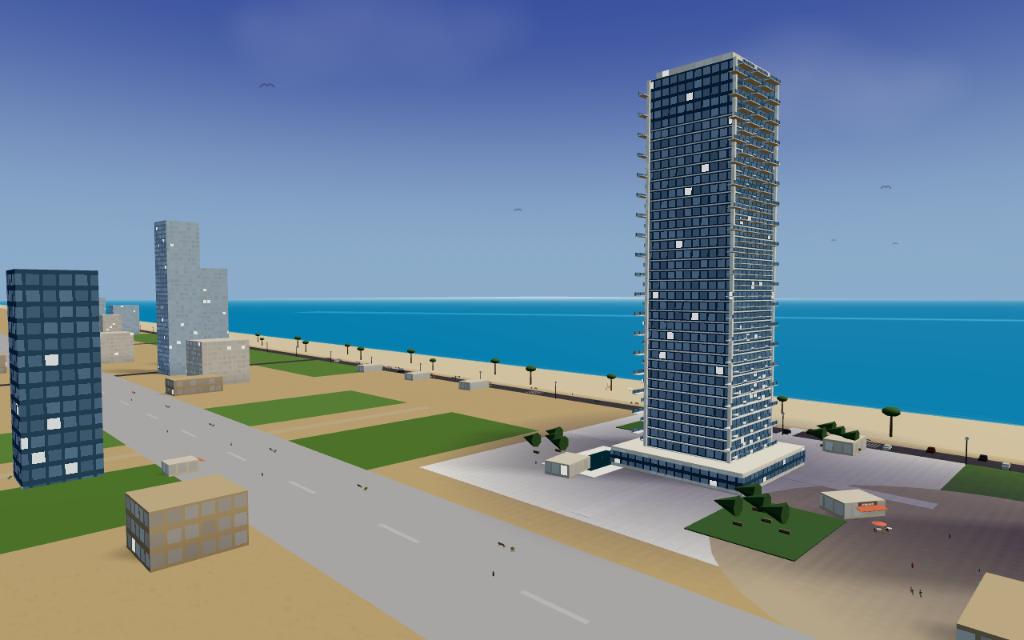
חדש · סיור תלת ממדי חי
נכנסים לעתיד של רובע שדה דב
מסתובבים ברחובות הרובע של 2035, עוברים בין המגדלים, יורדים לטיילת, ובוחרים דירה מתוך הבניין. הדמיה חיה בדפדפן, בלי להוריד כלום.
- מכונת זמן 2026 ⇄ 2035
- סיור חופשי עם חצים
- כל בניין לחיץ
הדמיה להמחשה על פי תכנית רובע שדה דב. אינה מטעם היזמים או גורם רשמי.