Israeli banks do lend to non-residents, but at a maximum of roughly 50% loan-to-value, with income documented abroad and a local bank account opened before the loan. The process differs from a US or European mortgage in ways that surprise buyers: consumer price index linkage on some tracks, mixed fixed-variable structures, and life insurance requirements. This guide covers which banks are active, realistic 2026 rates, and the document checklist.
- LTV: what non-residents can actually borrow
- The Israeli mortgage tracks explained
- Which banks work with foreign buyers
- Documents checklist
- Rates in 2026 and the linkage trap
- Using a mortgage broker vs going direct
- FAQ: Israeli mortgages for foreigners
- Sources
LTV: what non-residents can actually borrow
The first number to understand is the loan-to-value cap. It controls how much of the property price an Israeli bank may finance and how much equity the buyer must bring. For a non-resident, the practical starting point is usually not the same as for an Israeli resident buying a first home. Banks treat non-residents as investors, and that pushes the available financing down.
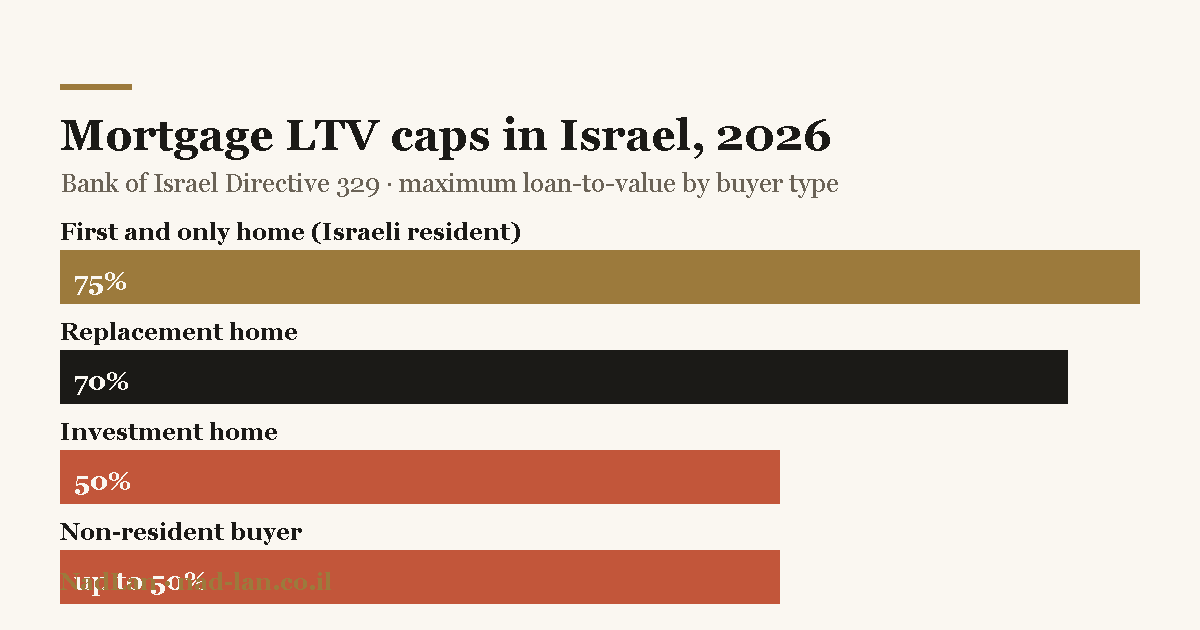
Under Bank of Israel Proper Conduct of Banking Business Directive 329, the LTV cap is 75% for an Israeli resident's first and only home, 70% for a replacement home, and 50% for an investment home. Banks treat non-residents as investors, so a non-resident mortgage is up to 50% of the lower of the purchase price or the bank's own appraisal, according to Bank of Israel Directive 329, checked July 2026 for this guide.
The phrase lower of the purchase price or the bank's own appraisal is where buyers get surprised. If the contract price is higher than the bank's valuation, the bank does not have to lend against the contract price. The bank can calculate the loan against its appraisal instead. The buyer then needs more equity, even if the buyer already agreed to pay the seller a higher amount.
This is why financing should be checked before signing. A buyer who has only modeled a 50% loan against the purchase price may still face a shortfall if the bank valuation comes in lower. That problem is sharper for foreign buyers because the equity portion must also pass source-of-funds checks when transferred from abroad. For the full purchase process around tax, legal checks and registration, read the complete guide to buying property in Israel as a foreign buyer.
| Buyer type | LTV cap | How the cap is applied | Source and date |
|---|---|---|---|
| Israeli resident, first and only home | 75% | Applied under the Bank of Israel housing-loan framework | Bank of Israel Proper Conduct of Banking Business Directive 329, checked July 2026 |
| Israeli resident, replacement home | 70% | Applied under the Bank of Israel housing-loan framework | Bank of Israel Proper Conduct of Banking Business Directive 329, checked July 2026 |
| Investment home | 50% | Applied under the Bank of Israel housing-loan framework | Bank of Israel Proper Conduct of Banking Business Directive 329, checked July 2026 |
| Non-resident foreign buyer | Up to 50% | Calculated on the lower of the purchase price or the bank's own appraisal | Bank of Israel Proper Conduct of Banking Business Directive 329 and bank treatment of non-residents as investors, checked July 2026 |
Mizrahi-Tefahot adds a useful status distinction on its official English mortgage QA page. The bank states that a buyer who is an Israeli citizen or entitled to Israeli citizenship can borrow up to 75% LTV instead of the 50% available to a foreign resident, according to mizrahi-tefahot.co.il, checked July 2026. For future olim and diaspora buyers, this can make status planning part of mortgage planning, not only a tax question.
Do not confuse mortgage LTV with purchase tax. The bank may treat a non-resident as an investor for financing, while the Tax Authority applies its own purchase-tax rules. The two systems affect the same budget but are not the same rulebook. A buyer should model equity, mortgage size and purchase tax together. For the tax side, read purchase tax for foreign residents before committing to a price.
The Israeli mortgage tracks explained
An Israeli mortgage is usually built from tracks rather than one simple fixed-rate loan. A bank may combine fixed non-linked debt, CPI-linked debt, prime-variable debt, variable-rate tracks and sometimes foreign-currency borrowing. The exact mix matters because the lowest initial payment is not always the safest structure. Non-resident buyers need to understand what changes the payment, what changes the outstanding principal and what creates currency exposure.
The Bank of Israel directives require at least one third of every mortgage at a fixed rate, and the variable-rate portion may not exceed two thirds, according to Bank of Israel banking supervision directives checked July 2026. That rule limits how aggressively a borrower can load the loan with variable-rate exposure. It still leaves a wide range of possible structures, so the buyer has to compare the effect of each track on future payments.
A fixed non-linked track gives more clarity because the principal is not adjusted by the consumer price index. A fixed CPI-linked track may begin with a lower nominal rate, but the principal is adjusted by inflation. A prime-variable track moves with the bank's prime rate. A variable track that resets periodically can look comfortable at the start but may change later. A foreign-currency mortgage may suit a buyer whose income is in the same currency, but it can create shekel value and repayment risk if the exchange rate moves.
| Track | What it means | Risk note | Rate anchor |
|---|---|---|---|
| Fixed non-linked | Rate is fixed and principal is not linked to the consumer price index | More payment clarity, but the initial quoted rate may be higher than a linked alternative | Average non-linked mortgage rate stood at about 4.79% in June 2026, per the Bank of Israel average-rate series |
| Fixed CPI-linked | Rate is fixed, but principal is linked to the consumer price index | The balance can rise even while payments are made on time if index linkage increases the principal | Weighted average rate on new CPI-linked mortgages was 3.57% in May 2026 data, published June 11, 2026 by the Bank of Israel average-rate series |
| Prime-variable | Rate moves with the bank prime rate | Monthly payment can change when the prime rate changes | Prime stood at 5.25% after the May 25, 2026 Bank of Israel decision |
| Variable every 5 years | Rate is fixed for a period and then resets under the loan terms | Payment risk is delayed rather than removed, because the reset can change the cost later | Quote depends on the bank and reset terms |
| Foreign-currency | Loan is connected to a foreign currency rather than only shekels | Can match foreign income, but creates currency and benchmark-rate exposure | Benchmark rate plus a fixed spread, per the lending bank |
The linkage trap is simple to state and easy to miss. CPI-linked tracks add the inflation adjustment to the principal, so the balance can rise even while payments are made on time. A buyer who focuses only on the opening monthly payment may understate the economic cost. This is especially relevant for non-residents who think in dollars, euros, pounds, Canadian dollars or Australian dollars but repay a shekel mortgage or hold a shekel asset.
The right track mix depends on income currency, risk tolerance, holding period, prepayment plans and whether the property is for use, rental or future Aliyah. This article does not give a model portfolio because no single track mix is correct for every foreign buyer. The practical discipline is to ask the bank or broker for the payment behavior under each track, not only the first monthly payment.
Which banks work with foreign buyers
The large Israeli mortgage lenders active with foreign buyers include Mizrahi-Tefahot, Bank Leumi, Bank Hapoalim, Israel Discount Bank and Bank of Jerusalem. Mizrahi-Tefahot is the largest mortgage bank. Bank of Jerusalem is known as a specialist in foreign residents and foreign-currency loans. A buyer should not assume that every branch or every banker handles non-resident files well. The lender name matters, but the desk handling the file matters too.
Mizrahi-Tefahot is often a first stop because of its mortgage scale and its English-language materials for overseas buyers. Its official English mortgage QA page states that a buyer who is an Israeli citizen or entitled to Israeli citizenship can borrow up to 75% LTV instead of the 50% available to a foreign resident, according to mizrahi-tefahot.co.il, checked July 2026. That makes the bank's treatment of citizenship or entitlement status a central question for some diaspora buyers.
Leumi, Hapoalim and Discount are major banks with broad mortgage activity and the ability to underwrite larger files. For a foreign buyer, the issue is not only whether the bank has a mortgage department. It is whether the bank will understand foreign income, accept translated documents, open or coordinate the required Israeli bank account, process anti-money-laundering questions and align the loan timetable with the purchase contract.
Bank of Jerusalem is especially relevant when foreign-currency borrowing is on the table. Bank of Jerusalem offers foreign-currency mortgages for terms of up to 20 years, based on a benchmark rate plus a fixed spread, according to bankjerusalem.co.il, checked July 2026. A foreign-currency mortgage can be useful when the buyer earns in the same currency, but it must be compared against shekel borrowing, exchange risk and the buyer's long-term plan for the property.
New-construction financing can add timing complexity. A buyer may sign with a developer, make staged payments and draw the mortgage according to bank and project rules. The bank will want to understand the project, the developer documents, the payment schedule and the security structure. If you are comparing new apartments, review current new projects only after the mortgage ceiling and equity transfer route are realistic.
Documents checklist
A non-resident mortgage file is a documentation project. The bank needs to identify the borrower, assess repayment ability, understand foreign income, verify assets, confirm the property and satisfy compliance requirements. The cleaner the file, the easier it is for the bank to underwrite. The weaker the file, the more likely the bank is to delay, ask for translations or reduce the approved amount.
A non-resident usually needs an Israeli bank account before drawdown. The account is used for loan administration and payments, and the opening process can trigger its own compliance review. Buyers should not leave account opening until the last moment. A purchase contract with a tight payment date can become stressful if the bank account, identity checks or incoming transfer review are still incomplete.
- Passport and identity documents for every borrower.
- Israeli identity or citizenship documents if the buyer has them or may be entitled to them.
- Proof of address outside Israel.
- Tax returns from the buyer's country of residence.
- Pay slips, employer letters or accountant letters showing current income.
- Bank statements and asset statements showing equity and reserves.
- Documents explaining the source of funds used for the equity portion.
- Purchase contract draft or signed contract, depending on the stage.
- Property documents requested by the bank, lawyer or appraiser.
- Translations where the bank requires them.
- Life insurance documents assigning the policy to the bank.
- Property insurance documents required by the bank.
- Power of attorney if the buyer will sign through a lawyer or representative.
Income earned abroad must be documented with tax returns, pay slips or accountant letters, usually translated. A salaried employee may need employer confirmation and income history. A self-employed buyer may need accountant letters and tax filings. A company owner may need company financial documents. The exact package depends on the bank, country and borrower profile, so the checklist should be confirmed before signing a binding purchase contract.
Anti-money-laundering checks apply to the equity portion transferred from abroad. The bank may ask where the money came from, when it was earned, how it moved between accounts and whether it belongs to the buyer. This is separate from the mortgage underwriting itself. For the equity route and compliance timing, use the guide to transferring money to Israel for a property purchase.
Banks require life insurance assigning the policy to the bank and property insurance. For older buyers or buyers with medical complexity, the insurance stage should not be treated as routine. If insurance approval is delayed or limited, it can affect loan timing. A serious mortgage plan includes the insurance question early enough to avoid a last-minute closing problem.
Rates in 2026 and the linkage trap
Rates in Israel need to be read through three lenses: the Bank of Israel policy rate, the bank prime rate and the actual mortgage track quoted to the borrower. A foreign buyer may see one headline rate and assume it applies to the whole loan. In practice, the mortgage may contain several tracks, each with different sensitivity to inflation, prime changes, currency movement or future reset terms.
The Bank of Israel Monetary Committee cut the policy rate by 0.25% to 3.75% on May 25, 2026. The prime rate, defined as the policy rate plus 1.5%, now stands at 5.25%. Inflation over the previous 12 months was 1.9%, and the next rate decision is scheduled for July 6, 2026, according to the Bank of Israel press release dated May 25, 2026.
The Bank of Israel average mortgage rate series gives useful anchors but not a personal quote. In May 2026 data published June 11, 2026, the weighted average rate on new CPI-linked mortgages was 3.57%, according to the Bank of Israel average-rate series. The average non-linked mortgage rate stood at about 4.79% in June 2026 according to trackers of the same Bank of Israel series.
| Rate anchor | Value | What it means | Source and date |
|---|---|---|---|
| Bank of Israel policy rate | 3.75% | Central policy anchor after the Monetary Committee cut | Bank of Israel press release, May 25, 2026 |
| Prime rate | 5.25% | Policy rate plus 1.5% | Bank of Israel press release, May 25, 2026 |
| Inflation over the previous 12 months | 1.9% | Inflation backdrop relevant to CPI-linked tracks | Bank of Israel press release, May 25, 2026 |
| Weighted average rate on new CPI-linked mortgages | 3.57% | Average-rate series anchor, not a borrower-specific quote | Bank of Israel average mortgage rate series, May 2026 data published June 11, 2026 |
| Average non-linked mortgage rate | About 4.79% | Average-rate series anchor, not a borrower-specific quote | Bank of Israel average mortgage rate series, June 2026 |
| Next rate decision | July 6, 2026 | Scheduled policy update date | Bank of Israel press release, May 25, 2026 |
The headline comparison between linked and non-linked rates can be misleading. A CPI-linked mortgage may show a lower stated rate, but the principal can grow with the consumer price index. If the principal rises, the buyer's outstanding balance can increase even when payments are made on time. That is the linkage trap. It is not a technical footnote. It changes the economics of the loan.
For a non-resident, the rate question also includes currency and income matching. A buyer earning in dollars or euros may prefer to think in foreign currency. The apartment, taxes, many costs and most shekel mortgage payments sit in Israel. A foreign-currency mortgage may reduce income-currency mismatch, but it adds its own benchmark-rate and exchange-rate risks. There is no substitute for modeling the actual monthly payment and balance behavior under each track.
Use the mortgage calculator for a first pass, but do not stop at the first payment. Ask for a track-by-track breakdown, whether the balance can rise, which part can change with prime, which part resets later and what happens if you repay early. The lowest opening payment is not necessarily the lowest-risk mortgage.
Using a mortgage broker vs going direct
A non-resident can go directly to banks, but many foreign buyers use a mortgage broker who specializes in non-residents. The broker's job is not only to shop for a rate. The broker packages foreign income for Israeli underwriting, anticipates which bank will understand the file, explains track combinations and helps coordinate documents. For buyers abroad, that coordination can be valuable.
Going direct can work when the buyer has a simple salary profile, strong documents, clear Israeli status and enough time to speak with several banks. Direct contact also helps buyers understand how each bank communicates and what it expects. The risk is that a buyer may compare incomplete quotes or lose time with a branch that is not comfortable with foreign income.
A broker can be more useful when the buyer is self-employed, earns in several currencies, owns a company, has complex assets, needs a foreign-currency option or will sign through a power of attorney. Mortgage brokers who specialize in non-residents can package foreign income for Israeli underwriting and present the file in a form the bank can process. That does not guarantee approval, but it can reduce avoidable friction.
The broker should not replace the buyer's lawyer. The broker handles financing. The lawyer handles rights, contract, tax filing coordination, warning notes, registration and legal risk. The two should speak before signing if the payment schedule depends on mortgage drawdown. A contract that assumes fast bank funding can create pressure if documents, appraisal, insurance or account opening move slowly.
Ask a broker or bank for clear written answers: maximum loan amount, appraisal dependency, required documents, expected account-opening steps, insurance requirements, signing requirements, track mix, linkage exposure and drawdown timing. If an answer is vague, do not treat the mortgage as solved. In a non-resident purchase, vague financing becomes a cash problem very quickly.
FAQ: Israeli mortgages for foreigners
How much can a non-resident borrow for a home in Israel?
A non-resident is generally treated by Israeli banks as an investor and can borrow up to 50% of the lower of the purchase price or the bank's own appraisal. That cap follows Bank of Israel Directive 329, checked July 2026, and means the buyer must bring substantial equity.
The appraisal point matters. If the bank values the property below the contract price, the buyer may need more cash than expected. Check financing before signing, not after the payment schedule is already binding.
Which Israeli bank is best for foreigners?
There is no single best bank for every foreign buyer. Active lenders include Mizrahi-Tefahot, Bank Leumi, Bank Hapoalim, Israel Discount Bank and Bank of Jerusalem. The right choice depends on buyer status, income country, currency needs, document quality, account opening, property type and the banker's experience with non-resident files.
Bank of Jerusalem is relevant for foreign-currency borrowing, and Mizrahi-Tefahot publishes English mortgage guidance. A broker can help compare which bank is likely to understand a specific foreign-income file.
What is the mortgage interest rate in Israel in 2026?
The Bank of Israel policy rate was 3.75% after the May 25, 2026 cut, and the prime rate was 5.25%. The Bank of Israel average mortgage rate series showed 3.57% for new CPI-linked mortgages in May 2026 data published June 11, 2026, and about 4.79% for non-linked mortgages in June 2026.
Those are anchors, not personal offers. A buyer's quote depends on the bank, track mix, LTV, income profile, property, term, insurance and risk assessment. Compare track behavior, not only headline rate.
Do new immigrants (olim) get better mortgage terms than non-residents?
They can. Mizrahi-Tefahot states on its official English mortgage QA page that a buyer who is an Israeli citizen or entitled to Israeli citizenship can borrow up to 75% LTV instead of the 50% available to a foreign resident, according to mizrahi-tefahot.co.il, checked July 2026.
This does not mean every oleh receives the same approval or pricing. The bank still underwrites income, property, repayment ability, insurance and documents. Status can improve the LTV framework, but it does not replace credit approval.
Can I sign the mortgage documents without coming to Israel?
Sometimes. A lawyer holding power of attorney can sign mortgage documents for a buyer abroad in some banks, while other banks require an in-person signature or a consular signature. The answer depends on the bank, document type, borrower status and whether the power of attorney is accepted.
Check this before signing the purchase contract. A buyer abroad should know whether a trip, consular appointment, original documents or local bank visit will be required before drawdown.
Sources
- Bank of Israel interest rate announcements
- Bank of Israel average mortgage rate series
- Mizrahi-Tefahot English mortgage QA
- Bank of Jerusalem foreign currency mortgage page
- Bank of Israel banking supervision directives
Next step: ask a bank or non-resident mortgage broker for a written pre-check showing the maximum loan, expected track mix, appraisal dependency, document list and signing route before you sign a binding purchase contract.
This guide is general information, not legal or financial advice. Every transaction requires its own review of the specific facts. For an initial consultation on a purchase in Israel, contact the office.