מחבר: בן בטש

  • Acheter un appartement en Israel en 2026 : le guide complet

    Acheter un appartement en Israel quand on vit en France, en Belgique ou en Suisse est un projet reel et accessible, mais c'est aussi une operation encadree par des regles qui different beaucoup de celles que connaissent les acheteurs europeens. La fiscalite d'achat, le plafond de financement pour un non-resident, la protection de l'acheteur sur un bien en construction et le transfert des fonds obeissent a une logique israelienne precise. Ce guide rassemble, de facon claire et a jour pour 2026, ce qu'un acheteur francophone doit comprendre avant de signer.

    Les chiffres cites ici proviennent de sources publiques de 2026 et des baremes officiels de l'Autorite fiscale israelienne et de la Banque d'Israel. Ils servent a comprendre les ordres de grandeur. Chaque dossier reste particulier, et un avocat specialise en immobilier verifie les montants exacts avant tout engagement. L'objectif est simple: vous permettre d'arriver a la table de negociation en comprenant deja les regles du jeu.

    Le marche israelien en 2026: le contexte

    Comprendre la tendance aide a acheter au bon moment et au bon prix. Apres un ralentissement du marche en 2024 et 2025, les prix sont repartis a la hausse dans les grandes villes du centre en 2026, Tel Aviv en tete avec une progression de l'ordre de 10% sur un an. La demande reste forte la ou l'offre est contrainte, notamment le long du littoral et dans les poles d'emploi. Pour un acheteur francophone, cela signifie deux choses: les emplacements de qualite conservent bien leur valeur dans le temps, et il faut se mefier des annonces qui affichent un prix de depart tres bas sans les frais et la taxe. Le bon reflexe est de raisonner en cout total et en emplacement precis, plutot qu'en moyenne de ville. Un marche qui monte ne dispense jamais de la verification juridique: c'est justement quand tout va vite que les erreurs coutent le plus cher.

    Le processus d'achat, etape par etape

    En Israel, il n'existe pas de notaire au sens francais. C'est l'avocat en immobilier qui joue le role central: il verifie le titre de propriete, redige et negocie le contrat, calcule les taxes, securise les paiements et procede a l'enregistrement final. Comprendre le deroulement evite les mauvaises surprises et vous fait gagner du temps.

    1. La recherche et la premiere selection

    Vous identifiez un bien, neuf ou ancien, directement, via un agent immobilier agree ou via un promoteur. En Israel, les honoraires d'agence tournent souvent autour de 2% plus TVA a la charge de l'acheteur lorsqu'un agent intervient. Rien n'est du tant qu'aucun accord n'est signe. Pour un acheteur a distance, il est utile de definir en amont un budget total, taxe et frais compris, et pas seulement un prix d'affichage.

    2. La verification prealable

    Avant toute offre ferme, l'avocat consulte le registre foncier, le Tabou, ou, pour un terrain de l'Autorite fonciere d'Israel, les droits de bail. Il verifie l'identite du vendeur, l'absence d'hypotheque ou de saisie, les droits reels, les surfaces reelles et, pour un projet neuf, le permis de construire et l'accompagnement bancaire. Cette phase de verification est la meilleure assurance contre un litige futur.

    3. Attention au zikaron dvarim

    Un simple protocole d'accord signe, appele zikaron dvarim, peut valoir contrat contraignant en droit israelien. Il ne faut jamais signer ce type de document sans avocat, car il peut vous lier avant meme la verification complete du bien. Beaucoup de litiges naissent d'un document signe trop vite dans l'enthousiasme d'une visite.

    4. Le contrat de vente

    Le contrat definitif fixe le prix, l'echeancier de paiement, la date de remise, les garanties et les penalites en cas de retard. Pour un bien sur plan, il precise le cahier des charges et les garanties de la loi sur la vente. C'est le document qui protege reellement l'acheteur, pas la brochure ni la conversation au bureau de vente. Chaque promesse orale utile doit se retrouver ecrite dans le contrat.

    5. Les paiements et la remise

    Les paiements suivent l'echeancier convenu, souvent etale pour un bien neuf. A la remise, l'avocat s'assure que le bien est conforme et que les garanties sont en place. Pour un bien neuf, une visite de reception permet de relever les eventuels defauts avant la remise des cles.

    6. L'enregistrement

    La derniere etape est l'inscription de votre propriete au Tabou ou aupres de l'organisme competent. Tant que l'enregistrement n'est pas finalise, l'avocat met en place des protections intermediaires, comme une note d'avertissement, la hearat azhara, qui bloque toute vente concurrente et securise vos droits dans l'intervalle.

    Le contrat de vente: les clauses a verifier

    Le contrat est le vrai bouclier de l'acheteur. Quelques clauses meritent une attention particuliere. Le prix et son mecanisme d'indexation: pour un bien neuf, une partie du prix peut etre indexee a l'indice du cout de la construction, ce qui augmente le montant final si le chantier dure. La date de remise et les penalites de retard: un bon contrat prevoit une indemnisation en cas de livraison tardive. Les specifications techniques, le mifrat, qui decrivent precisement ce qui est livre, du sol aux equipements. Les modifications possibles et leur cout. Les annexes, comme la place de parking et la cave, doivent etre nommement rattachees au bien. Les parties communes et les droits d'usage, surtout dans un projet avec piscine, salle de sport ou lobby. Enfin, les conditions de resiliation et les recours en cas de defaut. Chaque promesse faite oralement au bureau de vente doit se retrouver noir sur blanc, sinon elle n'existe pas juridiquement.

    La fiscalite de l'achat: le mas rechisha (taxe d'acquisition)

    La taxe d'acquisition, le mas rechisha, est le poste fiscal principal a l'achat. Son taux depend de votre statut. Point essentiel pour 2026: les baremes residentiels sont geles du 16 janvier 2025 au 15 janvier 2028, sans revalorisation annuelle pendant cette periode. Les seuils ci-dessous sont donc stables jusqu'en janvier 2028.

    Le resident etranger et l'investisseur

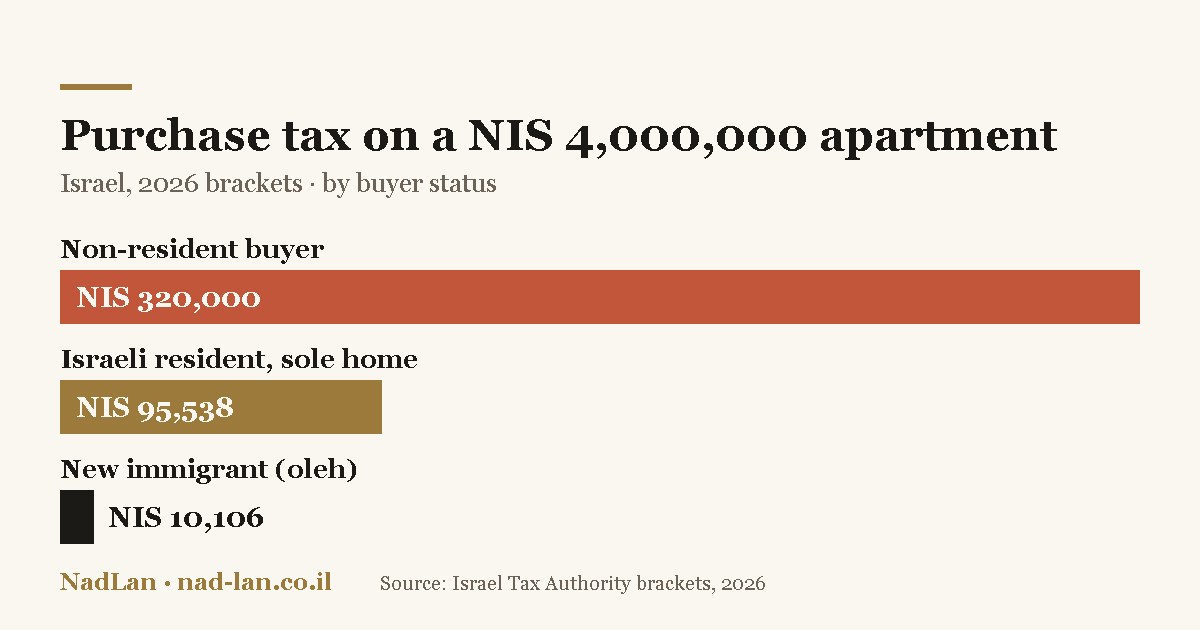
    Un acheteur non-resident, ou un resident israelien qui achete un bien supplementaire, paie 8% jusqu'a 6 055 070 ₪ et 10% au-dela, des le premier shekel. Il n'existe pas de tranche a 0% automatique pour un non-resident. Un non-resident ne peut acceder au bareme plus doux du logement unique que s'il ne possede aucun logement nulle part dans le monde et remplit les conditions strictes de l'Autorite fiscale.

    Statut de l'acheteur Taux de taxe d'acquisition (2026)
    Non-resident / investisseur / bien supplementaire 8% jusqu'a 6 055 070 ₪, puis 10% au-dela
    Nouvel immigrant (ole), logement unique 0% jusqu'a environ 1 988 000 ₪, puis 0,5% au-dela
    Resident israelien, logement unique Bareme progressif avec une premiere tranche a 0%, nettement plus bas

    Concretement, sur un bien a 3 000 000 ₪, un non-resident acquitte environ 240 000 ₪ de taxe, alors qu'un nouvel immigrant eligible paie de l'ordre de 5 000 ₪. L'ecart est enorme, et il justifie a lui seul de verifier votre statut avec un avocat avant l'achat.

    Le budget total: un exemple chiffre

    Le prix d'affichage n'est jamais le cout reel. Prenons un appartement a 3 000 000 ₪ achete par un non-resident finance a 50%.

    Poste Montant indicatif
    Prix du bien 3 000 000 ₪
    Apport minimum (50%) 1 500 000 ₪
    Taxe d'acquisition (8%) environ 240 000 ₪
    Honoraires d'avocat (environ 0,5% plus TVA) environ 17 500 ₪
    Honoraires d'agence le cas echeant (2% plus TVA) environ 70 000 ₪
    Expertise, enregistrement, transfert de devises quelques milliers de shekels

    Un acheteur non-resident doit donc mobiliser, des le depart, l'apport de 50% plus la taxe et les frais, soit ici de l'ordre de 1 830 000 ₪ en liquide, le solde du prix etant couvert par le pret. Pour un ole, la meme operation coute beaucoup moins, grace a la taxe reduite et a un pret pouvant atteindre 90%.

    Le statut d'olim: un avantage majeur pour l'acheteur francophone

    Faire son alya change profondement l'equation d'achat, sur trois plans.

    Une taxe d'acquisition tres reduite

    Le nouvel immigrant beneficie, pour un logement unique, d'un taux de 0% jusqu'a environ 1 988 000 ₪ puis de 0,5% au-dela. Cet avantage vaut pour un seul bien residentiel, s'applique dans une fenetre de sept ans autour de l'alya, avec une possibilite de rachat anterieur d'un an, et il est plafonne pour les biens en dessous d'environ 20 millions de shekels. Le montant exact du seuil doit etre confirme au moment de l'achat.

    Un financement plus genereux

    La ou un non-resident est plafonne a 50% de financement, un ole peut emprunter jusqu'a 90% de la valeur du bien, un levier decisif pour qui ne dispose pas de la totalite en liquide.

    Une reforme fiscale sur le revenu en 2026

    Pour les personnes faisant leur alya ou devenant resident fiscal israelien entre le 5 novembre 2025 et le 31 decembre 2026, une reforme temporaire prevoit un taux de 0% sur les revenus israeliens du travail jusqu'a 1 million de shekels pendant deux ans (2026 et 2027), puis 10% en 2028, 20% en 2029 et 30% en 2030. Cette mesure vise les revenus du travail (salaire, activite independante, entreprise en Israel) et ne couvre pas les revenus passifs comme les dividendes, les interets, les loyers ou les plus-values, imposes au bareme normal.

    Le financement: le pret immobilier pour un non-resident

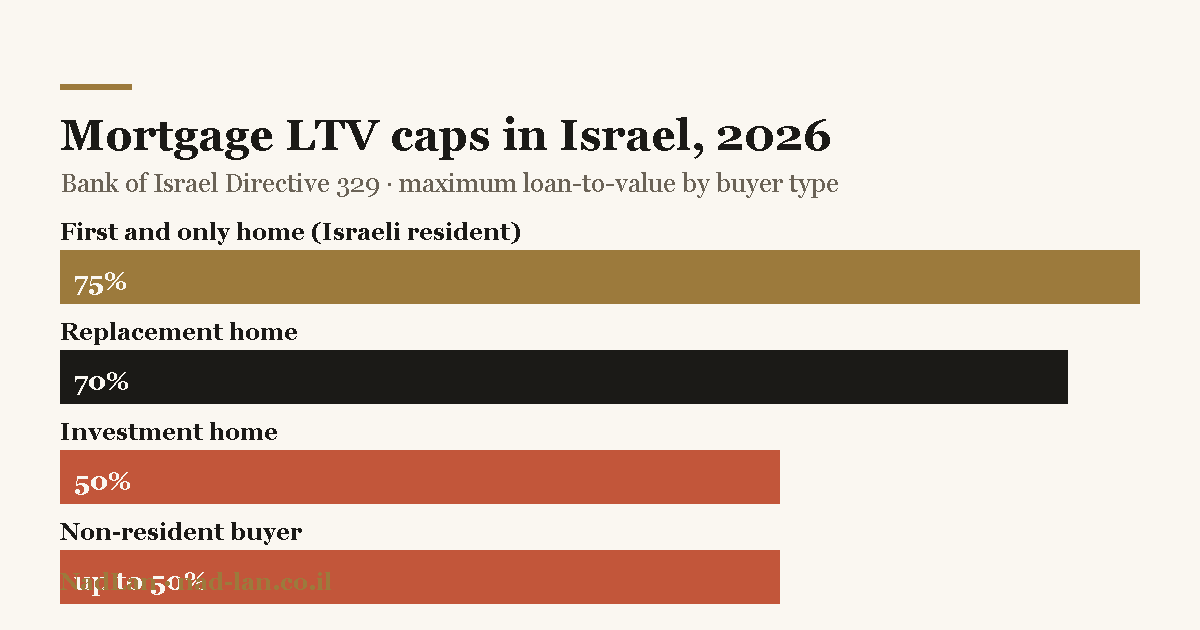
    La Banque d'Israel encadre strictement l'endettement. Le plafond de financement, le rapport pret-valeur, depend de votre statut.

    Profil Financement maximum
    Non-resident 50% de la valeur du bien
    Resident israelien, premier logement jusqu'a 75%
    Nouvel immigrant (ole) jusqu'a 90%

    Un acheteur francophone non-resident doit donc prevoir au minimum 50% du prix en apport, en liquide, auquel s'ajoutent la taxe d'acquisition, les honoraires et les frais annexes. Les banques israeliennes demandent des justificatifs de revenus et surtout de provenance des fonds. Le dossier peut prendre plusieurs semaines, et il est prudent d'obtenir un accord de principe avant de s'engager.

    Comprendre la structure d'un pret israelien

    Un pret immobilier israelien se compose souvent de plusieurs tranches combinees: une part indexee au taux directeur, dite prime, une part a taux fixe, indexee ou non a l'indice des prix, et parfois une part a taux variable. Cette architecture permet de repartir le risque de taux, mais elle rend la comparaison entre offres plus technique qu'en Europe. Les taux evoluent, et il est essentiel de comparer plusieurs banques et de verifier le cout total du credit, pas seulement la mensualite affichee. Un courtier en credit local peut aider un acheteur a distance a structurer le meilleur montage.

    La protection de l'acheteur: la loi sur la vente et la garantie bancaire

    C'est le point le plus important pour un achat sur plan. La loi israelienne sur la vente de logements et la garantie des investissements, de 1974, oblige le promoteur a securiser chaque somme versee par l'acheteur d'un bien en construction.

    Dans la grande majorite des cas, cette protection prend la forme d'une garantie bancaire, l'erevout hok mecher, adossee a un accompagnement bancaire du projet, le liouy bancai. Chaque versement que vous effectuez est verse sur un compte dedie et vous recevez, en echange, une garantie de la banque pour ce montant. Si le promoteur fait defaut ou n'acheve pas le chantier, la banque vous rembourse les sommes garanties. D'autres formes sont permises par la loi, comme une assurance ou l'inscription d'une surete, mais la garantie bancaire reste la reference.

    La regle pratique est simple: ne versez jamais un paiement pour un bien sur plan sans recevoir en retour la garantie correspondante. Votre avocat verifie que l'accompagnement bancaire existe et que chaque versement suit ce mecanisme.

    Le transfert de devises depuis l'Europe

    Transferer des euros ou des francs suisses vers des shekels demande de l'anticipation. Les banques israeliennes appliquent des controles stricts contre le blanchiment et exigent une documentation claire sur l'origine des fonds: vente d'un bien, epargne, heritage, revenus. Preparez ces justificatifs a l'avance.

    Le taux de change a un impact direct sur le cout total. Sur un achat de plusieurs centaines de milliers d'euros, un ecart de quelques centimes sur la parite represente une somme reelle. Beaucoup d'acheteurs comparent la banque et des prestataires de change specialises, et certains echelonnent leurs conversions pour lisser le risque. Les fonds transitent souvent par le compte fiduciaire de l'avocat, ce qui securise l'operation. Anticipez aussi les delais: un transfert international assorti de verifications peut prendre plusieurs jours.

    Ou acheter: les villes prisees des francophones et leurs niveaux de prix

    Les acheteurs francophones se concentrent sur quelques villes, pour des raisons de communaute, de services en francais, de proximite de la mer et d'acces a Tel Aviv. Les fourchettes ci-dessous refletent des prix moyens de 2026 et varient fortement selon le quartier, l'etage, l'etat et la vue. A titre de repere, le prix moyen national d'un appartement en 2026 se situe autour de 2,33 millions de shekels.

    Ville Prix moyen indicatif (2026) Profil
    Netanya environ 2,7 millions ₪ Forte communaute francophone, front de mer, bon rapport qualite-prix a distance raisonnable de Tel Aviv
    Ashdod environ 2,15 millions ₪ Grande communaute francophone, prix plus accessibles, ville en developpement
    Jerusalem environ 3,1 millions ₪ Marche cher et recherche, quartiers tres varies, forte demande internationale
    Tel Aviv-Jaffa de 3,4 a 4,6 millions ₪ Marche le plus cher du pays, prime au centre et au bord de mer
    Raanana 4 pieces environ 2,8 a 3,5 millions ₪, secteurs premium 3,5 a 5 millions ₪ Ville aisee, communaute anglophone et francophone, ecoles reputees

    Ces montants sont des ordres de grandeur. Un bien precis, avec une vue, une surface ou un emplacement particulier, peut s'ecarter nettement de la moyenne de sa ville. A Netanya, un appartement en front de mer se situe bien au-dessus de la moyenne, tandis que les quartiers plus a l'est restent plus accessibles. La meme logique vaut pour chaque ville: le prix se decide au quartier, a l'immeuble et a l'etage, davantage qu'a la ville.

    Louer son bien: rendement et fiscalite

    Beaucoup d'acheteurs francophones visent un bien qu'ils occuperont plus tard et qu'ils louent en attendant. Le rendement locatif brut dans les grandes villes du centre est modere: a Tel Aviv, il se situe souvent autour de 3% a 3,6% brut en 2026, l'attrait etant davantage la valorisation du bien et la solidite de l'emplacement que le rendement immediat.

    Cote fiscalite des loyers, un proprietaire dispose en general de plusieurs options: une exoneration pour les petits loyers mensuels en dessous d'un plafond revalorise chaque annee, une imposition forfaitaire a taux reduit sur les loyers residentiels, ou le regime au bareme avec deduction des charges. Le choix optimal depend du montant du loyer et de votre situation, et les seuils exacts doivent etre verifies pour l'annee en cours avec un avocat ou un expert-comptable.

    Neuf ou ancien: comment choisir

    Le choix entre un bien neuf, souvent sur plan, et un bien ancien depend de votre horizon et de votre tolerance au risque de delai.

    Le neuf sur plan

    Le neuf offre un logement aux dernieres normes, souvent des facilites de paiement echelonnees, comme les plans dits 20/80 ou une petite partie est versee au depart et le solde a la remise, et surtout la protection de la loi sur la vente via la garantie bancaire. En contrepartie, un bien neuf coute en general de 8% a 18% de plus qu'un bien ancien comparable, et il faut accepter un delai de livraison et un risque de retard de chantier.

    L'ancien

    L'ancien permet d'emmenager immediatement et de voir exactement ce que l'on achete. Il demande une vigilance sur l'etat du bien, sur la copropriete et sur les droits enregistres. La verification de l'avocat est ici tout aussi essentielle, notamment sur les extensions ou modifications realisees sans permis.

    La copropriete, les charges et les dmei nihoul

    Acheter un appartement, c'est aussi entrer dans une copropriete. Dans un immeuble classique, un comite de residents, le vaad bayit, gere l'entretien courant et repartit les charges. Dans les projets haut de gamme dotes de nombreux equipements, une societe de gestion professionnelle facture des frais de gestion, les dmei nihoul, qui peuvent etre significatifs et peser sur le budget mensuel. Avant d'acheter dans un tel projet, demandez une estimation de ces frais, la liste des services inclus, l'identite de la societe de gestion et la duree de son mandat. Un ensemble avec piscine, spa et espaces communs offre un vrai confort, mais son cout d'entretien se paie tous les mois. Pour un investisseur, ces frais reduisent le rendement net et doivent entrer dans le calcul des le depart.

    Les projets de renovation urbaine: tama 38 et pinui binui

    Une grande partie des projets neufs en Israel ne sont pas construits sur un terrain vierge, mais dans le cadre de la renovation urbaine. Le tama 38 consiste a renforcer et a agrandir un immeuble existant, souvent en ajoutant des etages et des logements, tandis que le pinui binui consiste a demolir des immeubles anciens pour reconstruire un ensemble neuf et plus dense. Pour un acheteur, ces projets peuvent offrir un logement neuf a un emplacement etabli, mais ils ajoutent des points de vigilance: la continuite des droits, l'accord des residents en place, les autorisations, le calendrier souvent plus long et la solidite du promoteur. La verification par un avocat est ici encore plus importante, car le montage juridique est plus complexe qu'une vente classique. Beaucoup de projets du catalogue israelien relevent de cette categorie, il est donc utile d'en connaitre la logique.

    Les erreurs frequentes a eviter

    Certaines erreurs reviennent souvent chez les acheteurs a distance. Signer un zikaron dvarim ou verser un acompte avant la verification juridique complete. Raisonner sur le seul prix d'affichage en oubliant la taxe d'acquisition et les frais. Sous-estimer l'apport reel exige d'un non-resident. Verser un paiement sur un bien neuf sans exiger la garantie bancaire correspondante. Negliger la documentation de provenance des fonds, ce qui bloque ensuite le transfert. Enfin, se fier aux promesses orales du bureau de vente au lieu d'exiger que tout figure au contrat. Un bon avocat fait de la prevention de ces erreurs son travail principal.

    Preparer son achat a distance: la check-list du francophone

    Acheter depuis l'Europe est courant, a condition de s'organiser. Voici les points a preparer. Definir un budget total realiste, apport, taxe, honoraires et frais compris, et non un simple prix d'affichage. Clarifier son statut, non-resident ou futur ole, car il change la taxe et le financement. Reunir a l'avance les justificatifs de provenance des fonds, indispensables pour la banque et le transfert. Choisir un avocat en immobilier independant du vendeur et du promoteur, qui defend vos seuls interets. Obtenir un accord de principe de financement avant de s'engager. Prevoir une procuration claire si vous ne pouvez pas etre present a la signature. Verifier, pour un bien neuf, l'existence de l'accompagnement bancaire et de la garantie sur chaque versement. Comparer les taux de change et anticiper les delais de transfert. Enfin, ne jamais signer un document, meme un simple protocole, sans que votre avocat l'ait relu. Cette preparation transforme un achat a distance, souvent percu comme risque, en une operation maitrisee.

    Le role de l'avocat en immobilier

    En Israel, l'avocat en immobilier n'est pas une formalite, c'est la piece maitresse de la securite de l'achat. Faute de systeme notarial a la francaise, c'est lui qui verifie le titre au Tabou, controle l'absence d'hypotheque et de litige, redige et negocie le contrat, calcule la taxe d'acquisition et optimise votre statut, verifie l'accompagnement bancaire et les garanties d'un projet neuf, securise les paiements et procede a l'enregistrement final de votre propriete.

    Ses honoraires se situent frequemment autour de 0,5% du prix plus TVA, un cout modeste au regard des sommes en jeu et des risques evites. Pour un acheteur francophone a distance, un avocat qui communique clairement, en francais si possible, est un atout considerable. Il devient votre representant sur place, capable d'agir par procuration et de vous eviter des allers-retours couteux.

    Petit glossaire des termes israeliens utiles

    Tabou: le registre foncier ou est inscrite la propriete. Mas rechisha: la taxe d'acquisition payee par l'acheteur. Zikaron dvarim: un protocole d'accord qui peut valoir contrat contraignant. Liouy bancai: l'accompagnement bancaire d'un projet neuf. Erevout hok mecher: la garantie bancaire au titre de la loi sur la vente. Hearat azhara: la note d'avertissement qui protege les droits de l'acheteur avant l'enregistrement. Ole: nouvel immigrant, beneficiaire d'avantages fiscaux et de financement. Rashout Mekarkein Israel: l'Autorite fonciere d'Israel, proprietaire d'une partie des terres louees a bail.

    Questions frequentes

    Un etranger peut-il acheter un bien en Israel?

    Oui. Un etranger, resident ou non, peut acheter la plupart des biens residentiels en pleine propriete. Certaines terres appartiennent a l'Autorite fonciere d'Israel et se transmettent sous forme de bail de longue duree, ce que l'avocat verifie au cas par cas.

    Quel apport minimum pour un non-resident?

    Au moins 50% du prix, puisque le financement bancaire est plafonne a 50% de la valeur pour un non-resident. Il faut y ajouter la taxe d'acquisition et les frais.

    Combien de taxe d'acquisition paie un non-resident?

    8% jusqu'a 6 055 070 ₪ et 10% au-dela, des le premier shekel. Ce bareme est gele jusqu'en janvier 2028.

    Les nouveaux immigrants paient-ils moins?

    Oui, nettement. Un ole paie, pour un logement unique, 0% jusqu'a environ 1 988 000 ₪ puis 0,5% au-dela, peut emprunter jusqu'a 90%, et peut beneficier de la reforme 2026 sur l'impot sur le revenu du travail. Le statut d'olim change fortement le cout total de l'operation.

    Faut-il un compte bancaire israelien?

    C'est en pratique tres utile pour les paiements, le pret et la gestion du bien. L'ouverture demande des justificatifs d'identite et de provenance des fonds, a preparer en amont.

    Combien de temps prend un achat?

    Pour un bien ancien, de quelques semaines a quelques mois selon la verification, le financement et les transferts. Pour un bien sur plan, la signature peut etre rapide mais la remise intervient a la fin du chantier, parfois plusieurs annees plus tard.

    Quels frais s'ajoutent au prix d'achat?

    La taxe d'acquisition, les honoraires d'avocat, souvent environ 0,5% plus TVA, les honoraires d'agence le cas echeant, environ 2% plus TVA, une eventuelle expertise, les frais d'enregistrement et les frais de transfert de devises.

    Sur un achat sur plan, mon argent est-il protege?

    Oui, si les versements sont couverts par une garantie bancaire au titre de la loi sur la vente. Ne versez jamais un paiement sans recevoir la garantie correspondante, et faites verifier l'accompagnement bancaire du projet par votre avocat.

    Peut-on acheter a distance, depuis l'Europe?

    Oui. De nombreux francophones achetent a distance en mandatant un avocat israelien et, si besoin, par procuration. La verification prealable et un contrat solide sont alors encore plus importants.

    Qu'est-ce que le tama 38?

    C'est un cadre de renovation urbaine qui permet de renforcer et d'agrandir un immeuble existant, souvent contre l'ajout de logements neufs. Il offre du neuf a un bon emplacement, mais demande une verification juridique renforcee.

    Les frais de gestion sont-ils eleves dans les projets de luxe?

    Ils peuvent l'etre. Un ensemble avec piscine, spa et services facture des dmei nihoul mensuels qui pesent sur le budget. Demandez une estimation ecrite avant d'acheter.

    Vaut-il mieux acheter avant ou apres l'alya?

    Cela depend. Acheter apres l'alya, ou dans la fenetre prevue autour de l'alya, ouvre droit a la taxe reduite et au financement a 90%. Un rachat anterieur d'un an peut parfois etre pris en compte. C'est une question a arbitrer avec un avocat selon votre calendrier personnel.

    En resume: les reflexes du bon acheteur francophone

    Retenez d'abord que votre statut, non-resident ou futur ole, determine a lui seul une grande partie du cout: la taxe d'acquisition passe de 8% et 10% pour un non-resident a des taux tres reduits pour un nouvel immigrant, et le financement possible passe de 50% a 90% de la valeur. Ce seul parametre peut representer des centaines de milliers de shekels d'ecart, il merite donc d'etre etudie tot avec un avocat. Retenez ensuite que le prix affiche n'est jamais le cout reel: taxe, honoraires, frais de change et frais annexes s'y ajoutent, et un apport consequent est exige d'un non-resident. Preparez tres en amont la documentation de provenance de vos fonds, sans quoi le transfert et le pret se bloquent. Sur un bien neuf, exigez systematiquement la garantie bancaire attachee a chaque versement, c'est votre filet de securite. Enfin, ne signez jamais un document, meme un simple protocole, avant qu'un avocat en immobilier, idealement francophone, ne l'ait examine. Avec ces reflexes, un achat a distance devient une operation claire et maitrisee, portee par un projet de vie plutot que par l'improvisation.

    Ce guide fournit une information generale a jour pour 2026 et ne constitue pas un conseil juridique, fiscal ou financier. Les baremes et les prix evoluent et chaque situation est particuliere. Avant tout engagement, faites verifier les montants exacts et votre statut par un avocat specialise en immobilier en Israel.

    Sources: Autorite fiscale israelienne (baremes de taxe d'acquisition 2025-2028), Banque d'Israel (plafonds de financement), donnees publiques de marche 2026 pour les prix par ville et le rendement locatif, et la loi israelienne sur la vente de logements de 1974 pour la garantie des versements.

  • דירות יוקרה בישראל: המדריך המלא 2026 לרוכשים ולמשקיעים

    דירות יוקרה בישראל: המדריך המלא 2026 לרוכשים ולמשקיעים

    המילה "יוקרה" מוטבעת היום כמעט על כל חוברת מכר של דירה חדשה בישראל, ודווקא משום שהיא נמצאת בכל מקום היא הפסיקה לומר משהו. המדריך הזה מחזיר לה משמעות. יוקרה אמיתית במגדל תל אביבי של 2026 איננה לובי משיש או שם מותג על המטבח. היא דרך חיים: בית שמחזיר לך זמן, שומר על הכסף שלך, יושב בקילומטר הרבוע הנכון של מדינה קטנה וצפופה, וניתן להבנה מלאה עוד לפני שקיים בו קיר אחד. לרוכש שיושב בפריז, בניו יורק, בלונדון או בבית, וגם למשקיע הישראלי שמכיר את השוק היטב, הנקודה האחרונה הזו חשובה יותר מכל נברשת. מבקשים ממך להתחייב על מיליוני שקלים לדירה שאינך יכול להלך בתוכה, במערכת מס ומימון שנבנתה בעיקר לרוכש דירה ראשונה. המדריך הזה נועד לסגור את הפער.

    בנינו את נדלן סביב רעיון פשוט: צריך להיות אפשר לבחור את הדירה מתוך הבניין, בתלת ממד, בשפה שלך, עוד לפני שטסת לראות. כל מה שכתוב כאן נועד להפוך אותך לרוכש חד יותר, בין אם תקנה מאיתנו ובין אם לא. נגדיר מה באמת מכילה דירה מוגבהת, נהלך על מפת היוקרה של תל אביב שכונה אחר שכונה עם טווחי מחירים אמיתיים, נשווה תמורה לכסף בין מגדלי הדגל העולים על שדה התעופה הישן של שדה דב, ונפרוש בדיוק כיצד רוכש נזקק למס, למימון ולהגנה משפטית כשקונים על הנייר.

    מהי דירת יוקרה בישראל?

    דירת יוקרה בישראל היא בית שבו המיקום, שירותי הבניין ומפרט הפנים מצטרפים יחד כדי להסיר חיכוך מהחיים היומיומיים, ולא רק לאותת על עושר. בפועל זה אומר כתובת מרכזית והליכתית קרוב לים, לתחבורה ולתעסוקה; בניין שמתנהל כמו מלון, עם לובי מאויש, אבטחה ומתקני נופש; ודירה גמורה ברמה גבוהה, עם שליטת בית חכם, ממ"ד נוח, מרפסת נדיבה ואור. המחיר לבדו אינו מגדיר אותה. דירת שלושה חדרים ליד תחנת רכבת קלה עם ועד בית מתפקד יכולה להעניק יוקרה אמיתית יותר מיחידה גדולה התקועה על כביש טבעתי תלוי רכב.

    ההקשר הישראלי מוסיף שני מאפיינים שלא תמצא ברוב שוקי המערב. הראשון הוא הממ"ד, המרחב המוגן הדירתי המחויב בחוק בבנייה חדשה. פעם התייחסו אליו כאל קופסה תועלתנית, וב-2025 וב-2026 הוא הפך לחלק מרכזי בעיצוב: רוכשים מצפים היום שישמש גם כחדר עבודה שקט או כחדר ילדים, גמור באותה רמה כמו שאר הבית. השני הוא עצם הנטייה כלפי מעלה של ההיצע החדש. ישראל היא מדינה קטנה שבונה לגובה במהירות, ובית היוקרה המודרני הוא יותר ויותר קומה גבוהה במגדל מגורים רזה עם מסדרון נוף אל הים התיכון.

    מה כוללת דירה מוגבהת?

    אם מסירים את השיווק, דירה מוגבהת באמת עומדת בשלוש שכבות. אם מפספסים ולו אחת מהן, משלמים מחיר יוקרה על בית רגיל.

    מיקום ראשון במעלה והחיים שסביבו

    הדבר היקר ביותר שדירת יוקרה מחזיקה הוא הכתובת שלה, כי זה הדבר היחיד שלעולם לא ניתן לשפץ. בתל אביב סולם הפרימיום רץ מהים פנימה: עמדה מול החוף או מול פארק, אחר כך הליכה קצרה לתחנת הרכבת הקלה של הקו האדום, ואז קרבה לבתי קפה, למוקדי תעסוקה ולשטח ירוק. הקו האדום, שפועל מאוגוסט 2023 ומסיע כבר יותר ממאה אלף נוסעים ביום, שכתב בשקט את מפת הערך. דירה במרחק הליכה מתחנה מבקשת היום פרמיה ונמכרת מחדש מהר יותר, וכל קו עתידי מרחיב את ההיגיון הזה. כשאתה בוחן מגדל, בחן את רדיוס עשר דקות ההליכה שלו באותה קפדנות שבה אתה בוחן את התוכנית.

    שירותי הבניין שעובדים כמו מלון

    השכבה השנייה היא הבניין עצמו. ממגדל תל אביבי פרימיום מצפים היום לחבילה שהייתה יוצאת דופן לפני עשור והיא כמעט תקן בצמרת השוק:

    • בריכת שחייה על הגג או ברמת נופש, לעיתים קרובות עם דק שיזוף ונוף לים התיכון.
    • ספא ומתחם וולנס: סאונה, חדרי טיפול וחדר כושר מאובזר, כך שדיירים כמעט לא צריכים לצאת מהבניין כדי להתאמן.
    • לובי מאויש וכפול גובה עם קונסיירז' ואבטחה מסביב לשעון.
    • טרקלין דיירים, ויותר ויותר גם מרחב עבודה משותף, המשקף כמה בעלים עובדים היום מהבית בחלק מהשבוע.
    • חניון תת קרקעי מאובטח, יקר ונדיר בלב תל אביב, כיום פעמים רבות עם עמדות טעינה לרכב חשמלי.
    • גינות משותפות מעוצבות, אזור ילדים, ולעיתים קולנוע פרטי או חדר יין בפרויקטים השאפתניים ביותר.

    המתקנים הם רק חצי מהסיפור. החצי השקט הוא הניהול: ועד בית מקצועי, תחזוקה מגיבה, וקרנות רזרבה ששומרות על הבריכה חמה והלובי מבריק גם בשנה השתים עשרה, לא רק במסיבת ההשקה. כשאתה מעריך בניין, שאל מי מנהל אותו וכיצד, כי איכות השירות היא מה שמפריד בין מגדל שמתבגר לכדי ציון דרך לבין מגדל שמתבגר לכדי נטל.

    מפרט הפנים, הבית החכם והממ"ד

    השכבה השלישית היא הדירה עצמה: גובה תקרות, אור טבעי ביותר מכיוון אחד, מרפסת פונקציונלית ונדיבה, ומטבח וחדרי רחצה גמורים באבן, בנגרות איכותית ובאביזרים מעולים. בצמרת השוק, יזמים מזמינים מעצבי פנים בעלי שם בינלאומי כדי לקבוע את המפרט, מה שגם מעלה את האיכות וגם מאותת יוקרה. יותר ויותר הבית כולו מחווט לשליטה חכמה על תאורה, וילונות חשמליים, אקלים וגישה מאובטחת מהטלפון. והממ"ד, כאמור, הוא כיום חדר מעוצב ולא מחשבה בטונית שנייה. הפרט הטכני שאוסף את כל זה הוא המפרט המכר, מסמך המפרט המחויב בחוק, וקריאתו שורה אחר שורה היא אחד הדברים החשובים ביותר שרוכש עושה אי פעם. נחזור אליו בפרק הרכישה.

    ההרגל היחיד והמועיל ביותר שרוכש יכול לפתח: לשפוט את הדירה לפי מיקום, ניהול הבניין והמפרט הכתוב, בסדר הזה. גימורים אפשר לשדרג. כתובת חלשה או ועד בית תת ממומן, לא.

    שפת העיצוב של 2026

    מעבר לתקן הבסיסי, השכבה שמבדילה מגדל פרמיום היא שפת העיצוב שלו. המגמות הבולטות בשוק הישראלי כוללות חומרים טבעיים וחמים, אבן ועץ אלון, פלטות צבע רגועות ומונוכרומטיות, תאורה שקועה ורכה, ומרפסות שמתוכננות כחדר מגורים חיצוני ולא כנספח. מטבחים נעים לכיוון קווים נקיים עם אי מרכזי כלב הבית, וחדרי הרחצה מקבלים יחס של ספא. בפרויקטים המובילים, כאמור, מעצב בעל שם קובע את הטון, מה שמעלה גם את האיכות וגם את היוקרה הנתפסת. רוכש שמבין את שפת העיצוב יודע להבחין בין מפרט שבאמת עשוי היטב לבין גימור שנראה יקר אך אינו מחזיק. הרחבנו על הצבעים, החומרים והטרנדים בנפרד, וזה שיקול ששווה להביא לפגישת הרכישה.

    למי מיועדות דירות היוקרה?

    ציבור הרוכשים של מגדלי היוקרה הישראליים בינלאומי במידה יוצאת דופן, והבנה של מי עומד לצידך בחדר עוזרת לתמחר ולנהל משא ומתן בבהירות.

    • רוכש התפוצות עם רגל בשתי מדינות. משפחות בצרפת, בארצות הברית, בבריטניה ומעבר, שרוצות בסיס מאובטח ונטול תחזוקה בישראל שאפשר לנעול ולעזוב, ובית שמוכן ברגע שהן נוחתות. מגדל עם שירותי מלון קרוב לאידיאלי לבית שמשמש חלק מהשנה.
    • הרוכש שלפני עלייה. מי שמתכננים לעלות לישראל וקונים לפני העלייה או סביבה, כאשר תזמון הרכישה מול מסלול המס המופחת לעולה יכול לחסוך רבות.
    • המשקיע הטהור. רוכשים המתמקדים בשימור הון ובעליית ערך לטווח ארוך באחד משוקי הנדל"ן העמידים בעולם המפותח, שמעריכים בנייה חדשה במיקום מוביל שקל להשכיר ולמכור מחדש.
    • המשדרג והמצמצם המקומי. משפחות ישראליות שעולות למרחב ולשירותים רבים יותר, ומשפחות שהילדים עזבו וממירות בית ותחזוקתו בדירת נעל ולך עם בריכה, חדר כושר וקונסיירז' למטה.

    יוקרה מול דירה רגילה: ההשוואה הכנה

    הפער בין מגדל יוקרה אמיתי לבין דירה רגילה במיקום טוב אמיתי, אך הוא לא תמיד היכן שרוכשים מניחים. הוא יושב פחות בגודל הסלון ויותר בעמידות המיקום, בשירותי הבניין ובאופן שבו בית שומר על ערכו.

    ממד דירת מגדל מוגבהת דירה רגילה
    מיקום מרכזי, הליכתי, קרוב לים ולרכבת הקלה; מסדרונות נוף מוגנים בגובה משתנה; פעמים רבות תלוי רכב, נוף לא מובטח
    שירותי הבניין קונסיירז', אבטחה, בריכה, ספא, חדר כושר, ניהול מקצועי בסיסי או ללא; ועד המנוהל עצמאית
    מפרט בהובלת מעצב, אבן ונגרות איכותית, בית חכם, ממ"ד מעוצב גימורי קבלן תקניים, ממ"ד פונקציונלי
    מכירה חוזרת ונזילות ביקוש חזק, קהל רוכשים בינלאומי, נמכרת מהר יותר ביקוש מקומי, איטי יותר בשווקים רכים
    עלות אחזקה דמי ניהול גבוהים יותר, מקוזזים בשירותים ובשמירת ערך דמי ניהול נמוכים, פחות שירותים, יותר תחזוקת בעלים
    מחיר כניסה למ"ר פרמיה, מונעת נוף, קומה ומותג קרוב יותר לממוצע העירוני

    הלקח אינו שיוקרה תמיד הקנייה הנכונה. הוא שכדאי לשלם את הפרמיה רק על השכבות ששומרות ערך, מיקום ואיכות בניין, ולהיות ספקן לגבי תשלום עליה עבור גימורים שתוכל להוסיף בעצמך מאוחר יותר.

    מפת היוקרה של תל אביב, שכונה אחר שכונה

    תל אביב אינה שוק אחד אלא קומץ שווקים זעירים, לכל אחד היגיון מחיר משלו. המחירים למטה הם טווחי שוק רחבים בשקלים חדשים למ"ר, ויש לקרוא אותם כאומדנים להתמצאות ולא כהצעות מחיר; השוק התרכך במהלך 2025, לכן יש להתייחס לקצה העליון של כל טווח כתמחור שיא ולאמת מול הצעה חיה לפני שמתחייבים.

    שדה דב: החוף שתל אביב בונה מאפס

    הסיפור החשוב ביותר בנדל"ן התל אביבי הוא שדה התעופה הישן של שדה דב. זה היה שדה התעופה העירוני דב הוז, על כ-1,300 דונם של חוף ים תיכוני מוביל בצפון העיר; הוא נסגר ב-2019, והתוכנית הכוללת שלו הופכת אותו לרובע חוף חדש של כ-16,000 דירות וכ-35,000 תושבים, עם בנייה בגובה בינוני ומגדלי מגורים שמגיעים לכ-ארבעים קומות. זהו שחרור הקרקע הגדול ביותר בלב תל אביב בזיכרון החי, הנמסר בשלבים מכ-2026 ו-2027 ועד אמצע העשור הבא, כאשר תת הרובע אשכול הוא המתקדם ביותר. עבור רוכש זו ההזדמנות המכוננת על הנייר: שכונת חוף חדשה לגמרי, נרכשת מוקדם, בעיר שכמעט אף פעם לא יוצרת חוף חדש. תמחור הבנייה החדשה כאן נע באופן כללי מכ-80,000 עד 130,000 שקל ומעלה למ"ר בהתאם לנוף הים ולקומה. מגדלי הדגל שלנו, ובהם ריינבו, אשירה, דמרי ימה וDUO, יושבים בתוך הרובע הזה וסביבו, ולכן אנחנו מאפשרים לך לסייר בהם בתלת ממד עוד לפני יציקת הבטון.

    מרכז העיר וציר רוטשילד

    ליבת היוקרה ההיסטורית רצה לאורך שדרות רוטשילד ומרכז העיר הסובב, שם אדריכלות באוהאוס משומרת פוגשת מספר קטן של מגדלי דגל. זו צמרת השוק התל אביבי, שם יוקרה חדשה נסחרת בדרך כלל מכ-88,000 עד 150,000 שקל למ"ר, ושם עסקאות פנטהאוז שיא דחפו הרחק מעבר לכך. רוכשים כאן משלמים על כתובת ונדירות מעל הכל.

    נווה צדק והדרום הישן

    נווה צדק, השכונה הראשונה שנבנתה מחוץ ליפו העתיקה, מציעה אופי כפרי ונמוך שאי אפשר לשחזר, ובדיוק בגלל זה היא מבקשת פרמיה. בניינים רגילים נסחרים הרבה מתחת לשכבת הדגל, בעוד מלאי חדש משומר ובוטיק מגיע מכ-120,000 עד 180,000 שקל למ"ר. זו רכישת אורח חיים יותר מאשר משחק תשואה.

    פארק בבלי וצפון תל אביב

    מצפון לירקון, עמדות הפונות אל הירק של פארק בבלי והמגדלים הצפוניים החדשים יותר מציעות גרסה רגועה ומשפחתית יותר של יוקרה עם גישה חזקה לפארקים ולחוף. מלאי חדש פרמיום כאן חופף באופן רחב לטווח של שדה דב, כאשר נוף ירוק ושקט הם מנופי המחיר המקומיים ולא ההמולה של השדרה במרכז.

    יפו והנמל: אופי מול תמורה

    בקצה הדרומי, יפו המתחדשת והרצועה סביב הנמל מציעות אופי היסטורי, קרבה לים ותמחור שלעיתים נמוך יותר מהליבה הצפונית, לצד תנודתיות רבה יותר בין רחוב לרחוב. עבור רוכש שמחפש אופי ואפסייד יותר מיוקרה ממורקת, זהו אזור שכדאי להכיר, אך הוא דורש הכרות מקומית מדוקדקת של הבלוק הספציפי. הכלל נשאר זהה: המיקום המדויק, לא רק שם השכונה, קובע את הערך.

    דירה מקבלן מול יד שנייה: מה עדיף למשקיע

    אחת ההחלטות הראשונות היא אם לרכוש בנייה חדשה מקבלן או דירה קיימת יד שנייה, ולכל דרך היגיון משלה. דירה מקבלן על הנייר מציעה מפרט מודרני, אחריות בדק, בניין עם מתקנים חדשים, וההזדמנות לקנות במחיר של היום נכס שיימסר בעוד שנים, עם ההגנה של חוק המכר על הכסף. המחיר: המתנה ארוכה, סיכון לוח זמנים, ואי ודאות מסוימת לגבי איך ייראה הרובע בפועל. דירה יד שנייה, לעומת זאת, ניתנת לראייה מיידית, זמינה להשכרה מהיום הראשון, ולעיתים במיקום ותיק ומבוסס עם עצים ותשתית קיימת, אך היא נושאת בלאי, מפרט ישן יותר, ולעיתים ועד בית וקרן רזרבה חלשים. עבור משקיע שמחפש תזרים מיידי, יד שנייה במיקום מוכח עשויה להתאים; עבור מי שמחפש עליית ערך ורוכש לטווח ארוך, בנייה חדשה ברובע מתפתח כמו שדה דב היא לרוב המשחק החזק יותר. ההחלטה אינה עקרונית אלא תלוית מטרה, ובדיוק לכן השלב הראשון במסגרת הבחירה שלנו הוא להגדיר איך תשתמש בנכס, עוד לפני שמסתכלים על מחיר.

    מחירים, תשואות ותמורה לכסף

    ישראל היא שוק נדל"ן מונע עליית ערך, לא שוק תשואה, ומשקיע שמבין זאת מהיום הראשון מקבל החלטות טובות יותר. תשואות השכירות הברוטו בתל אביב צנועות, באזור השלושה עד שלושה וחצי אחוזים באופן כללי, ואחרי דמי ניהול, ארנונה, תחזוקה וניהול הנתון הנטו נוחת בדרך כלל קרוב יותר לאחוז וחצי עד שני אחוזים. אף אחד לא קונה מגדל יוקרה תל אביבי בשביל צ'ק השכירות. קונים אותו לשימור הון ולצמיחה ארוכת טווח בעיר רעבת היצע: דירה תל אביבית ממוקמת היטב עלתה בסדר גודל של שמונים וחמישה אחוזים במונחים שקליים לאורך העשור עד 2024. עם זאת, 2025 הביאה תיקון גלוי, עם ירידה מדווחת בסדר גודל של שלושה עשר אחוזים במחירים הממוצעים משנה לשנה, תזכורת שהמומנטום לעולם אינו מובטח בטווח הקצר ושמחיר הכניסה וכושר ההחזקה משנים.

    אז היכן התמורה באמת יושבת? היא מתרכזת ברשימה קצרה של מכפילים עמידים: מיקום מרכזי והליכתי קרוב לים ולתחנת רכבת קלה; תכנון יעיל שאינו מבזבז מ"ר; מרפסת אמיתית; חניה מאובטחת, נדירה ובעלת ערך עצמאי; ממ"ד מתוכנן היטב; בניין בריא ומנוהל מקצועית; ויזם עם רקורד של מסירה בזמן ולפי מפרט. דירה גדולה יותר שמפספסת את אלה היא תמורה גרועה יותר מדירה קטנה שפוגעת בכולם.

    למטה השוואת התמצאות של ארבעת מגדלי הדגל שאנחנו מאפשרים לסייר בהם בתלת ממד. מספרי היחידות והקומות הם עובדות פרויקט; התמחור מוצג במכוון כהכוונה בלבד, כי מספר אמיתי נקבע על ידי היזם מול היחידה הספציפית ומול מפרט המכר העדכני, ואנחנו לעולם לא נמציא אותו. השתמש בה כדי למסגר את השיחה, ואז פתח את קטלוג התלת ממד כדי להלך בכל בניין.

    פרויקט אופי היקף חתימה תמחור
    ריינבו מגדל מול הים, שדה דב מגדל גבוה, בנייני בוטיק מודל התלת ממד ברמת הייחוס וקווים מול הים לפי הצעת יזם, ליחידה
    אשירה מתחם מדורג נסוג מהחוף ארבעה בניינים, 8 עד 35 קומות מסה ריאליסטית, טווח דירות מהגן אל השמיים לפי הצעת יזם, ליחידה
    דמרי ימה מגדל מול הים עם פודיום כ-39 קומות מפרט פנים ברוח יוקרת מעצבים בינלאומית לפי הצעת יזם, ליחידה
    DUO מגדלים תאומים, עיר וים שני מגדלים עד כ-50 קומות מגורים פנורמיים בקומות גבוהות לפי הצעת יזם, ליחידה

    עלויות האחזקה השוטפות: ארנונה, ועד בית וניהול

    מחיר הכניסה הוא רק ההתחלה; דירת מגדל יוקרה נושאת מבנה עלויות שוטף שרוכש חכם מתמחר מראש. שלושה רכיבים מרכזיים: הארנונה העירונית, המחושבת לפי שטח ואזור ומשולמת לעירייה; דמי ועד הבית או דמי הניהול, שבמגדל עם בריכה, ספא, חדר כושר, קונסיירז' ואבטחה יכולים להיות גבוהים משמעותית מבניין רגיל, ולעיתים מגיעים לאלפי שקלים בחודש; ותחזוקה שוטפת של הדירה עצמה. הפרדוקס הוא שדמי הניהול הגבוהים אינם בהכרח חיסרון: הם מה שמממן את השירותים ששומרים על ערך הבניין לאורך זמן, ובניין עם קרן רזרבה בריאה ותחזוקה עקבית מתבגר טוב יותר מבניין זול לתחזוקה שמתדרדר. עבור משקיע, יש לנכות את כל אלה מהתשואה הברוטו כדי להגיע לתשואה הנטו האמיתית, וכאן שוב המחשבונים שלנו עוזרים למדל את התמונה המלאה לפני ההחלטה, לא אחריה.

    הזמן הנכון להיכנס לשוק

    שאלה שכל רוכש שואל היא אם 2026 הוא הזמן הנכון. אין תשובה אחת, אך יש מסגרת. שוק שתיקן, כפי שתל אביב עשתה ב-2025, מציע לרוכש עם מזומן ואופק ארוך נקודת כניסה טובה יותר מאשר בשיא, כל עוד היסודות המבניים, מחסור בהיצע, ביקוש תפוצה וכלכלת טכנולוגיה, נותרים במקומם, והם נותרים. הרוכש שמפסיד הוא לרוב זה שמנסה לתזמן את התחתית המדויקת ומחמיץ נכס טוב במיקום נדיר בזמן שהוא מחכה. הרוכש שמצליח הוא זה שקונה נכס איכותי במיקום עמיד במחיר שהוא יכול להגן עליו, ומחזיק לאורך זמן. על הנייר, ברובע חדש כמו שדה דב, המשמעות היא לקנות את השכונה הגמורה של סוף העשור במחיר של תחילתו, עם ההגנה המשפטית של חוק המכר על הכסף לאורך הדרך.

    היזמים שמאחורי המגדלים

    ברכישה על הנייר אתה קונה הבטחה, וזהות הצד שנותן אותה היא חלק מרכזי מהערך. אלה השמות שחוזרים בתל אביב הפרמיום המרכזית, בתיאור עובדתי פשוט.

    • ישראל קנדה היא יזמית ציבורית הידועה במגדלי יוקרה בולטים במרכז ישראל ועל חוף שדה דב.
    • י.ח דמרי היא אחת מחברות הבנייה הגדולות במדינה וחברה נסחרת, פעילה ממגורים רחבים ועד פרויקטים פרמיום עם עיצוב פנים בהובלת מעצב.
    • אביסרור היא קבלנית ויזמית ותיקה, פעילה בזכייה ובמסירה של מכרזי שדה דב אשכול בהיקף גדול.
    • אזורים היא יזמית ציבורית גדולה עם מיקוד כבד בהתחדשות עירונית ובמגדלי הריסה ובנייה מחדש.
    • אשטרום וזרוע המגורים שלה אשדר נמנות עם קבוצות הבנייה הגדולות בישראל, ידועות במסירת דיור איכותי.
    • מבנה, לוינשטיין ומטרופוליס הן קבוצות נכסים גדולות המשתפות פעולה במגורי שדה דב הפרמיום.
    • גינדי ידועה במתחמים תל אביביים גדולים מעורבי שימושים והשיקה בשדה דב פרויקט רב מגדלים עם מתקנים ברמת חמישה כוכבים.

    כשאתה מכין רשימה קצרה של פרויקטים, התייחס ליזם כחלק מהמפרט. יזם מוכר, מבוסס היטב ובעל רקורד מסירה הוא בעצמו סוג של הגנת רוכש, נוסף על ההגנות המשפטיות שאליהן נפנה כעת.

    לרכוש כמשקיע: מס, מימון והגנה משפטית

    אזרחים זרים יכולים לרכוש נכס מגורים בישראל בחופשיות, ללא דרישת אזרחות או תושבות. המורכבות אינה ההיתר; היא מכונת המס, המימון והמשפט, שכולן מתייחסות לרוכש שאינו רוכש דירה יחידה אחרת מאשר לרוכש דירה ראשונה מקומי. טפל בארבעת הפריטים האלה היטב ושאר העסקה פשוטה.

    מס רכישה: תקצב שמונה עד עשרה אחוזים מהשקל הראשון

    זו ההפתעה הגדולה ביותר לרוכשי משקיע. ישראל ממסה רכישות נכס בסולם מדורג, אך המדרגות הנמוכות והעדינות שמורות לרוכש דירתו היחידה. תושב חוץ, ולמעשה כל מי שאינו רוכש דירה ישראלית יחידה, משלם את לוח המשקיע הגבוה מהשקל הראשון: שמונה אחוזים על חלק המחיר עד כ-6,055,070 שקל, ועשרה אחוזים על החלק שמעליו. מדרגות המגורים האלה קפואות עד אמצע ינואר 2028, כך שהן לא ינועו עם האינפלציה, אך לוח המשקיע עצמו פועל תחת הוראת שעה שכדאי לבדוק לגבי הארכה. לשם השוואה, רוכש דירה יחידה ישראלי נהנה ממדרגות מדורגות: אפס עד כ-1,978,745 שקל, שלושה וחצי אחוזים עד כ-2,347,040, חמישה אחוזים עד כ-6,055,070, ורק אז שמונה ועשרה. על דירה של 6,000,000 שקל, הפער הזה מסתכם במאות אלפי שקלים. אם אתה מתכנן לעלות, קיים מסלול עולה מופחת, ותזמון הרכישה מול העלייה יכול לשנות מהותית את החשבון. אנחנו מחזיקים את המדרגות החיות ומחשבון עובד במחשבון מס הרכישה, ואת המכניקה המלאה במדריך מס הרכישה לתושבי חוץ.

    מימון: תכנן לפחות מחצית במזומן

    הבנקים בישראל מתייחסים לתושבי חוץ כמשקיעים, וזה דוחף את ההלוואה הזמינה למטה. תושב חוץ יכול בדרך כלל ללוות עד כחמישים אחוזים משווי הנכס, מול עד כשבעים וחמישה אחוזים לתושב או למי שזכאי לאזרחות ישראלית. צפה להביא לפחות מחצית מהמחיר במזומן, בתוספת עלויות, וריביות משכנתא לרוכש זר שבתקופה האחרונה נעו בסדר גודל של חמישה עד שישה וחצי אחוזים. התמונה המלאה, כולל אילו בנקים מלווים לרוכשים זרים ואילו מסמכים תצטרך, נמצאת במדריך המשכנתא לתושבי חוץ, ואת ההחזר החודשי אפשר למדל במחשבון המשכנתא.

    מסלולי המשכנתא בישראל: מה חשוב לדעת

    המשכנתא הישראלית אינה הלוואה אחת אלא תמהיל של מסלולים שהרוכש מרכיב יחד, וההרכב הזה משפיע דרמטית על ההחזר החודשי ועל הסיכון. המסלולים המרכזיים כוללים ריבית פריים, הצמודה לריבית בנק ישראל ולכן משתנה עם המשק; מסלול בריבית קבועה לא צמודה, שנותן ודאות מלאה אך בדרך כלל בריבית פתיחה גבוהה יותר; ומסלולים צמודי מדד, שהקרן בהם גדלה עם האינפלציה. רוכש זר, שהכנסתו לרוב אינה שקלית, נושא סיכון מטבע נוסף על סיכון הריבית, ולכן נוטים לייעץ לו על תמהיל שמרני יותר עם משקל גבוה לוודאות. בנק ישראל מגביל את שיעור המסלול המשתנה מסך המשכנתא, מה שמאלץ פיזור. הכלל המעשי: אל תבחר מסלול לפי הריבית הנמוכה ביותר היום, אלא לפי התרחיש שבו הריבית או האינפלציה עולות, ובדוק אם עדיין תוכל לעמוד בהחזר. את כל התמהיל אפשר למדל במחשבון המשכנתא לפני שמתחייבים לבנק.

    עלויות כוללות: הוסף כשנים עשר עד ארבעה עשר אחוזים

    מעבר למחיר, רוכש צריך לתקצב בסדר גודל של שנים עשר עד ארבעה עשר אחוזים ממחיר הרכישה עבור העסקה המלאה: מס רכישה של שמונה עד עשרה אחוזים, שכר טרחת עורך דין של כאחוז וחצי בתוספת מע"מ, דמי תיווך מצד הרוכש היכן שנעשה בהם שימוש של כשני אחוזים בתוספת מע"מ, ועלויות רישום. בנייה של זה מההתחלה מונעת את הזעזוע הנפוץ והכואב ביותר בשלב מאוחר.

    הגנה משפטית ברכישה על הנייר

    רוב ההיצע החדש והמרגש, וכל שדה דב, נמכר על הנייר, מה שאומר שאתה משלם בשלבים על בית שעדיין אינו קיים. חוק המכר הישראלי מגן עליך כאן, והבנתו הופכת רכישה מפחידה לרכישה מבוקרת. כל תשלום שאתה מבצע מעל סף צנוע חייב להיות מובטח, לרוב באמצעות ערבות בנקאית שהונפקה על שמך עבור מלוא הסכום ששילמת, או באמצעות פוליסת ביטוח מאושרת. אם היזם נכשל או הופך חדל פירעון, אתה מקבל את כספך בחזרה. החוק גם מעניק תקופת חסד סטטוטורית של כשישים יום מעבר למועד המסירה החוזי לפני שפיצוי איחור מתחיל להצטבר לטובתך. שתי אזהרות: הערבות מגנה על כספך, לא על לוח הזמנים שלך, לכן תקצב את ההמתנות רבות השנים שפרויקטים גדולים ומשולבים כמו שדה דב יכולים לכלול; ותמיד כדאי לשכור עורך דין מקרקעין ישראלי משלך ולא להסתמך רק על עורך הדין של היזם. עורך דינך קורא את החוזה ואת מפרט המכר, המפרט הטכני שמגדיר בחוק כל גימור, מידה והכללה, ומוודא שהערבויות שלך הונפקו כראוי לפני שאתה משחרר כספים.

    מסע הרכישה על הנייר: איך תשלום וזמן באמת עובדים

    רכישה על הנייר עוקבת אחר קצב שכדאי להפנים לפני שחותמים, כי הוא שולט בתזרים המזומנים שלך לשנים. רוב חוזי הרכישה על הנייר בישראל בנויים סביב לוח תשלומים מדורג, המתואר לעיתים באופן רופף כחלוקת עשרים שמונים: מקדמה משמעותית בחתימה, ואז היתרה משוחררת מול אבני דרך של בנייה או מול תאריכים, כשהנתחים הגדולים ביותר נופלים ככל שהבניין עולה והתשלום האחרון במסירה. כל אחד מהתשלומים האלה, כאמור, חייב להיות מובטח בערבות בנקאית על שמך. התוצאה המעשית היא שההון שלך יוצא בהדרגה, מה שמקל על המימון אך גם אומר שכספך מחויב ועובד עבור היזם הרבה לפני שאתה מחזיק מפתחות. ברובע גדול ומשולב כמו שדה דב, הפער בין התשלום הראשון למסירה יכול להימשך מספר שנים, ותשתיות כמו כבישים, בתי ספר וחיבור הרכבת הקלה המובטח מגיעות בלוח הזמנים הממשלתי שלהן. רוכש ממושמע מתכנן לזה במפורש, מחזיק כרית מטבע, מתעד כל אבן דרך, ולעולם לא מניח שמועד המסירה השיווקי הוא האמיתי. הפרס על הסבלנות הוא רכישת השכונה הגמורה של מחר במחיר על הנייר של היום, וזו בדיוק הסיבה שרוכשים מוקדמים במיזם ציון דרך היטיבו היסטורית.

    העברת כספים וניהול מטבע עבור רוכש זר

    פרט שקט אחד מפריד בין רכישות זרות חלקות למלחיצות: המכניקה של העברת סכומים גדולים לשקלים. הבנקים ועורכי הדין בישראל פועלים תחת כללי איסור הלבנת הון מחמירים, ורוכש זר צריך לצפות לתעד את מקור הכספים בבירור ומוקדם. משום שהתשלומים מדורגים על פני שנים, שער החליפין בין השקל לדולר או לאירו הופך למשתנה אמיתי בעלות הכוללת שלך; תנועה של כמה אחוזים על רכישה של מיליוני שקלים היא סכום משמעותי. רוכשים מתוחכמים מחליטים מראש אם להמיר בשלבים ככל שאבני דרך מגיעות לפירעון או לגדר, ובונים כרית קטנה לסחף מטבע לתוך מעטפת העלויות של שנים עשר עד ארבעה עשר אחוזים. שום דבר מזה אינו קשה, אך זה מתגמל תכנון, וזו עוד סיבה שרוכש זר נהנה מעורך דין ישראלי, והיכן שרלוונטי גם מיועץ מס חוצה גבולות, מההתחלה ולא באמצע העסקה.

    איך לבחור את הדירה הנכונה: מסגרת בשישה שלבים

    עם הבנת המכונה, ההחלטה עצמה הופכת לרצף. עבוד אותו לפי הסדר ולא תיסחף אחרי דירת מדגם.

    1. הגדר איך באמת תחיה בה. בסיס נעל ולך לחלק מהשנה, בית משפחתי במשרה מלאה, והשקעת שכירות טהורה מובילים לקומות, תכניות ובניינים שונים. החלט זאת לפני שאתה מסתכל על תוכנית אחת.
    2. שפוט את המיקום ראשון והכי קשה. הלך, או הלך וירטואלית, את רדיוס עשר הדקות. ים, רכבת קלה, שטח ירוק, בתי קפה ושקט, הכל מתומחר. הכתובת היא הדבר היחיד שאינך יכול לשנות.
    3. הערך את היחידה הספציפית. קומה, כיוון, אור טבעי ביותר מצד אחד, מרפסת שמישה באמת, מיקום ואיכות הממ"ד, ותכנון יעיל ללא מטרים מבוזבזים.
    4. הערך את הבניין ואת שירותיו. מתקנים חשובים, אך ניהול חשוב יותר. שאל מי מנהל את הבניין, מה דמי הניהול החודשיים קונים, וכיצד בנויות הרזרבות לשנה העשירית ומעבר.
    5. שקול את היזם ואת הכסף. רקורד, איתנות והיסטוריית מסירה מצד אחד; המס, המימון והעלות הכוללת שלך מהצד השני, ממודלים בכנות עם המחשבונים לפני שאתה מתאהב.
    6. אשר את התאמת אורח החיים המלאה. הדירה הנכונה היא זו שהמיקום, השירותים והמפרט שלה תואמים את החיים שתיארת בשלב הראשון, במחיר שאת ערכו אתה יכול להגן על סמך המכפילים העמידים, לא הגימורים.

    מה לבדוק במפרט המכר: רשימת בדיקה לרוכש

    מפרט המכר הוא המסמך שהופך הבטחה שיווקית להתחייבות משפטית, ורוב המחלוקות בין רוכש ליזם נולדות מפער בין מה שהוצג בדירת המדגם לבין מה שנכתב בו. לפני החתימה, עבור עליו עם עורך דינך שורה אחר שורה ובדוק לפחות את אלה:

    • שטחים מדויקים. השטח הרשום, הגדרת השטח הבנוי מול השטח הנטו, ושטח המרפסת והממ"ד בנפרד. ודא שהמספרים תואמים את מה שהוצג.
    • גימורים מוגדרים בשמם. סוג וגודל הריצוף, אבן המטבח, הכלים הסניטריים, הברזים והדלתות, כולל יצרן ודגם או רמת מחיר, ולא תיאורים מעורפלים כמו "איכותי".
    • מערכות הבית. מיזוג, חשמל ונקודות התקשורת, הכנה לבית חכם, והכנה לטעינת רכב חשמלי בחניה.
    • הרכוש המשותף והמתקנים. אילו מתקנים מובטחים חוזית, מי מתחזק אותם, ומה הצפי לדמי הניהול החודשיים בשנים הראשונות.
    • חניה ומחסן. מספר החניות המשויכות ליחידה, מיקומן, וגודל המחסן, שכולם נכסים בעלי ערך עצמאי בתל אביב.
    • לוח זמנים וערבויות. מועד המסירה החוזי, מנגנון הפיצוי על איחור, וסוג הבטוחה שאתה מקבל על כל תשלום.

    רוכש שמגיע לפגישת החתימה עם הרשימה הזו ביד מנהל משא ומתן מעמדה של ידע, ולא של התלהבות. זה, יותר מכל טקטיקת מיקוח, מה שחוסך כסף ומונע אכזבות בהמשך.

    חמש טעויות שרוכשים עושים, וכיצד להימנע מהן

    רוב החרטה של רוכשים בישראל מתחקה אחר רשימה קצרה של טעויות שאפשר להימנע מהן. שיום שלהן הוא הדרך המהירה ביותר לדלג עליהן.

    • תת תקצוב המס. להגיע עם מחיר בראש ורק מאוחר יותר לגלות את מס הרכישה של שמונה עד עשרה אחוזים ואת מעטפת העלויות הרחבה של שנים עשר עד ארבעה עשר אחוזים. מדל אותו ראשון, עם מחשבון, לא אחרון.
    • הנחת מימון תושב. תכנון סביב משכנתא של שבעים וחמישה אחוזים שתושב חוץ אינו יכול לקבל. אשר את תקרת החמישים אחוז ואת הריבית שלך לפני שאתה מתחייב.
    • הסתמכות על עורך הדין של היזם. עורך הדין של היזם מייצג את היזם. רוכש נזקק לייעוץ משפטי ישראלי עצמאי שיקרא את החוזה ואת מפרט המכר ויאמת את הערבות הבנקאית.
    • אמון במועד המסירה השיווקי. לוחות זמנים על הנייר מחליקים, במיוחד במיזמים גדולים ומשולבים. תקצב את הזמן ואת המטבע שלך למסירה ריאלית, לא אופטימית.
    • קניית גימורים במקום יסודות. להיפול בקסם של דירת מדגם יפה תוך התעלמות מכתובת חלשה או בניין תת מנוהל. שלם את הפרמיה על מיקום ואיכות בניין, ששומרים ערך, לא על גימורים שתוכל להוסיף בעצמך.

    תל אביב בהקשר עולמי: למה ההון הזר ממשיך להגיע

    רוכשים זרים ששוקלים את תל אביב מול לונדון, מיאמי, ליסבון או דובאי שואלים למעשה שאלה אחת: מה השוק הזה נותן לי שהאחרים לא נותנים? התשובה הכנה היא צירוף ספציפי. תל אביב היא עיר חוף קטנה ומוגבלת בהיצע במדינה עם צמיחת אוכלוסייה חזקה לטווח ארוך, בסיס ביקוש עמוק וחוזר של תפוצה, וכלכלת טכנולוגיה שממשיכה לייצר רוכשים מקומיים בעלי הכנסה גבוהה. המחסור המבני הזה הוא הסיבה שהעיר עלתה בערכה בעוצמה כה רבה לאורך זמן גם דרך מחזורים. על בסיס מחיר למ"ר טהור, תל אביב הפרמיום יושבת היום באותה שיחה עם בירות מערביות מרכזיות, כך שהערך אינו בכך שהיא זולה; הוא בכך שהביקוש שמתחתיה עמיד ואישי במידה יוצאת דופן. עבור רוכש תפוצה, דירה בתל אביב היא לעיתים נדירות רק עמדה פיננסית. היא אחיזה, מקום לנחות בו, תוכנית למשפחה, והטבע הכפול הזה, חלק השקעה וחלק שייכות, הוא בדיוק הסיבה שהשוק הזה מתנהג אחרת משוק ספקולטיבי טהור והוכיח עמידות כשאחרים תיקנו חזק יותר. את התרככות 2025 הכי טוב להבין באור הזה: נשימה מחזורית בשוק מבני צפוף, ולרוכש סבלני עם המזומן להיכנס, ניתן לטעון שהזדמנות ולא אזהרה.

    היתרון התלת ממדי: לבחור את הדירה מתוך הבניין

    כל מה שלמעלה מתנגש במציאות קשה אחת: הבתים החדשים הטובים ביותר נמכרים לפני שהם נבנים, מתוך תוכנית דו ממדית, לעיתים במדינה שאתה מבקר בה רק מדי פעם. זו בדיוק הבעיה שיצאנו לפתור. בנדלן אתה יכול לפתוח פרויקט, לסובב את מודל התלת ממד הנאמן למסה שלו, לבחור דירה ספציפית על החזית או על הבניין, ולראות את הקומה, הכיוון, מספר החדרים והכיוון שאליו היא פונה, כשהמפה סביבה מסתובבת כדי להראות לך על מה הדירה הזו באמת משקיפה, כמה רחוק הים, ומה יושב סביב הכניסה. אתה יכול להשוות יחידות, לראות הדמיית פנים מייצגת, וכשאתה מוכן, לבנות בקשה מותאמת אישית שמרכיבה את רמת הגימור שבחרת ואת היועצים שאתה רוצה, מעצב פנים, עורך דין מקרקעין, יועץ משכנתא, בודק, למסמך מאורגן אחד, ללא תשלום וללא התחייבות. זה הדבר הקרוב ביותר להליכה בדירה לפני שהיא קיימת, ולרוכש הוא הופך מעשה של אמונה להחלטה מושכלת. התחל בקטלוג התלת ממד, ואם תרצה ללחוץ על המספרים קודם, הרץ תרחיש דרך כלי קנייה מול שכירות ובדיקת עסקה.

    שאלות נפוצות

    האם תושב חוץ יכול לקנות דירה בישראל?

    כן. תושבי חוץ יכולים לרכוש נכס מגורים בישראל בחופשיות, ללא דרישת אזרחות או תושבות. ההבדלים הם במס, במימון ובתהליך, לא בהיתר.

    כמה מס רכישה משלם רוכש זר בישראל?

    תושב חוץ, וכל מי שאינו רוכש דירה ישראלית יחידה, משלם את לוח המשקיע מהשקל הראשון: כשמונה אחוזים עד כ-6,055,070 שקל ועשרה אחוזים מעל. מדרגות המגורים האלה קפואות עד אמצע ינואר 2028.

    כמה יכול תושב חוץ ללוות לדירה ישראלית?

    הבנקים בישראל בדרך כלל מממנים עד כחמישים אחוזים מהשווי לתושב חוץ, מול עד כשבעים וחמישה אחוזים לתושב או למי שזכאי לאזרחות ישראלית. תכנן להביא לפחות מחצית מהמחיר במזומן בתוספת עלויות.

    מהן העלויות הכוללות של רכישת נכס בישראל כזר?

    תקצב בסדר גודל של שנים עשר עד ארבעה עשר אחוזים מהמחיר מעל המחיר עצמו: מס רכישה של שמונה עד עשרה אחוזים, שכר טרחת עורך דין של כאחוז וחצי בתוספת מע"מ, דמי תיווך היכן שנעשה בהם שימוש של כשני אחוזים בתוספת מע"מ, ורישום.

    האם בטוח לקנות דירה על הנייר בישראל?

    כן, כאשר ההגנות המשפטיות במקום. לפי חוק המכר, כל תשלום שלב מעל סף צנוע חייב להיות מובטח בערבות בנקאית על שמך או בביטוח מאושר, כך שכספך ניתן להשבה אם היזם נכשל. תמיד השתמש בעורך דין משלך, וזכור שהערבות מגנה על כספך, לא על לוח הזמנים למסירה.

    מה זה שדה דב ולמה משקיעים מתעניינים?

    שדה דב הוא שדה התעופה דב הוז לשעבר בצפון תל אביב, כ-1,300 דונם של חוף מוביל שנבנה מחדש לרובע חוף חדש של כ-16,000 דירות עם מגדלים עד כ-ארבעים קומות. זהו שחרור הקרקע הגדול ביותר בלב תל אביב מזה דורות והצינור המרכזי של מגדלי יוקרה חדשים מול הים, ולכן כל כך הרבה עניין מתרכז שם.

    איזו תשואת שכירות אפשר לצפות בתל אביב?

    התשואות הברוטו צנועות, באופן רחב שלושה עד שלושה וחצי אחוזים, והנתונים הנטו נופלים בדרך כלל קרוב יותר לאחוז וחצי עד שני אחוזים אחרי עלויות. ישראל היא שוק מונע עליית ערך; הטיעון לדירת יוקרה תל אביבית נשען על צמיחת הון ושימור לטווח ארוך, לא על שכירות.

    מה זה ממ"ד והאם לכל דירה יש?

    ממ"ד הוא מרחב מוגן דירתי המחויב בחוק בבנייה ישראלית חדשה. לכל דירה חדשה יש אחד, ובשוק הנוכחי רוכשי יוקרה מצפים שישמש גם כחדר עבודה נוח או כחדר שינה, גמור באותה רמה כמו שאר הבית.

    האם כדאי לקנות ליד הרכבת הקלה?

    קרבה לתחנת הקו האדום היא מנוף ערך מוכר. הקו מסיע יותר ממאה אלף נוסעים ביום מאז פתיחתו, ודירות במרחק הליכה מבקשות פרמיה ונמכרות מחדש מהר יותר. שקול את רדיוס ההליכה ברצינות כמו את התוכנית.

    האם באמת אפשר לבחור את הדירה לפני שהבניין קיים?

    כן. בנדלן אתה יכול לסייר בפרויקט במודל תלת ממד מדויק, לבחור יחידה ספציפית, לראות את הנוף והכיוון שלה על מפה מסונכרנת, להשוות בתים, ולהרכיב מסמך בקשה ללא התחייבות, הכל לפני הבנייה. כך רוכש הופך רכישה על הנייר לרכישה מושכלת.

    מהן עלויות האחזקה החודשיות של דירת יוקרה?

    מעבר להחזר המשכנתא, יש לתקצב ארנונה עירונית לפי שטח ואזור, ודמי ניהול או ועד בית שבמגדל עם בריכה, חדר כושר, קונסיירז' ואבטחה יכולים להגיע לאלפי שקלים בחודש. דמי הניהול הגבוהים הם גם מה שמממן את השירותים ששומרים על ערך הבניין, כך שבניין מנוהל היטב שווה את ההשקעה. משקיע צריך לנכות את כל אלה מהתשואה הברוטו כדי לחשב תשואה נטו אמיתית.

    עדיף לקנות דירה מקבלן או יד שנייה?

    תלוי במטרה. דירה מקבלן על הנייר מציעה מפרט חדש, אחריות והגנת חוק המכר, במחיר של היום למסירה עתידית, אך דורשת המתנה וסבלנות לסיכון לוח זמנים. דירה יד שנייה זמינה מיד ומניבה שכר דירה מהיום הראשון, אך נושאת בלאי ומפרט ישן יותר. למשקיע לטווח ארוך במיקום מתפתח, בנייה חדשה היא לרוב המשחק החזק יותר.

    מוכן לראות בעצמך? פתח את קטלוג התלת ממד הפרמיום והלך במגדלי החוף החדשים של תל אביב מכל מקום, ואז מדל את המס שלך ואת המימון שלך לפני שתחליט. כשבית מרגיש נכון, בנה בקשת הצעה חינמית וללא התחייבות תוך דקות.

  • Luxury Apartments in Israel: The Complete 2026 Guide for Foreign Buyers and Investors

    Luxury Apartments in Israel: The Complete 2026 Guide for Foreign Buyers and Investors

    The word "luxury" is stamped on almost every new apartment brochure in Israel, and precisely because it is everywhere it has stopped meaning anything. This guide takes it back. Real luxury in a 2026 Tel Aviv tower is not a marble lobby or a brand name on the kitchen. It is a way of living: a home that gives you back time, protects your money, sits in the right square kilometer of a small and crowded country, and can be understood completely before a single wall exists. For a buyer sitting in Paris, New York, London or Johannesburg, that last point matters more than any chandelier. You are being asked to commit millions of shekels to an apartment you cannot walk through, in a language you may not read, under a tax and finance system built for residents. This guide exists to close that gap.

    We built nad-lan around a simple idea: you should be able to choose your apartment from inside the building, in three dimensions, in your own language, before you ever fly in. Everything below is written to make you a sharper buyer, whether you buy from us or not. We will define what an elevated apartment actually contains, walk the Tel Aviv luxury map neighborhood by neighborhood with real price ranges, compare value across the flagship towers rising on the old Sde Dov airfield, and lay out exactly how a foreign resident buys, is taxed, is financed, and is legally protected when purchasing on paper.

    What is a luxury apartment in Israel?

    A luxury apartment in Israel is a residence where location, building services, and interior specification combine to remove friction from daily life rather than simply signal wealth. In practice it means a prime, walkable address near the sea, transport, and employment; a building that runs like a hotel with a staffed lobby, security, and resort-style amenities; and an apartment finished to a standard, with smart-home control, a comfortable reinforced safe room, generous outdoor space, and light. Price alone does not define it. A three-room apartment beside a light-rail station with a well-run building committee can deliver more genuine luxury than a larger unit stranded on a car-dependent ring road.

    The Israeli context adds two features you will not find in most Western markets. The first is the mamad, the reinforced safe room required by law in new construction. Once treated as a utilitarian box, in 2025 and 2026 it has become a design centerpiece: buyers now expect it to double as a quiet home office or a childs bedroom, finished to the same standard as the rest of the home. The second is the sheer verticality of the new supply. Israel is a small country building upward fast, and the modern luxury home is increasingly a high floor in a slender residential tower with a view corridor to the Mediterranean.

    What does an elevated apartment include?

    Strip away the marketing and a genuinely elevated apartment delivers on three layers. Miss any one of them and you are paying luxury prices for an ordinary home.

    Prime location and the life around it

    The most valuable thing a luxury apartment owns is its address, because that is the one thing that can never be renovated. In Tel Aviv the premium ladder runs from the seafront inward: a beachfront or park-facing position, then a short walk to a Red Line light-rail station, then proximity to cafes, employment hubs, and green space. The Red Line, running since August 2023 and already carrying more than 100,000 riders a day, has quietly rewritten the value map. An apartment within walking distance of a station now commands a premium and resells faster, and every future line extends that logic. When you evaluate a tower, evaluate its ten-minute walking radius as carefully as its floor plan.

    Building amenities and services that run like a hotel

    The second layer is the building itself. A premium Tel Aviv tower is expected to offer a package that would have been exceptional a decade ago and is now close to standard at the top of the market:

    • A rooftop or resort-style swimming pool, frequently with a sun deck and a Mediterranean view.
    • A spa and wellness suite: sauna, treatment rooms, and a fully equipped gym so residents rarely need to leave the building to train.
    • A staffed, double-height lobby with a concierge and around-the-clock security.
    • A residents lounge and, increasingly, a co-working space, reflecting how many owners now work from home for part of the week.
    • Secure underground parking, valuable and scarce in central Tel Aviv, now often with electric-vehicle charging.
    • Landscaped shared gardens, a childrens area, and sometimes a private cinema or wine room in the most ambitious projects.

    Amenities are only half the story. The quieter half is management: a professional building committee, responsive maintenance, and reserve funds that keep the pool warm and the lobby immaculate in year twelve, not just at the launch party. When you assess a building, ask who manages it and how, because service quality is what separates a tower that ages into a landmark from one that ages into a liability.

    Interior specification, smart home, and the safe room

    The third layer is the apartment itself: ceiling heights, natural light on more than one aspect, a functional and generous balcony, and a kitchen and bathrooms finished in stone, quality joinery, and premium fittings. At the top of the market, developers commission internationally recognized interior designers to set the specification, which both raises quality and signals prestige. Increasingly the whole home is wired for smart control of lighting, electric shades, climate, and secure access from a phone. And the mamad, as noted, is now a designed room rather than a concrete afterthought. The technical detail that captures all of this is the mefrat mechr, the legally required sale specification, and reading it line by line is one of the most important things a buyer ever does. We return to it in the buying section.

    The single most useful habit a foreign buyer can build: judge the apartment on location, building management, and the written specification, in that order. Finishes can be upgraded. A weak address or an under-funded building committee cannot.

    Who are elevated apartments for?

    The buyer pool for Israeli luxury towers is unusually international, and understanding who you are standing beside in the room helps you price and negotiate with clarity.

    • The diaspora buyer with a foot in two countries. Families in France, the United States, Britain, and elsewhere who want a secure, low-maintenance base in Israel they can lock and leave, and a home that is ready the moment they land. A hotel-serviced tower is close to ideal for a home used part of the year.
    • The pre-aliyah buyer. Those planning to move to Israel who buy before or around their immigration, where timing the purchase against the reduced new-immigrant tax track can save a great deal.
    • The pure investor. Buyers focused on capital preservation and long-term appreciation in one of the developed worlds most resilient property markets, who value a new-build in a landmark location that lets and resells easily.
    • The local upgrader and downsizer. Israeli families trading up into more space and services, and empty-nesters trading a house and its upkeep for a lock-and-go apartment with a pool, a gym, and a concierge downstairs.

    Luxury versus a standard apartment: the honest comparison

    The gap between a genuine luxury tower and a well-located standard apartment is real, but it is not always where buyers assume. It sits less in the size of the living room and more in location resilience, building services, and how a home holds its value.

    Dimension Elevated tower apartment Standard apartment
    Location Prime, walkable, near sea and light rail; view corridors protected by height Variable; often car-dependent, view not guaranteed
    Building services Concierge, security, pool, spa, gym, professional management Basic or none; self-managed committee
    Specification Designer-led, stone and quality joinery, smart home, designed safe room Builder-standard finishes, functional safe room
    Resale and liquidity Strong demand, international buyer pool, resells faster Local demand, slower in soft markets
    Cost of ownership Higher building fees, offset by services and value retention Lower fees, fewer services, more owner upkeep
    Entry price per sqm Premium, driven by view, floor, and brand Closer to the city average

    The lesson is not that luxury is always the right buy. It is that you should pay the premium only for the layers that hold value, location and building quality, and be sceptical of paying it for finishes you could add yourself later.

    The Tel Aviv luxury map, neighborhood by neighborhood

    Tel Aviv is not one market but a handful of micro-markets, each with its own price logic. Prices below are broad market ranges in new shekels per square meter and should be read as estimates for orientation, not quotes; the market softened through 2025, so treat the top of each range as peak-deal pricing and verify against a live offer before you commit.

    Sde Dov: the coast Tel Aviv is building from scratch

    The single most important story in Tel Aviv real estate is the old Sde Dov airfield. This was Dov Hoz municipal airport, on roughly 1,300 dunams of prime Mediterranean coastline in the north of the city; it closed in 2019, and its master plan turns it into a new seafront quarter of around 16,000 homes and some 35,000 residents, with mid-rise buildings and residential towers reaching around forty floors. It is the largest release of central Tel Aviv land in living memory, delivered in phases from roughly 2026 and 2027 through the middle of the next decade, with the Eshkol sub-district furthest along. For a foreign buyer this is the defining on-paper opportunity: a brand-new beachfront neighborhood, bought early, in a city that almost never creates new coastline. New-build pricing here broadly runs from around NIS 80,000 to NIS 130,000 and higher per square meter depending on the sea view and the floor. Our flagship towers, including Rainbow, Ashira, Dimri Yama and DUO, sit in and around this quarter, which is why we let you tour them in 3D before the concrete is poured.

    City center and the Rothschild axis

    The historic prestige core runs along Rothschild Boulevard and the surrounding city center, where preserved Bauhaus architecture meets a small number of trophy towers. This is the top of the Tel Aviv market, where new luxury commonly trades from around NIS 88,000 to NIS 150,000 per square meter, and where record penthouse deals have pushed well beyond that. Buyers here pay for address and scarcity above all.

    Neve Tzedek and the old south

    Neve Tzedek, the first neighborhood built outside old Jaffa, offers a low-rise, village-like character that is impossible to replicate, which is exactly why it commands a premium. Standard buildings trade well below the trophy tier, while restored and boutique new stock reaches from roughly NIS 120,000 to NIS 180,000 per square meter. This is a lifestyle purchase more than a yield play.

    Park Bavli and northern Tel Aviv

    North of the Yarkon, positions facing the greenery of Park Bavli and the newer northern towers offer a calmer, family-oriented version of luxury with strong access to parks and the coast. Premium new stock here broadly overlaps the Sde Dov range, with green views and quiet as the local price levers rather than the boulevard buzz of the center.

    Prices, yields, and value for money

    Israel is an appreciation-driven property market, not a yield market, and a foreign investor who understands that from day one makes better decisions. Gross rental yields in Tel Aviv are modest, broadly in the region of three to three and a half percent, and after building fees, municipal tax, maintenance, and management the net figure typically lands closer to one and a half to two percent. Nobody buys a Tel Aviv luxury tower for the rent check. They buy it for capital preservation and long-run growth in a supply-starved city: a well-located Tel Aviv apartment rose on the order of eighty-five percent in shekel terms across the decade to 2024. That said, 2025 delivered a visible correction, with average prices reported down in the region of thirteen percent year on year, a reminder that momentum is never guaranteed in the short term and that entry price and holding power matter.

    So where does value actually sit? It concentrates in a short list of durable multipliers: a prime, walkable location near the sea and a light-rail station; an efficient layout that wastes no square meter; a real balcony; secure parking, which is scarce and independently valuable; a well-designed safe room; a healthy, professionally run building; and a developer with a track record of delivering on time and to specification. A larger apartment that misses these is worse value than a smaller one that hits them all.

    Below is an orientation comparison of the four flagship towers we let you tour in 3D. Unit counts and floors are project facts; pricing is deliberately shown as guidance only, because a real number is set by the developer against the specific unit and the current sale specification, and we will never invent one. Use it to frame the conversation, then open the 3D catalog to walk each building.

    Project Character Scale Signature Pricing
    Rainbow Seafront tower, Sde Dov High-rise, boutique podium buildings The reference-grade 3D model and sea-facing lines On developer proposal, per unit
    Ashira Stepped complex set back from the shore Four buildings, 8 to 35 floors Realistic massing, garden-to-sky range of homes On developer proposal, per unit
    Dimri Yama Seafront tower with podium Around 39 floors Interior specification in the spirit of international designer luxury On developer proposal, per unit
    DUO Twin towers, city and sea Two towers to around 50 floors High-floor panoramic living On developer proposal, per unit

    The developers behind the towers

    In an off-plan purchase you are buying a promise, and the identity of the party making it is a core part of the value. These are the names that recur across premium central Tel Aviv, described in plain factual terms.

    • Israel Canada is a publicly traded developer known for high-profile luxury towers in central Israel and on the Sde Dov coast.
    • Y.H. Dimri is one of the countrys largest homebuilders and a listed company, active from broad residential to premium projects with designer-led interiors.
    • Avisror is an established contractor and developer active in winning and delivering Sde Dov Eshkol tenders at scale.
    • Azorim is a large publicly traded developer with a heavy focus on urban-renewal, demolish-and-rebuild towers.
    • Ashtrom and its residential arm Ashdar sit among Israels biggest construction groups, known for quality housing delivery.
    • Mivne, Levinstein and Metropolis are major property groups partnering on premium Sde Dov residential.
    • Gindi is known for large mixed-use Tel Aviv complexes and has launched a multi-tower Sde Dov project with five-star amenities.

    When you shortlist a project, treat the developer as part of the specification. A reputable, well-capitalized developer with a delivery record is itself a form of buyer protection, on top of the legal protections we turn to next.

    Buying as a foreign investor: tax, finance, and legal protection

    Foreigners can buy residential property in Israel freely, with no citizenship or residency requirement. The complexity is not permission; it is the tax, finance, and legal machinery, all of which treat a non-resident differently from a local first-home buyer. Handle these four items well and the rest of the transaction is straightforward.

    Purchase tax: budget eight to ten percent from the first shekel

    This is the single largest surprise for foreign buyers. Israel taxes property purchases on a progressive scale, but the gentle low-rate bands are reserved for an Israeli buying their only home. A foreign resident, and indeed anyone not buying a sole Israeli home, pays the higher investor schedule from the first shekel: eight percent on the portion of the price up to roughly NIS 6,055,070, and ten percent on the portion above it. These residential brackets are frozen through the middle of January 2028, so they will not drift with inflation, but the investor schedule itself runs under a temporary order that should be checked for renewal. On a NIS 6,000,000 apartment, that is close to NIS 480,000 in tax alone. If you plan to make aliyah, a reduced new-immigrant track exists and the timing of your purchase against your immigration can materially change the bill. We keep the live brackets and a working calculator on our purchase tax calculator, and the full mechanics in our guide to purchase tax for foreign residents.

    Financing: plan for at least half in cash

    Israeli banks treat non-residents as investors, and that pushes the available loan down. A non-resident can typically borrow up to around fifty percent of the property value, against up to roughly seventy-five percent for a resident or someone entitled to Israeli citizenship. Expect to bring at least half the price in cash, plus costs, and foreign-buyer mortgage rates that in recent times have run roughly in the region of five to six and a half percent. The full picture, including which banks lend to foreign buyers and the documents you will need, is in our guide to getting an Israeli mortgage as a non-resident, and you can model the monthly figure on our mortgage calculator.

    All-in costs: add roughly twelve to fourteen percent

    Beyond the price, a foreign buyer should budget in the region of twelve to fourteen percent of the purchase price for the full transaction: purchase tax at eight to ten percent, legal fees of around one and a half percent plus VAT, a buyer-side agent fee where used of around two percent plus VAT, and registration costs. Building this in from the start prevents the most common and most painful late-stage shock.

    Legal protection when buying on paper

    Most of the exciting new supply, and all of Sde Dov, is sold off-plan, which means you are paying in stages for a home that does not yet exist. Israels Sale Law protects you here, and understanding it converts a scary purchase into a controlled one. Every payment you make above a modest threshold must be secured, most commonly by an arvut bankit, a bank guarantee issued in your name for the full sum you have paid, or by an approved insurance policy. If the developer fails or becomes insolvent, you recover your money. The law also grants a statutory grace period of around sixty days past the contractual delivery date before delay compensation begins to accrue to you. Two cautions: the guarantee protects your money, not your timeline, so budget for the multi-year waits that large phased projects like Sde Dov can involve; and you should always engage your own Israeli real estate lawyer rather than relying solely on the developers lawyer. Your lawyer reads the contract and the mefrat mechr, the technical sale specification that legally defines every finish, dimension, and inclusion, and confirms your guarantees are correctly issued before you release funds.

    The off-plan journey: how payment and time actually work

    Buying on paper follows a rhythm that is worth internalizing before you sign, because it governs your cash flow for years. Most Israeli off-plan contracts are structured around a staged payment schedule, often loosely described as a twenty-eighty split: a meaningful deposit on signing, then the balance released against construction milestones or dates, with the largest tranches falling as the building rises and the final payment at handover. Each of those payments, as covered above, must be secured by a bank guarantee in your name. The practical consequence is that your capital goes out gradually, which eases financing but also means your money is committed and working for the developer long before you hold keys. On a large phased quarter like Sde Dov, the gap between first payment and delivery can run several years, and infrastructure such as roads, schools, and the promised light-rail connection arrives on its own government timetable. A disciplined foreign buyer plans for this explicitly: they hold a currency buffer, they diarize each milestone, and they never assume the marketing delivery date is the real one. The reward for that patience is buying tomorrows finished neighborhood at todays off-plan price, which is precisely why early buyers in a landmark scheme have historically done well.

    Moving money and managing currency as a foreign buyer

    One quiet detail separates smooth foreign purchases from stressful ones: the mechanics of moving large sums into shekels. Israeli banks and lawyers operate under strict anti-money-laundering rules, and a foreign buyer should expect to document the source of funds clearly and early. Because payments are staged over years, the shekel-to-dollar or shekel-to-euro exchange rate becomes a real variable in your total cost; a move of a few percent on a multi-million-shekel purchase is a meaningful sum. Sophisticated buyers decide in advance whether to convert in stages as milestones fall due or to hedge, and they build a small buffer for currency drift into the twelve-to-fourteen-percent cost envelope. None of this is difficult, but it rewards planning, and it is one more reason a foreign buyer benefits from an Israeli lawyer and, where relevant, a cross-border tax adviser from the outset rather than mid-transaction.

    How to choose the right apartment: a six-step framework

    With the machinery understood, the decision itself becomes a sequence. Work it in order and you will not be swept along by a show apartment.

    1. Define how you will actually live in it. A part-year lock-and-go base, a full-time family home, and a pure rental investment lead to different floors, layouts, and buildings. Decide this before you look at a single plan.
    2. Judge the location first and hardest. Walk, or virtually walk, the ten-minute radius. Sea, light rail, green space, cafes, and quiet all price in. The address is the one thing you cannot change.
    3. Evaluate the specific unit. Floor, aspect, natural light on more than one side, a genuinely usable balcony, the position and quality of the safe room, and an efficient layout with no wasted meters.
    4. Assess the building and its services. Amenities matter, but management matters more. Ask who runs the building, what the monthly fees buy, and how the reserves are structured for year ten and beyond.
    5. Weigh the developer and the money. Track record, capitalization, and delivery history on one side; your tax, financing, and all-in cost on the other, modeled honestly with the calculators before you fall in love.
    6. Confirm the full lifestyle fit. The right apartment is the one whose location, services, and specification match the life you described in step one, at a price whose value you can defend on the durable multipliers, not the finishes.

    Tel Aviv in a global context: why foreign capital keeps coming

    Foreign buyers weighing Tel Aviv against London, Miami, Lisbon, or Dubai are really asking one question: what does this market give me that the others do not? The honest answer is a specific combination. Tel Aviv is a small, supply-constrained coastal city in a country with strong long-term population growth, a deep and returning diaspora demand base, and a technology economy that keeps generating high-income local buyers. That structural scarcity is why the city has appreciated so powerfully over the long run even through cycles. On a pure price-per-square-meter basis, prime Tel Aviv now sits in the same conversation as major Western capitals, so the value is not that it is cheap; it is that the demand underneath it is unusually durable and personal. For a diaspora buyer, an apartment in Tel Aviv is rarely only a financial position. It is a foothold, a place to land, a plan for the family, and that dual nature, part investment and part belonging, is exactly why this market behaves differently from a purely speculative one and why it has proven resilient when others corrected harder. The 2025 softening is best understood in that light: a cyclical breath in a structurally tight market, and for a patient buyer with the cash to enter, arguably an opportunity rather than a warning.

    Five mistakes foreign buyers make, and how to avoid them

    Most foreign-buyer regret in Israel traces back to a short list of avoidable errors. Naming them is the fastest way to skip them.

    • Underbudgeting the tax. Arriving with a price in mind and only later discovering the eight-to-ten-percent purchase tax and the wider twelve-to-fourteen-percent cost envelope. Model it first, with a calculator, not last.
    • Assuming resident financing. Planning around a seventy-five-percent mortgage that a non-resident cannot get. Confirm your fifty-percent cap and your rate before you commit, using our non-resident mortgage guide.
    • Relying on the developers lawyer. The developers lawyer represents the developer. A foreign buyer needs independent Israeli legal counsel to read the contract and the sale specification and to verify the bank guarantee.
    • Trusting the marketing delivery date. Off-plan timelines slip, especially on large phased schemes. Budget your time and your currency for a realistic, not an optimistic, handover.
    • Buying finishes instead of fundamentals. Falling for a beautiful show apartment while ignoring a weak address or an under-managed building. Pay the premium for location and building quality, which hold value, not for finishes you could add yourself.

    The 3D advantage: choose your apartment from inside the building

    Everything above collides with one hard reality for the foreign buyer: the best new homes are sold before they are built, from a two-dimensional plan, in a country you may visit only occasionally. That is the exact problem we set out to solve. On nad-lan you can open a project, rotate its true-to-massing 3D model, select a specific apartment on the facade or the building, and see its floor, orientation, room count, and the direction it faces, with the surrounding map turning to show you what that apartment actually looks out on, how far the sea is, and what sits around the entrance. You can compare units, view a representative interior, and, when you are ready, build a personalized request that assembles your chosen finish level and the advisors you want, an interior designer, a real estate lawyer, a mortgage advisor, an inspector, into a single organized document, with no payment and no obligation. It is the closest thing to walking the apartment before it exists, and for a buyer abroad it turns an act of faith into an informed decision. Start in the 3D catalog, and if you want to pressure-test the numbers first, run a scenario through our buy-or-rent and deal-check tools.

    Frequently asked questions

    Can a foreigner buy an apartment in Israel?

    Yes. Foreign residents can buy residential property in Israel freely, with no citizenship or residency requirement. The differences are in tax, financing, and process, not in permission.

    How much purchase tax does a foreign buyer pay in Israel?

    A foreign resident, and anyone not buying a sole Israeli home, pays the investor schedule from the first shekel: about eight percent up to roughly NIS 6,055,070 and ten percent above it. These residential brackets are frozen through mid-January 2028.

    How much can a non-resident borrow for an Israeli apartment?

    Israeli banks typically finance up to around fifty percent of the value for a non-resident, versus up to about seventy-five percent for a resident or someone entitled to Israeli citizenship. Plan to bring at least half the price in cash plus costs.

    What are the total costs of buying property in Israel as a foreigner?

    Budget roughly twelve to fourteen percent of the price on top of the price itself: purchase tax of eight to ten percent, legal fees around one and a half percent plus VAT, an agent fee where used of about two percent plus VAT, and registration.

    Is it safe to buy an apartment on paper in Israel?

    It is, when the legal protections are in place. Under the Sale Law, every stage payment above a modest threshold must be secured by a bank guarantee in your name or approved insurance, so your money is recoverable if the developer fails. Always use your own lawyer, and remember the guarantee protects your funds, not the delivery timeline.

    What is Sde Dov and why do investors care?

    Sde Dov is the former Dov Hoz airport in northern Tel Aviv, roughly 1,300 dunams of prime coastline being redeveloped into a new seafront quarter of around 16,000 homes with towers up to about forty floors. It is the largest release of central Tel Aviv land in generations and the main pipeline of new beachfront luxury towers, which is why so much foreign interest concentrates there.

    What rental yield can I expect in Tel Aviv?

    Gross yields are modest, broadly three to three and a half percent, and net figures typically fall closer to one and a half to two percent after costs. Israel is an appreciation-driven market; the case for a Tel Aviv luxury apartment rests on long-term capital growth and preservation, not on rent.

    What is a mamad and does every apartment have one?

    A mamad is a reinforced safe room required by law in new Israeli construction. Every new apartment has one, and in the current market luxury buyers expect it to double as a comfortable office or bedroom, finished to the same standard as the rest of the home.

    Should I buy near the light rail?

    Proximity to a Red Line station is a recognized value driver. The line has carried more than one hundred thousand riders a day since opening, and apartments within walking distance command a premium and resell faster. Weigh the walking radius as seriously as the floor plan.

    Can I really choose my apartment before the building exists?

    Yes. On nad-lan you can tour a project in an accurate 3D model, select a specific unit, see its view and orientation on a synchronized map, compare homes, and assemble a no-obligation request document, all before construction. It is how a buyer abroad turns an on-paper purchase into an informed one.

    Ready to see it for yourself? Open the 3D premium catalog and walk Tel Avivs new seafront towers from wherever you are, then model your tax and your financing before you decide. When a home feels right, build a free, no-obligation offer request in minutes.

  • Affordable Apartments in Israel 2026: Where 690,000 Shekels Still Buys a Full 3-Room Home

    Affordable Apartments in Israel 2026: Where 690,000 Shekels Still Buys a Full 3-Room Home

    A 3-room, 67 square meter apartment on the 5th floor of an elevator building just changed hands for 690,000 shekels, roughly 187,000 US dollars, in Beer Sheva, southern Israel. The sale, reported in Maariv's real estate review, captures something most international coverage of Israeli property misses entirely: while Tel Aviv averages over a million dollars per apartment, whole functioning homes in Israel's south still trade below the price of a parking spot in Manhattan. This article breaks the deal down with full tables: price per square meter city by city, rental yields, the mortgage math, exactly what a foreign buyer pays in purchase tax, and why urban renewal could reshape these numbers. If you are researching an affordable entry into Israeli real estate, start here.

    The deal, and the two-market reality behind it

    The apartment sits in one of Beer Sheva's established older neighborhoods: 67 sqm, three rooms (which in Israeli terms means two bedrooms plus a living room), two balconies, an elevator, fifth floor of eight. Comparable transactions have been recorded in the city repeatedly in recent months, including a 3-room sale at 665,000 shekels.

    Israel in 2026 effectively runs two housing markets in parallel. The center, even after the cooling we analyzed in our buyer's market review (published in Hebrew), remains among the most expensive urban markets in the world. The southern periphery trades at a fraction of those prices, with materially higher rental yields. Understanding which market you are actually buying into is the single most important decision, before any specific property.

    Table 1: What 690,000 shekels buys, city by city

    We divided the money by the average price per square meter in each area. Central figures draw on citywide transaction averages and on the new-build prices we track in our projects catalog, including the Sde Dov luxury quarter:

    Location Avg price per sqm (estimate) What 690,000 ILS buys
    Beer Sheva (the reported deal) ~10,300 ILS (~$2,780) A complete 67 sqm 3-room apartment with elevator
    Haifa (city average) ~21,500 ILS (~$5,800) ~32 sqm, a small 1.5-room flat
    Tel Aviv (city average) ~49,000 ILS (~$13,200) ~14 sqm, a single bedroom
    Tel Aviv, Sde Dov new-builds 62,000-81,000 ILS ~9-11 sqm, a bathroom

    Same money, entirely different products: a complete home in the south, or a bathroom's worth of floor area in a Tel Aviv luxury tower. Neither is wrong. They serve different goals, and mixing them up is the most common mistake foreign buyers make.

    Table 2: Average apartment prices in Israel's major cities

    Based on Q4 2025 transaction data reported by Ynet and Israeli data services (USD at ~3.7 ILS):

    City Avg apartment price (Q4 2025) In USD (approx) vs the deal
    Tel Aviv ~4,160,000 ILS ~$1,124,000 6.0x
    Haifa ~1,830,000 ILS ~$495,000 2.7x
    Beer Sheva ~1,280,000 ILS ~$346,000 1.9x
    The reported deal 690,000 ILS ~$187,000 1.0x

    Read the last column carefully: one average Tel Aviv apartment equals six apartments like the reported deal. That arithmetic is what pushes yield-focused investors south, but the yield side deserves its own honest table.

    Table 3: Rental yields, computed from real rents

    Average monthly rents for 3-room apartments, per current Israeli rental surveys: 3,200 ILS in Beer Sheva, 3,450 in Haifa, 6,718 in Tel Aviv. Annual rent divided by price gives gross yield, before costs, tax and vacancies:

    City Avg monthly rent, 3 rooms Apartment price Gross annual yield (est.)
    Beer Sheva 3,200 ILS 690,000 ILS (deal) ~5.6%
    Haifa 3,450 ILS ~1,830,000 ILS ~2.3%
    Tel Aviv 6,718 ILS ~4,160,000 ILS ~1.9%

    A 5.6% gross yield is nearly triple Tel Aviv's. The trade-off is real: central Israel has historically stronger appreciation and deeper liquidity, while older peripheral buildings carry higher maintenance and tenant-turnover risk. Serious buyers model both scenarios, ideally with a licensed appraiser who knows the specific neighborhood.

    Table 4: Purchase tax, where foreign buyers must pay attention

    Israel taxes property purchases on a progressive scale that treats resident first-home buyers, investors and non-residents very differently. On a 690,000 ILS purchase:

    Buyer type Purchase tax on 690,000 ILS (est.) Note
    Israeli resident, only home 0 ILS Price is below the exempt bracket
    Israeli investor (2nd home+) 55,200 ILS 8% from the first shekel
    Non-resident foreign buyer 55,200 ILS (~$14,900) 8% from the first shekel

    The full brackets, worked examples at higher price points and the special rules for new immigrants are covered in our complete guide to Israeli purchase tax for foreign residents, and you can run your own numbers in the purchase tax calculator. Budget also for legal fees, appraisal and translation costs; the full transaction cost calculator aggregates them.

    The mortgage math: when owning beats renting

    At 25% down (172,500 ILS, about $46,600) and a 30-year mortgage at an illustrative 5% annual rate, the monthly payment on the reported deal comes to roughly 2,800 ILS. That is below the 3,200 ILS average rent for the same apartment type in the same city. On pure monthly cash flow, owning this apartment costs less than renting it, a relationship that inverted years ago in central Israel, where the payment on an average Tel Aviv apartment runs about 2.5 times its achievable rent.

    Non-resident buyers face different loan-to-value caps and documentation requirements at Israeli banks, typically financing 50% rather than 75%. The full picture, banks, rates, the approval process and a document checklist, is in our dedicated guide to getting an Israeli mortgage as a non-resident, and the mortgage calculator accepts any equity structure.

    Urban renewal: the variable that could rewrite these prices

    Beer Sheva's older neighborhoods are increasingly covered by urban renewal programs. Israel's updated pinui-binui framework (demolish-and-rebuild) now requires consent from only 67% of a building's owners, and the government's incentive structure deliberately favors peripheral cities. An older apartment bought today inside a declared renewal compound can eventually be exchanged for a brand-new unit in a modern tower, a materially different asset.

    Our catalog, built from official government registries, tracks hundreds of pinui-binui compounds nationwide and the full projects database. Checking whether a specific building sits inside a declared compound is a five-minute step that can change the entire investment thesis.

    How to approach a purchase like this from abroad

    • Verify title. A clean land-registry extract (nesach tabu) is non-negotiable, and it is in Hebrew: work with an independent Israeli real estate lawyer representing you, not the seller.
    • Inspect the building, not just the unit. In decades-old buildings, a professional structural inspection is the best money in the deal.
    • Appraise before you commit. A local licensed appraiser confirms the price reflects the market rather than a hidden defect.
    • Plan currency and financing early. Transfer timing and bank pre-approval shape your real cost; our non-resident mortgage guide covers the sequence.
    • Start with the full picture. Our complete 2026 guide for foreign buyers walks the entire process, and the English hub gathers projects and tools in one place.

    One budget, three different strategies

    The same 690,000 shekels can play three different roles in an Israeli property plan, and they behave nothing alike:

    Strategy What $187,000 becomes Capital required Monthly cash flow profile
    Full ownership, south A complete 3-room apartment ~$46,600 equity (75% loan) or all cash Positive from day one at market rent
    25% down payment, center A quarter of a ~$750,000 Gush Dan apartment ~$187,000 equity Deeply negative monthly cash flow
    Split strategy Southern apartment + liquidity reserve ~$46,600 + reserve Positive, with a safety cushion

    Yield-focused buyers usually land on the first or third row; appreciation-focused buyers on the second, accepting negative carry as the price of Tel Aviv exposure. The mistake is drifting between strategies mid-purchase. Decide first, then shop, and pressure-test every scenario in the mortgage calculator and value estimator.

    The currency dimension foreign buyers underestimate

    Every figure in this article moves with the shekel-dollar rate. At 3.7 ILS to the dollar the deal costs about $187,000; a five percent currency swing shifts your effective price by nearly $10,000 before you have negotiated a single shekel. Practical implications: agree with your bank or a licensed transfer service on the conversion mechanics BEFORE signing a contract with fixed shekel milestones; keep a shekel buffer for taxes and fees so a rate move does not force a rushed conversion; and remember that rental income arrives in shekels, which is a natural hedge if your costs are in shekels too but an open currency position if you measure returns in dollars or euros. Israeli banks also apply enhanced verification to inbound property transfers, so the money trail documentation (source of funds, tax residency forms) is worth preparing in parallel with the property search, not after it.

    The process from abroad, step by step

    A realistic sequence for a purchase like this, without flying in more than once:

    1. Define the strategy and budget (this article's tables are the starting point), then get bank pre-approval terms in writing; non-residents typically finance up to 50%.
    2. Retain an independent Israeli real estate lawyer early. They will verify the land-registry extract, draft a power of attorney so you can sign remotely, and hold funds in escrow. Choose from the verified directory.
    3. Shortlist remotely. Listings and projects on the board and in the projects catalog carry the data these tables are built from; our English hub concentrates the English-ready material.
    4. Inspect and appraise locally through a structural inspector and a licensed appraiser; both produce written reports you can read before wiring anything.
    5. Sign, register a caution note (he'arat azhara), pay purchase tax within the statutory window, then complete registration. Your lawyer drives this; your job is to have the funds and forms ready.
    6. Set up management if renting out: a local manager typically costs one month's rent per year and turns a 5.6% gross yield into a genuinely passive net figure.

    What this deal says about Israel's 2026 market

    Three larger currents run through this single transaction. First, Israel's affordability gap has widened into two distinct markets, and the periphery is where first-time buyers and yield investors still clear the math. Second, the country's updated urban renewal framework, which lowered the owner-consent threshold to 67%, is aimed squarely at cities like Beer Sheva, meaning today's cheapest stock is also tomorrow's redevelopment pipeline. Third, developer inventory nationwide sits at record levels, which strengthens buyers in new-build negotiations too, a dynamic we covered for Hebrew readers and that applies equally to foreign purchasers negotiating through counsel. For the deeper foundations, start with the complete foreign buyer's guide and the purchase tax deep dive.

    Can I complete the entire purchase without visiting Israel?

    Legally yes, through a notarized and apostilled power of attorney held by your Israeli lawyer. Practically, one visit for the inspection stage is money well spent, especially for older buildings where condition varies dramatically between properties that look identical on paper.

    How liquid is an apartment like this if I need to sell?

    Less liquid than central Israel: marketing times in peripheral cities run longer and the buyer pool is thinner. Price realistically against recent registered transactions (your appraiser will pull them) and treat this as a multi-year hold, not a trading position.

    Frequently asked questions

    Can foreigners really buy apartments in Israel at these prices?

    Yes. There are no citizenship restrictions on buying Israeli residential property. Apartments in the 600,000-700,000 ILS range (roughly $160,000-190,000) trade regularly in southern cities such as Beer Sheva, as documented in the Israeli financial press.

    What taxes does a foreign buyer pay on a 690,000 ILS apartment?

    Purchase tax of 8% from the first shekel, about 55,200 ILS ($14,900), since non-residents do not receive the resident first-home exemption. Ongoing municipal tax applies; rental income is taxable in Israel with treaty relief in many home countries. Details and worked examples are in our purchase tax guide.

    What rental yield should I expect?

    At average rents, roughly 5.6% gross annually on the reported deal, before expenses, management and vacancy. Net yields run meaningfully lower; a local appraiser and property manager can turn this into a realistic projection for a specific street.

    Is the south riskier than Tel Aviv?

    Different, rather than simply riskier: lower entry price and higher yield, against slower historical appreciation, thinner resale liquidity and older building stock. Urban renewal programs are the main upside variable. Model both markets before choosing.

    This article is general information, not investment, tax or legal advice. Figures are non-binding estimates from cited public sources and the NadLan catalog. Sources: Maariv, Ynet.

  • דירת 3 חדרים ב-690 אלף שקל: המספרים המלאים מאחורי הדירות הזולות בישראל 2026

    דירת 3 חדרים ב-690 אלף שקל: המספרים המלאים מאחורי הדירות הזולות בישראל 2026

    דירת 3 חדרים בשטח 67 מ"ר, בקומה חמישית מתוך שמונה, עם מעלית ושתי מרפסות, החליפה ידיים ב-690,000 שקל בשכונה יא בבאר שבע. העסקה, שנחשפה בסקירת הנדל"ן של מעריב, היא לא טעות דפוס: בעוד שבתל אביב סכום כזה לא קונה אפילו חדר שינה, בדרום הוא עדיין קונה דירה שלמה, מוכנה למגורים, עם החזר משכנתא חודשי שנמוך משכר הדירה באותה שכונה. בכתבה הזאת פירקנו את העסקה למספרים: כמה באמת עולה מטר בכל עיר, מה התשואה למשקיע, כמה מס רכישה משלמים, ואיך ההתחדשות העירונית בדרום עשויה לשנות את התמונה. כל הטבלאות לפניכם.

    מה בדיוק נמכר, ולמה זה מעניין את כל השוק

    לפי הדיווח, מדובר בדירת 3 חדרים ברחבת השילה שבשכונה יא, אחת השכונות הוותיקות של באר שבע. 67 מ"ר, קומה 5 מתוך 8, מעלית, שתי מרפסות. אלה נתונים של דירה מתפקדת לחלוטין: לא קרקע, לא נכס להריסה, לא דירת נופש. עסקאות דומות נרשמו בעיר גם בחודשים האחרונים, ובהן דירת 3 חדרים שנמכרה ב-665 אלף שקל ואף עסקה ב-600 אלף שקל שדווחה בוואינט.

    העניין הרחב הוא הפער: השוק הישראלי של 2026 הוא בעצם שני שווקים שחיים במקביל. במרכז, גם אחרי ההתמתנות שתיארנו בניתוח שוק של קונים 2026, מחירי הכניסה נשארו גבוהים מאוד. בפריפריה הדרומית, לעומת זאת, מחירי הכניסה נמוכים עד כדי כך שההשוואה למרכז נראית כמו שתי מדינות שונות.

    טבלה 1: מה קונים ב-690 אלף שקל, עיר מול עיר

    החישוב פשוט: לוקחים את המחיר הממוצע למ"ר בכל אזור ובודקים כמה מטרים מקבלים באותם 690 אלף שקל. הנתונים למרכז מבוססים על ממוצעי העסקאות העירוניים ועל מחירי הבנייה החדשה שאנחנו עוקבים אחריהם בקטלוג הפרויקטים של נדלן, כולל רובע שדה דב היוקרתי.

    אזור מחיר ממוצע למ"ר (אומדן) מה קונים ב-690,000 ₪
    באר שבע (שכונה יא, העסקה) כ-10,300 ₪ כ-67 מ"ר - דירת 3 חדרים שלמה עם מעלית
    חיפה (ממוצע עירוני) כ-21,500 ₪ כ-32 מ"ר - דירת חדר וחצי ישנה
    תל אביב (ממוצע עירוני) כ-49,000 ₪ כ-14 מ"ר - חדר שינה בודד
    תל אביב, רובע שדה דב (בנייה חדשה) 62,000-81,000 ₪ כ-9-11 מ"ר - חדר רחצה

    המסקנה חדה: אותו סכום כסף בדיוק קונה דירה שלמה בדרום או חדר רחצה בפרויקט יוקרה במרכז. אין כאן טוב או רע, יש כאן שני מוצרים שונים לחלוטין, ומי שמבין את זה יכול לבחור במקום לגלוש בין השניים בלי החלטה.

    טבלה 2: מחירי הדירות הממוצעים בערים הגדולות

    לפי סקירות המבוססות על נתוני הרבעון האחרון של 2025, שפורסמו בוואינט ובאתרי הנתונים, אלה הממוצעים העירוניים:

    עיר מחיר דירה ממוצע (רבעון אחרון 2025) כמה עסקאות כאלה שוות דירה אחת
    תל אביב כ-4,160,000 ₪ פי 6.0
    חיפה כ-1,830,000 ₪ פי 2.7
    באר שבע כ-1,280,000 ₪ פי 1.9
    העסקה שבכתבה 690,000 ₪ 1.0

    שימו לב לשורה התחתונה: בתקציב של דירה ממוצעת אחת בתל אביב אפשר, על הנייר, לרכוש שש דירות כמו זו שבכתבה. זה בדיוק החישוב שמניע משקיעים לדרום, והוא גם הסיבה שחשוב לבדוק את צד התשואה.

    טבלה 3: התשואה למשקיע, במספרים אמיתיים

    שכר הדירה הממוצע לדירת 3 חדרים, לפי סקירות השכירות העדכניות: 3,200 ₪ בבאר שבע, 3,450 ₪ בחיפה ו-6,718 ₪ בתל אביב. חילקנו את שכר הדירה השנתי במחיר הדירה וקיבלנו תשואה שנתית ברוטו, לפני הוצאות, מסים ותקופות ריקות:

    עיר שכ"ד חודשי ממוצע ל-3 חדרים מחיר הדירה תשואה שנתית ברוטו (אומדן)
    באר שבע 3,200 ₪ 690,000 ₪ (העסקה) כ-5.6%
    חיפה 3,450 ₪ כ-1,830,000 ₪ כ-2.3%
    תל אביב 6,718 ₪ כ-4,160,000 ₪ כ-1.9%

    תשואת ברוטו של 5.6% היא כמעט פי שלושה מהמקובל בתל אביב. מנגד, פוטנציאל עליית הערך ההיסטורי במרכז גבוה יותר, והסיכון התפעולי בפריפריה (תחלופת שוכרים, תיקונים בבניינים ותיקים) גבוה יותר. משקיע רציני מריץ את שני התרחישים במחשבון לפני שהוא מחליט, ורצוי עם שמאי מקרקעין שמכיר את השכונה הספציפית.

    טבלה 4: ההחזר החודשי, והנתון שהופך את העסקה

    הרצנו את המספרים בתנאים אחידים: 25% הון עצמי, משכנתא ל-30 שנה בריבית שנתית ממוצעת של 5%. אלה אומדנים לא מחייבים, והמסלול האישי שלכם ייקבע מול הבנק. את החישוב המדויק לתנאים שלכם אפשר להריץ במחשבון המשכנתא שלנו:

    תרחיש הון עצמי (25%) משכנתא החזר חודשי משוער* ביחס לשכירות
    באר שבע (העסקה) 172,500 ₪ 517,500 ₪ כ-2,800 ₪ נמוך משכר הדירה הממוצע
    חיפה (דירה ממוצעת) 457,500 ₪ 1,372,500 ₪ כ-7,400 ₪ יותר מכפול משכר הדירה
    תל אביב (דירה ממוצעת) 1,040,000 ₪ 3,120,000 ₪ כ-16,700 ₪ פי 2.5 משכר הדירה

    *אומדן לא מחייב. ריבית להמחשה בלבד.

    וכאן מסתתר הנתון החזק ביותר בכל הכתבה: ההחזר החודשי על הדירה שבעסקה, כ-2,800 שקל, נמוך משכר הדירה הממוצע לדירה כזאת באותה עיר, 3,200 שקל. במילים פשוטות, ברמת תזרים חודשי, לקנות את הדירה הזאת זול יותר מלשכור אותה. בערים היקרות היחס הפוך לגמרי: בתל אביב ההחזר החודשי על דירה ממוצעת גבוה פי 2.5 משכר הדירה שהיא מניבה.

    טבלה 5: מס רכישה, ולמה 690 אלף זה מתחת לרדאר

    מדרגות מס הרכישה המעודכנות פוטרות רוכשי דירה יחידה עד תקרה שגבוהה בהרבה ממחיר העסקה הזאת. התוצאה:

    סוג רוכש מס רכישה על 690,000 ₪ (אומדן) הערה
    רוכשי דירה ראשונה 0 ₪ המחיר נמוך ממדרגת הפטור
    משפרי דיור (בכפוף למכירת הדירה הקודמת) 0 ₪ בתנאי עמידה בלוחות הזמנים שבחוק
    משקיעים (דירה שנייה ומעלה) 55,200 ₪ 8% מהשקל הראשון

    את המדרגות המדויקות לתאריך הרכישה שלכם בודקים במחשבון מס הרכישה, ואת כל העלויות הנלוות, עו"ד, שמאות, תיווך ומעבר, מרכזים במחשבון עלות העסקה המלאה.

    ההתחדשות העירונית בדרום: המשתנה שיכול לשנות את התמונה

    שכונה יא, כמו שכונות ותיקות רבות בבאר שבע, נמצאת בטווח הרלוונטי לתוכניות התחדשות עירונית. אחרי פקיעת תמ"א 38 במאי 2026, מסלול פינוי-בינוי המעודכן, שבו מספיקה הסכמה של 67% מבעלי הדירות, הפך לכלי המרכזי, והתמריצים החדשים מכוונים בדיוק לערים כמו באר שבע: קטנים במרכז וגדלים בפריפריה. דירה ישנה שנרכשת היום בשכונה מתחדשת עשויה להיות שווה הרבה יותר כדירת תמורה בפרויקט חדש.

    בקטלוג שלנו, המבוסס על מאגרי המידע הממשלתיים, מרוכזים הפרויקטים והתוכניות בבאר שבע וכן מאות מתחמי פינוי-בינוי בכל הארץ. לפני רכישה בשכונה ותיקה, שווה לבדוק אם הבניין נמצא במתחם מוכרז: זה משנה את שווי הנכס ואת אופק ההשקעה.

    צ'ק-ליסט לרוכש: איך ניגשים לעסקה כזאת נכון

    מחיר נמוך אינו תחליף לבדיקות. להפך, בבניינים ותיקים הבדיקות חשובות שבעתיים:

    • נסח טאבו ורישום. מוודאים בעלות נקייה, ללא הערות אזהרה בעייתיות. מדריך בדיקת נסח טאבו מסביר בדיוק מה לחפש.
    • בדק בית מקצועי. בבניין בן עשרות שנים, בדיקת בדק בית היא ההוצאה המשתלמת ביותר בעסקה: רטיבות, תשתיות וחוזק המעטפת.
    • שמאות מוקדמת. שמאי מקומי יאמת שהמחיר משקף את השוק ולא בעיה נסתרת בנכס.
    • ליווי משפטי עצמאי. עורך דין מקרקעין מטעמכם, לא מטעם המוכר.
    • תכנון מימון מראש. אישור עקרוני לפני החיפוש, בעזרת יועץ משכנתאות, הופך אתכם לקונים רציניים בעיני מוכרים.

    ומי ששוקל דווקא דירה חדשה מקבלן, גם בדרום ההיצע גדל: מדריך המשא ומתן מול קבלן ב-2026 מסביר איך מלאי השיא של הדירות החדשות עובד לטובת הקונים, ואת ההיצע המלא אפשר לראות בלוח הדירות ובקטלוג הפרויקטים. בעלי דירות בדרום שרוצים למכור מוזמנים לפרסם דירה בחינם אצלנו.

    אותם 690 אלף שקל, שלוש אסטרטגיות שונות לגמרי

    הסכום שבכותרת יכול לשמש לא רק לרכישה ישירה בדרום. הוא יכול להיות הון עצמי של 25% לדירת 2.76 מיליון שקל במרכז, או להתפצל בין רכישה זולה לכרית נזילות. שלוש האסטרטגיות נבדלות זו מזו בתזרים, במס וברגישות לריבית:

    אסטרטגיה מה מקבלים ב-690 אלף ₪ מס רכישה תזרים חודשי צפוי פרופיל סיכון
    בעלות מלאה בדרום דירת 3 חדרים שלמה בבאר שבע 0 ₪ (דירה יחידה) כ-3,200 ₪ (שכירות מלאה) נמוך: אין חוב, אין ריבית
    הון עצמי במרכז (25%) רבע מדירת 2.76 מיליון ₪ בגוש דן לפי מדרגות, עשרות אלפי ₪ תלוי בהשכרה, בקיזוז החזר של כ-11,100 ₪ גבוה: רגישות מלאה לריבית
    פיצול: דירה בדרום + יתרה בחיסכון דירה שלמה + כרית ביטחון 0 ₪ (דירה יחידה) שכירות + תשואת החיסכון מאוזן

    אין תשובה אחת נכונה. משק בית שזקוק לקורת גג בדרום נמצא במשחק אחר לגמרי ממשקיע שבוחן מינוף במרכז. מה שחשוב הוא לבחור אסטרטגיה במודע, עם המספרים על השולחן, ולא להיגרר לעסקה בגלל כותרת. מחשבון שווי הדירה שלנו נותן נקודת פתיחה לאומדן כל נכס שמעניין אתכם.

    מה הפער הזה מספר על שוק 2026 כולו

    הפער בין 690 אלף שקל בבאר שבע ל-4.16 מיליון שקל בממוצע בתל אביב אינו רק סקרנות סטטיסטית. הוא מסביר שלוש תופעות שמעצבות את השוק השנה. הראשונה היא נדידת קונים צעירים דרומה ומזרחה: כשהפער בין הערים גדול פי שישה, גם מי שעובד במרכז מתחיל לחשב מסלול של מגורים בפריפריה ונסיעה, במיוחד בעידן העבודה ההיברידית. השנייה היא חזרת המשקיעים הקטנים: תשואת ברוטו של 5.6% עם כרטיס כניסה של פחות מ-200 אלף שקל הון עצמי מחזירה לשוק שחקנים שהמרכז דחק החוצה לפני שנים. והשלישית היא הלחץ הגובר על ההתחדשות העירונית בפריפריה: ככל שנכנס ביקוש לשכונות הוותיקות, כך גדל התמריץ של יזמים לקדם שם מתחמי פינוי-בינוי, מה שבתורו מזין את מחזור עליית הערך.

    חשוב לזכור גם את צד הזהירות: שכונות ותיקות בפריפריה רגישות יותר למחזורי שוק, נזילות המכירה בהן נמוכה יותר, ובניינים ישנים דורשים תחזוקה אמיתית. מי שנכנס לעסקה כזאת עם ציפייה לרווח מהיר עלול להתאכזב; מי שנכנס עם אופק של שנים, תזרים חיובי וסבלנות להתחדשות עירונית, נמצא בעמדה אחרת לגמרי. את ההקשר הרחב של השוק השנה פירטנו בסקירת שוק של קונים 2026.

    המילון הקטן של העסקה: שלושה מונחים שחייבים להכיר

    נסח טאבו הוא תעודת הזהות של הנכס: מי הבעלים הרשום, אילו שעבודים והערות רובצים עליו. בבניינים ותיקים בדרום נתקלים לעיתים ברישום ישן או בבתים משותפים שטרם הוסדרו, ולכן הבדיקה קריטית עוד לפני משא ומתן. הערת אזהרה היא הרישום שמגן עליכם מרגע חתימת החוזה ועד העברת הבעלות, והיעדרה הוא נורת אזהרה בפני עצמה. מס שבח רלוונטי דווקא למוכר, אבל משפיע עליכם בעקיפין: מוכר שצפוי למס גבוה יתעקש לעיתים על מחיר או על מבנה עסקה מסוים. שלושת המונחים, ועשרות נוספים, מוסברים בעברית פשוטה במילון המונחים שלנו, וההליך המלא צעד אחר צעד מפורט במדריך קניית הדירה.

    ומה עם שכונה יא עצמה?

    שכונה יא היא מהשכונות הוותיקות של באר שבע, עם בנייה טורית ובנייני שיכון משנות השישים והשבעים לצד מבני מגורים חדשים יותר. המשמעות לרוכש כפולה. מצד אחד, מלאי הדירות הישן מסביר את רמות המחירים הנמוכות, וגם את פוטנציאל ההתחדשות: בדיוק בשכונות כאלה מקודמים מתחמי פינוי-בינוי בעדיפות ממשלתית. מצד שני, פערי האיכות בין בניין לבניין גדולים מאוד, ולכן שתי דירות זהות על הנייר יכולות להיות עסקאות שונות בתכלית. ההמלצה המעשית: לא לקנות "שכונה", לקנות בניין ספציפי, אחרי בדק בית, שמאות ובדיקה אם הכתובת נכללת במתחם התחדשות מוכרז. את רשימת הפרויקטים והתוכניות בבאר שבע אנחנו מעדכנים מהמאגרים הממשלתיים.

    כמה הון עצמי צריך בשביל דירה של 690 אלף שקל?

    לדירה יחידה הבנקים מממנים עד 75%, כלומר נדרש הון עצמי של כ-172,500 שקל, בתוספת עלויות נלוות של אחוזים בודדים (עו"ד, שמאות, אגרות). משקיעים מוגבלים ל-50% מימון, כלומר כ-345 אלף שקל הון עצמי.

    האם עדיף לקנות דירה ישנה בדרום או חדשה מקבלן?

    אלה שני מסלולים שונים: הישנה זולה משמעותית ולעיתים עם פוטנציאל התחדשות, החדשה יקרה יותר אבל עם ערבויות חוק מכר, אחריות בדק ותשתיות חדשות. במלאי השיא הנוכחי של דירות הקבלן יש מרחב מיקוח אמיתי גם בדרום, כפי שפירטנו במדריך המשא ומתן מול קבלן.

    שורה תחתונה: העסקה בשכונה יא אינה קוריוז אלא שיקוף מדויק של שוק הדיור הישראלי ב-2026, שוק שבו המרחק בין דירה ראשונה בהישג יד לבין חלום רחוק נמדד בעשרות קילומטרים על הכביש. מי שמוכן לעשות את שיעורי הבית, לבדוק את הבניין, לרוץ על המספרים במחשבונים ולקחת ליווי מקצועי, ימצא בדרום הזדמנויות שהמרכז כבר לא מציע מזמן. ומי שבכל זאת מכוון למרכז, לפחות ייכנס למשא ומתן כשהוא יודע בדיוק מה שווה כל שקל.

    שאלות נפוצות

    האם באמת אפשר לקנות דירת 3 חדרים ב-690 אלף שקל ב-2026?

    כן, בעיקר בשכונות הוותיקות של באר שבע ובערי פריפריה נוספות. העסקה שבכתבה, 67 מ"ר עם מעלית, דווחה בסקירת מעריב, ועסקאות דומות בטווח 600-700 אלף שקל נרשמות בעיר באופן שוטף.

    כמה מס רכישה משלמים על דירה ב-690 אלף שקל?

    רוכשי דירה יחידה: אפס, המחיר נמוך ממדרגת הפטור. משקיעים: 8% מהשקל הראשון, כ-55 אלף שקל. בדקו את המדרגות המדויקות במחשבון מס הרכישה שלנו.

    מה התשואה על דירה כזאת בהשכרה?

    לפי שכר הדירה הממוצע לדירת 3 חדרים בבאר שבע, כ-3,200 שקל בחודש, מדובר בתשואת ברוטו של כ-5.6% בשנה, לפני הוצאות ומס. זה אומדן לא מחייב, והתשואה בפועל תלויה בשכונה, במצב הדירה ובתחלופת השוכרים.

    האם ההחזר החודשי באמת נמוך משכר הדירה?

    בתרחיש של 25% הון עצמי ומשכנתא ל-30 שנה בריבית 5%, ההחזר המשוער הוא כ-2,800 שקל בחודש, לעומת שכר דירה ממוצע של כ-3,200 שקל. החישוב האישי שלכם עשוי להיות שונה, הריצו אותו במחשבון המשכנתא.

    הכתבה מבוססת על דיווחי מעריב ווואינט, סקירות שכירות פומביות ונתוני קטלוג נדלן. כל האומדנים אינם מחייבים ואינם ייעוץ השקעות, מס או משפטי. מקורות: מעריב, וואינט.

  • Israel Purchase Tax (Mas Rechisha) for Foreign Residents: 2026 Brackets

    Israel Purchase Tax (Mas Rechisha) for Foreign Residents: 2026 Brackets

    Non-residents pay Israeli purchase tax from the first shekel. There is no exempt bracket like the one Israeli residents get on a single home. The 2026 brackets for foreign buyers start at 8% and climb to 10%, which on a Tel Aviv apartment can mean hundreds of thousands of shekels. Here are the exact brackets, the legal ways families reduce them (Aliyah benefits, becoming a resident), and the calculator to run your own number.

    The 2026 brackets for non-residents

    For a foreign buyer, purchase tax is not a rounding error. It is one of the largest cash items in the transaction and it must be budgeted before making an offer. The tax is paid by the buyer, calculated on the purchase price, and handled separately from the mortgage. A foreign buyer who has enough equity for the down payment but not enough cash for the tax bill can still run into a closing problem.

    The rule for foreign residents is direct. A foreign resident, and anyone not buying a sole home as an Israeli resident, pays 8% on the part of the price up to NIS 6,055,070 and 10% on the part above NIS 6,055,070. Those brackets are in force from January 16, 2024 through December 31, 2026, according to Israel Tax Authority rates via the official Kol Zchut guide, checked July 2026.

    An Israeli-resident sole-home buyer is in a different bracket system. The sole-home brackets are frozen from January 16, 2024 to January 15, 2028: 0% up to NIS 1,978,745; 3.5% up to NIS 2,347,040; 5% up to NIS 6,055,070; 8% up to NIS 20,183,565; and 10% above NIS 20,183,565, according to Israel Tax Authority rates via the official Kol Zchut guide, checked July 2026.

    This is the first reason a foreign buyer should compute tax before negotiating price. A small change in price can matter, but the larger issue is status. The same apartment can produce a very different tax bill depending on whether the buyer is treated as a foreign resident, an Israeli-resident sole-home buyer, a returning resident, or a new immigrant under the special Aliyah track.

    Buyer track Price bracket Purchase tax rate Source and date
    Foreign resident, and anyone not buying a sole home as an Israeli resident Part of the price up to NIS 6,055,070 8% Israel Tax Authority rates via Kol Zchut, in force January 16, 2024 through December 31, 2026, checked July 2026
    Foreign resident, and anyone not buying a sole home as an Israeli resident Part of the price above NIS 6,055,070 10% Israel Tax Authority rates via Kol Zchut, in force January 16, 2024 through December 31, 2026, checked July 2026
    Israeli-resident sole-home buyer Up to NIS 1,978,745 0% Israel Tax Authority rates via Kol Zchut, frozen January 16, 2024 to January 15, 2028, checked July 2026
    Israeli-resident sole-home buyer Above NIS 1,978,745 and up to NIS 2,347,040 3.5% Israel Tax Authority rates via Kol Zchut, frozen January 16, 2024 to January 15, 2028, checked July 2026
    Israeli-resident sole-home buyer Above NIS 2,347,040 and up to NIS 6,055,070 5% Israel Tax Authority rates via Kol Zchut, frozen January 16, 2024 to January 15, 2028, checked July 2026
    Israeli-resident sole-home buyer Above NIS 6,055,070 and up to NIS 20,183,565 8% Israel Tax Authority rates via Kol Zchut, frozen January 16, 2024 to January 15, 2028, checked July 2026
    Israeli-resident sole-home buyer Above NIS 20,183,565 10% Israel Tax Authority rates via Kol Zchut, frozen January 16, 2024 to January 15, 2028, checked July 2026

    Budgeting for tax also affects financing. Foreign buyers should budget the purchase tax as part of the equity, since Israeli banks do not finance the tax bill. The mortgage conversation should therefore happen after tax is modeled, not before. For the lending side, read getting an Israeli mortgage as a non-resident alongside the broader complete guide to buying property in Israel as a foreign buyer.

    Market context should not drive the tax calculation, but it explains why this issue matters commercially: the Finance Ministry Chief Economist review for March 2026, published May 13, 2026, counted 487 foreign-resident purchases in Q1 2026, an 18% rise year over year.

    Worked example: a NIS 4 million apartment

    The cleanest way to understand Mas Rechisha is to run the same apartment through each track. The example below uses a NIS 4,000,000 apartment and applies the official brackets described above, using Israel Tax Authority rates via Kol Zchut checked July 2026, plus the new-immigrant rule under regulation 12A sourced to the gov.il announcement of July 29, 2024 and Ministry of Aliyah and Integration page updated November 14, 2024.

    For the non-resident track, the arithmetic is simple because the entire NIS 4,000,000 purchase price is below NIS 6,055,070. The buyer pays 8% on the full NIS 4,000,000, which equals NIS 320,000. That calculation follows the foreign-resident bracket in force January 16, 2024 through December 31, 2026, according to the official Kol Zchut guide checked July 2026.

    For the Israeli-resident sole-home track, the same NIS 4,000,000 apartment is split across the resident brackets frozen January 16, 2024 to January 15, 2028, according to the official Kol Zchut guide checked July 2026. The buyer pays NIS 0 on the first NIS 1,978,745, then NIS 12,890 at 3.5% on the next NIS 368,295, then NIS 82,648 at 5% on the remaining NIS 1,652,960. The total is NIS 95,538.

    For a new immigrant under regulation 12A, the same NIS 4,000,000 apartment can produce a much lower tax bill if the conditions are met. Under the rule for aliyah from August 15, 2024, on a single home the oleh will live in, the buyer pays NIS 0 up to NIS 1,978,745 and 0.5% on the remaining NIS 2,021,255, for a total of NIS 10,106. The source is the gov.il announcement of July 29, 2024 and Ministry of Aliyah and Integration page updated November 14, 2024.

    Status Calculation Total tax
    Non-resident buyer 8% on the full NIS 4,000,000, using the foreign-resident brackets in force January 16, 2024 through December 31, 2026 via Kol Zchut, checked July 2026 NIS 320,000
    Israeli-resident sole-home buyer NIS 0 on NIS 1,978,745; NIS 12,890 at 3.5% on NIS 368,295; NIS 82,648 at 5% on NIS 1,652,960, using resident brackets frozen January 16, 2024 to January 15, 2028 via Kol Zchut, checked July 2026 NIS 95,538
    New immigrant under regulation 12A NIS 0 up to NIS 1,978,745, then 0.5% on NIS 2,021,255, under the gov.il announcement of July 29, 2024 and Ministry of Aliyah and Integration page updated November 14, 2024 NIS 10,106

    The gap is the point. On this NIS 4,000,000 apartment, the non-resident pays NIS 224,462 more than a sole-home resident and NIS 309,894 more than an oleh under regulation 12A, using the official bracket calculations described above and checked July 2026. If the buyer is close to Aliyah, returning residency or Israeli-resident status, this is not a side issue. It is a transaction decision.

    For your own price, use the purchase tax calculator before sending an offer. Do not wait until the lawyer sends the tax estimate. The buyer needs to know the total cash needed for contract payments, tax, equity transfer and bank requirements before signing.

    Aliyah and returning-resident tracks

    Aliyah planning can change the tax result if the buyer qualifies for the relevant track and meets the conditions. The major special rule in this guide is regulation 12A. For aliyah from August 15, 2024, a new immigrant buying a single home they will live in pays 0% up to NIS 1,978,745 based on the 2024 index, 0.5% from there to NIS 6 million, and regular sole-home rates above NIS 6 million. The source is the gov.il announcement of July 29, 2024 and Ministry of Aliyah and Integration page updated November 14, 2024.

    The words single home they will live in matter. The benefit is not a general discount for every asset a new immigrant may want to buy. It is a tax track tied to the home, the buyer's Aliyah status and intended residential use. A buyer who is comparing investment property, family-use property and future residence should separate those use cases before signing.

    A foreign buyer who becomes an Israeli resident or returning resident can qualify retroactively for the sole-home brackets. The baseline window is two years from the purchase. For purchases signed between February 28, 2024 and May 30, 2026, it was extended to 27 months from purchase or August 31, 2026, whichever is later, under the war-related extension. The source is the Kol Zchut purchase tax guide, checked July 2026.

    Returning-resident planning is not only a tax label. The buyer has to understand whether they can meet the residency condition in time, how the family unit is treated, whether another home affects the sole-home position, and which declarations will be made. A buyer who signs first and asks later may lose options that could have been structured correctly in advance.

    Status track What the buyer pays Key condition Source and date
    Foreign resident 8% up to NIS 6,055,070 and 10% above NIS 6,055,070 Buyer is not buying as an Israeli-resident sole-home buyer Israel Tax Authority rates via Kol Zchut, in force January 16, 2024 through December 31, 2026, checked July 2026
    Become-resident within window Can qualify retroactively for the Israeli-resident sole-home brackets Baseline window is two years from purchase; for purchases signed between February 28, 2024 and May 30, 2026, extended to 27 months from purchase or August 31, 2026, whichever is later Kol Zchut purchase tax guide, checked July 2026
    Returning resident Can qualify retroactively for the Israeli-resident sole-home brackets if conditions are met Resident status and sole-home conditions must be reviewed before signing Kol Zchut purchase tax guide, checked July 2026
    New immigrant under regulation 12A 0% up to NIS 1,978,745, 0.5% from there to NIS 6 million, regular sole-home rates above NIS 6 million Aliyah from August 15, 2024, single home the buyer will live in gov.il announcement July 29, 2024; Ministry of Aliyah and Integration page updated November 14, 2024

    Mixed-status families should not guess. One spouse may be an Israeli resident, another may be foreign, and the family may already hold property abroad or in Israel. The family unit rule can pull facts together in a way the buyer did not expect. Before relying on a lower track, ask an Israeli real estate tax advisor to review the family status, ownership history and timing.

    Resident vs non-resident: who counts

    The purchase-tax question is not only what passport the buyer holds. It is how the buyer is treated for the relevant Israeli purchase-tax track at the time of the transaction and under any applicable become-resident or returning-resident rule. A foreign passport does not automatically block every benefit, and an emotional connection to Israel does not automatically create the resident bracket. The legal status has to be checked.

    The family unit rule is one of the practical traps. A buyer, their spouse living with them and their minor unmarried children are treated as one purchaser, so a home owned by one spouse counts for both. This can affect whether the purchase is treated as a sole home or not. It can also complicate planning when one spouse has Israeli status and the other does not.

    Mixed-status couples need individual review before signing. If one buyer is an Israeli resident and the other is foreign, the result can depend on the facts: marital status, residence, existing homes, intended use, timing, family unit treatment and the declarations made to the Land Taxation office. A tax result that looks obvious from one fact may change once the whole family picture is reviewed.

    Another common mistake is assuming that the Israeli Tax Authority and the bank use the same categories. They do not necessarily ask the same question. A buyer may be treated one way for mortgage LTV and another way for purchase tax. For a clean budget, tax status, bank treatment and residency plan should be reviewed together before the contract is signed.

    Foreign buyers should also think about proof. If the plan depends on becoming an Israeli resident or returning resident within the allowed window, the buyer should know what documents will be needed, who will file them, and how the refund or adjustment process is handled. Planning is useful only if the facts can be documented.

    How and when the tax is paid

    Purchase tax timing is strict. The buyer files a declaration, form 7000, with the Land Taxation office within 30 days of the transaction day, and pays the purchase tax by self-assessment within 60 days of the transaction day. The transaction day is the contract signing date, not the delivery date. The sources are the gov.il form 7000 service page and Kol Zchut payment-of-purchase-tax page, checked July 2026.

    In practice, the buyer's lawyer usually files the declaration through the online reporting system. The buyer still needs to understand the timing and the cash requirement. If the tax is not paid on time, late declaration can trigger fines and late payment carries interest and linkage. This is a cash-flow issue, not just an administrative issue.

    The tax is also connected to registration. A tax payment confirmation is needed for Tabu registration, so the tax is a condition for registering the purchase. A buyer who delays the payment can delay the legal completion of registration. For a foreign buyer, that can become especially uncomfortable if the buyer is abroad, documents are being signed by power of attorney and the bank is also waiting for closing confirmations.

    When buying from a developer, the purchase price for tax includes VAT. That matters because new-construction contracts often show a price that already includes VAT, and the tax is calculated on the purchase price used for the transaction. If the buyer is comparing developer projects, the tax computation should be part of the project comparison before looking at current new projects.

    The equity transfer should also be planned in advance. Foreign buyers should budget the tax as part of the equity because Israeli banks do not finance the tax bill. Anti-money-laundering checks may apply to the equity portion transferred from abroad, and payment deadlines do not wait for a foreign bank to move slowly. For the money path, read transferring money to Israel for a property purchase.

    A practical purchase file should therefore include a tax calendar. Put the signing date, the declaration deadline, the self-assessment payment deadline, the expected mortgage drawdown date and the equity-transfer date in one place. If one piece moves, the buyer should know which other obligation is affected.

    FAQ: purchase tax for foreign buyers

    How much is purchase tax in Israel for foreigners?

    Foreign residents pay 8% on the part of the price up to NIS 6,055,070 and 10% on the part above NIS 6,055,070. These brackets are in force January 16, 2024 through December 31, 2026, according to Israel Tax Authority rates via Kol Zchut, checked July 2026.

    The tax starts from the first shekel. A foreign buyer should calculate it before signing, because Israeli banks do not finance the tax bill and the money must be available as part of the buyer's equity.

    Do foreigners pay more purchase tax than Israelis?

    Usually yes, when compared with an Israeli-resident sole-home buyer. The resident sole-home brackets frozen January 16, 2024 to January 15, 2028 start at 0% up to NIS 1,978,745, while the foreign-resident track starts at 8%, according to Kol Zchut, checked July 2026.

    The difference depends on price and status. A foreign buyer who becomes an Israeli resident or returning resident may be able to qualify retroactively for the resident sole-home brackets if the conditions and timing are met.

    Can I get the purchase tax back if I make Aliyah after buying?

    Possibly. A buyer who becomes an Israeli resident or returning resident can qualify retroactively for the sole-home brackets. The baseline window is two years from purchase, with the war-related extension for purchases signed between February 28, 2024 and May 30, 2026, according to Kol Zchut, checked July 2026.

    New immigrants may also have the regulation 12A track for a single home they will live in, under the gov.il announcement of July 29, 2024 and Ministry of Aliyah and Integration page updated November 14, 2024. Get status advice before signing.

    When do I have to pay the purchase tax?

    The buyer files form 7000 with the Land Taxation office within 30 days of the transaction day and pays purchase tax by self-assessment within 60 days of the transaction day. The transaction day is the contract signing date, according to the gov.il form 7000 page and Kol Zchut payment page, checked July 2026.

    Your lawyer usually files online, but the buyer must have the funds ready. Late declaration can trigger fines, late payment carries interest and linkage, and tax confirmation is needed for Tabu registration.

    Does buying with an Israeli-resident spouse change the tax?

    It can, but the answer is case-specific. The family unit rule treats a buyer, their spouse living with them and their minor unmarried children as one purchaser. A home owned by one spouse counts for both, and mixed-status couples need individual legal review before signing.

    Do not rely on a general answer from a friend or broker. A mixed-status purchase should be reviewed against resident status, existing homes, family-unit treatment, intended use and the declarations that will be filed.

    Sources

    Next step: calculate the tax for the exact contract price, then ask your lawyer or tax advisor to confirm the buyer-status track before the purchase agreement is signed.


    This guide is general information, not legal or tax advice. Every transaction requires its own review of the specific facts. For an initial consultation on a purchase in Israel, contact the office.

  • Getting an Israeli Mortgage as a Non-Resident: Banks, LTV, Rates

    Getting an Israeli Mortgage as a Non-Resident: Banks, LTV, Rates

    Israeli banks do lend to non-residents, but at a maximum of roughly 50% loan-to-value, with income documented abroad and a local bank account opened before the loan. The process differs from a US or European mortgage in ways that surprise buyers: consumer price index linkage on some tracks, mixed fixed-variable structures, and life insurance requirements. This guide covers which banks are active, realistic 2026 rates, and the document checklist.

    LTV: what non-residents can actually borrow

    The first number to understand is the loan-to-value cap. It controls how much of the property price an Israeli bank may finance and how much equity the buyer must bring. For a non-resident, the practical starting point is usually not the same as for an Israeli resident buying a first home. Banks treat non-residents as investors, and that pushes the available financing down.

    Under Bank of Israel Proper Conduct of Banking Business Directive 329, the LTV cap is 75% for an Israeli resident's first and only home, 70% for a replacement home, and 50% for an investment home. Banks treat non-residents as investors, so a non-resident mortgage is up to 50% of the lower of the purchase price or the bank's own appraisal, according to Bank of Israel Directive 329, checked July 2026 for this guide.

    The phrase lower of the purchase price or the bank's own appraisal is where buyers get surprised. If the contract price is higher than the bank's valuation, the bank does not have to lend against the contract price. The bank can calculate the loan against its appraisal instead. The buyer then needs more equity, even if the buyer already agreed to pay the seller a higher amount.

    This is why financing should be checked before signing. A buyer who has only modeled a 50% loan against the purchase price may still face a shortfall if the bank valuation comes in lower. That problem is sharper for foreign buyers because the equity portion must also pass source-of-funds checks when transferred from abroad. For the full purchase process around tax, legal checks and registration, read the complete guide to buying property in Israel as a foreign buyer.

    Buyer type LTV cap How the cap is applied Source and date
    Israeli resident, first and only home 75% Applied under the Bank of Israel housing-loan framework Bank of Israel Proper Conduct of Banking Business Directive 329, checked July 2026
    Israeli resident, replacement home 70% Applied under the Bank of Israel housing-loan framework Bank of Israel Proper Conduct of Banking Business Directive 329, checked July 2026
    Investment home 50% Applied under the Bank of Israel housing-loan framework Bank of Israel Proper Conduct of Banking Business Directive 329, checked July 2026
    Non-resident foreign buyer Up to 50% Calculated on the lower of the purchase price or the bank's own appraisal Bank of Israel Proper Conduct of Banking Business Directive 329 and bank treatment of non-residents as investors, checked July 2026

    Mizrahi-Tefahot adds a useful status distinction on its official English mortgage QA page. The bank states that a buyer who is an Israeli citizen or entitled to Israeli citizenship can borrow up to 75% LTV instead of the 50% available to a foreign resident, according to mizrahi-tefahot.co.il, checked July 2026. For future olim and diaspora buyers, this can make status planning part of mortgage planning, not only a tax question.

    Do not confuse mortgage LTV with purchase tax. The bank may treat a non-resident as an investor for financing, while the Tax Authority applies its own purchase-tax rules. The two systems affect the same budget but are not the same rulebook. A buyer should model equity, mortgage size and purchase tax together. For the tax side, read purchase tax for foreign residents before committing to a price.

    The Israeli mortgage tracks explained

    An Israeli mortgage is usually built from tracks rather than one simple fixed-rate loan. A bank may combine fixed non-linked debt, CPI-linked debt, prime-variable debt, variable-rate tracks and sometimes foreign-currency borrowing. The exact mix matters because the lowest initial payment is not always the safest structure. Non-resident buyers need to understand what changes the payment, what changes the outstanding principal and what creates currency exposure.

    The Bank of Israel directives require at least one third of every mortgage at a fixed rate, and the variable-rate portion may not exceed two thirds, according to Bank of Israel banking supervision directives checked July 2026. That rule limits how aggressively a borrower can load the loan with variable-rate exposure. It still leaves a wide range of possible structures, so the buyer has to compare the effect of each track on future payments.

    A fixed non-linked track gives more clarity because the principal is not adjusted by the consumer price index. A fixed CPI-linked track may begin with a lower nominal rate, but the principal is adjusted by inflation. A prime-variable track moves with the bank's prime rate. A variable track that resets periodically can look comfortable at the start but may change later. A foreign-currency mortgage may suit a buyer whose income is in the same currency, but it can create shekel value and repayment risk if the exchange rate moves.

    Track What it means Risk note Rate anchor
    Fixed non-linked Rate is fixed and principal is not linked to the consumer price index More payment clarity, but the initial quoted rate may be higher than a linked alternative Average non-linked mortgage rate stood at about 4.79% in June 2026, per the Bank of Israel average-rate series
    Fixed CPI-linked Rate is fixed, but principal is linked to the consumer price index The balance can rise even while payments are made on time if index linkage increases the principal Weighted average rate on new CPI-linked mortgages was 3.57% in May 2026 data, published June 11, 2026 by the Bank of Israel average-rate series
    Prime-variable Rate moves with the bank prime rate Monthly payment can change when the prime rate changes Prime stood at 5.25% after the May 25, 2026 Bank of Israel decision
    Variable every 5 years Rate is fixed for a period and then resets under the loan terms Payment risk is delayed rather than removed, because the reset can change the cost later Quote depends on the bank and reset terms
    Foreign-currency Loan is connected to a foreign currency rather than only shekels Can match foreign income, but creates currency and benchmark-rate exposure Benchmark rate plus a fixed spread, per the lending bank

    The linkage trap is simple to state and easy to miss. CPI-linked tracks add the inflation adjustment to the principal, so the balance can rise even while payments are made on time. A buyer who focuses only on the opening monthly payment may understate the economic cost. This is especially relevant for non-residents who think in dollars, euros, pounds, Canadian dollars or Australian dollars but repay a shekel mortgage or hold a shekel asset.

    The right track mix depends on income currency, risk tolerance, holding period, prepayment plans and whether the property is for use, rental or future Aliyah. This article does not give a model portfolio because no single track mix is correct for every foreign buyer. The practical discipline is to ask the bank or broker for the payment behavior under each track, not only the first monthly payment.

    Which banks work with foreign buyers

    The large Israeli mortgage lenders active with foreign buyers include Mizrahi-Tefahot, Bank Leumi, Bank Hapoalim, Israel Discount Bank and Bank of Jerusalem. Mizrahi-Tefahot is the largest mortgage bank. Bank of Jerusalem is known as a specialist in foreign residents and foreign-currency loans. A buyer should not assume that every branch or every banker handles non-resident files well. The lender name matters, but the desk handling the file matters too.

    Mizrahi-Tefahot is often a first stop because of its mortgage scale and its English-language materials for overseas buyers. Its official English mortgage QA page states that a buyer who is an Israeli citizen or entitled to Israeli citizenship can borrow up to 75% LTV instead of the 50% available to a foreign resident, according to mizrahi-tefahot.co.il, checked July 2026. That makes the bank's treatment of citizenship or entitlement status a central question for some diaspora buyers.

    Leumi, Hapoalim and Discount are major banks with broad mortgage activity and the ability to underwrite larger files. For a foreign buyer, the issue is not only whether the bank has a mortgage department. It is whether the bank will understand foreign income, accept translated documents, open or coordinate the required Israeli bank account, process anti-money-laundering questions and align the loan timetable with the purchase contract.

    Bank of Jerusalem is especially relevant when foreign-currency borrowing is on the table. Bank of Jerusalem offers foreign-currency mortgages for terms of up to 20 years, based on a benchmark rate plus a fixed spread, according to bankjerusalem.co.il, checked July 2026. A foreign-currency mortgage can be useful when the buyer earns in the same currency, but it must be compared against shekel borrowing, exchange risk and the buyer's long-term plan for the property.

    New-construction financing can add timing complexity. A buyer may sign with a developer, make staged payments and draw the mortgage according to bank and project rules. The bank will want to understand the project, the developer documents, the payment schedule and the security structure. If you are comparing new apartments, review current new projects only after the mortgage ceiling and equity transfer route are realistic.

    Documents checklist

    A non-resident mortgage file is a documentation project. The bank needs to identify the borrower, assess repayment ability, understand foreign income, verify assets, confirm the property and satisfy compliance requirements. The cleaner the file, the easier it is for the bank to underwrite. The weaker the file, the more likely the bank is to delay, ask for translations or reduce the approved amount.

    A non-resident usually needs an Israeli bank account before drawdown. The account is used for loan administration and payments, and the opening process can trigger its own compliance review. Buyers should not leave account opening until the last moment. A purchase contract with a tight payment date can become stressful if the bank account, identity checks or incoming transfer review are still incomplete.

    • Passport and identity documents for every borrower.
    • Israeli identity or citizenship documents if the buyer has them or may be entitled to them.
    • Proof of address outside Israel.
    • Tax returns from the buyer's country of residence.
    • Pay slips, employer letters or accountant letters showing current income.
    • Bank statements and asset statements showing equity and reserves.
    • Documents explaining the source of funds used for the equity portion.
    • Purchase contract draft or signed contract, depending on the stage.
    • Property documents requested by the bank, lawyer or appraiser.
    • Translations where the bank requires them.
    • Life insurance documents assigning the policy to the bank.
    • Property insurance documents required by the bank.
    • Power of attorney if the buyer will sign through a lawyer or representative.

    Income earned abroad must be documented with tax returns, pay slips or accountant letters, usually translated. A salaried employee may need employer confirmation and income history. A self-employed buyer may need accountant letters and tax filings. A company owner may need company financial documents. The exact package depends on the bank, country and borrower profile, so the checklist should be confirmed before signing a binding purchase contract.

    Anti-money-laundering checks apply to the equity portion transferred from abroad. The bank may ask where the money came from, when it was earned, how it moved between accounts and whether it belongs to the buyer. This is separate from the mortgage underwriting itself. For the equity route and compliance timing, use the guide to transferring money to Israel for a property purchase.

    Banks require life insurance assigning the policy to the bank and property insurance. For older buyers or buyers with medical complexity, the insurance stage should not be treated as routine. If insurance approval is delayed or limited, it can affect loan timing. A serious mortgage plan includes the insurance question early enough to avoid a last-minute closing problem.

    Rates in 2026 and the linkage trap

    Rates in Israel need to be read through three lenses: the Bank of Israel policy rate, the bank prime rate and the actual mortgage track quoted to the borrower. A foreign buyer may see one headline rate and assume it applies to the whole loan. In practice, the mortgage may contain several tracks, each with different sensitivity to inflation, prime changes, currency movement or future reset terms.

    The Bank of Israel Monetary Committee cut the policy rate by 0.25% to 3.75% on May 25, 2026. The prime rate, defined as the policy rate plus 1.5%, now stands at 5.25%. Inflation over the previous 12 months was 1.9%, and the next rate decision is scheduled for July 6, 2026, according to the Bank of Israel press release dated May 25, 2026.

    The Bank of Israel average mortgage rate series gives useful anchors but not a personal quote. In May 2026 data published June 11, 2026, the weighted average rate on new CPI-linked mortgages was 3.57%, according to the Bank of Israel average-rate series. The average non-linked mortgage rate stood at about 4.79% in June 2026 according to trackers of the same Bank of Israel series.

    Rate anchor Value What it means Source and date
    Bank of Israel policy rate 3.75% Central policy anchor after the Monetary Committee cut Bank of Israel press release, May 25, 2026
    Prime rate 5.25% Policy rate plus 1.5% Bank of Israel press release, May 25, 2026
    Inflation over the previous 12 months 1.9% Inflation backdrop relevant to CPI-linked tracks Bank of Israel press release, May 25, 2026
    Weighted average rate on new CPI-linked mortgages 3.57% Average-rate series anchor, not a borrower-specific quote Bank of Israel average mortgage rate series, May 2026 data published June 11, 2026
    Average non-linked mortgage rate About 4.79% Average-rate series anchor, not a borrower-specific quote Bank of Israel average mortgage rate series, June 2026
    Next rate decision July 6, 2026 Scheduled policy update date Bank of Israel press release, May 25, 2026

    The headline comparison between linked and non-linked rates can be misleading. A CPI-linked mortgage may show a lower stated rate, but the principal can grow with the consumer price index. If the principal rises, the buyer's outstanding balance can increase even when payments are made on time. That is the linkage trap. It is not a technical footnote. It changes the economics of the loan.

    For a non-resident, the rate question also includes currency and income matching. A buyer earning in dollars or euros may prefer to think in foreign currency. The apartment, taxes, many costs and most shekel mortgage payments sit in Israel. A foreign-currency mortgage may reduce income-currency mismatch, but it adds its own benchmark-rate and exchange-rate risks. There is no substitute for modeling the actual monthly payment and balance behavior under each track.

    Use the mortgage calculator for a first pass, but do not stop at the first payment. Ask for a track-by-track breakdown, whether the balance can rise, which part can change with prime, which part resets later and what happens if you repay early. The lowest opening payment is not necessarily the lowest-risk mortgage.

    Using a mortgage broker vs going direct

    A non-resident can go directly to banks, but many foreign buyers use a mortgage broker who specializes in non-residents. The broker's job is not only to shop for a rate. The broker packages foreign income for Israeli underwriting, anticipates which bank will understand the file, explains track combinations and helps coordinate documents. For buyers abroad, that coordination can be valuable.

    Going direct can work when the buyer has a simple salary profile, strong documents, clear Israeli status and enough time to speak with several banks. Direct contact also helps buyers understand how each bank communicates and what it expects. The risk is that a buyer may compare incomplete quotes or lose time with a branch that is not comfortable with foreign income.

    A broker can be more useful when the buyer is self-employed, earns in several currencies, owns a company, has complex assets, needs a foreign-currency option or will sign through a power of attorney. Mortgage brokers who specialize in non-residents can package foreign income for Israeli underwriting and present the file in a form the bank can process. That does not guarantee approval, but it can reduce avoidable friction.

    The broker should not replace the buyer's lawyer. The broker handles financing. The lawyer handles rights, contract, tax filing coordination, warning notes, registration and legal risk. The two should speak before signing if the payment schedule depends on mortgage drawdown. A contract that assumes fast bank funding can create pressure if documents, appraisal, insurance or account opening move slowly.

    Ask a broker or bank for clear written answers: maximum loan amount, appraisal dependency, required documents, expected account-opening steps, insurance requirements, signing requirements, track mix, linkage exposure and drawdown timing. If an answer is vague, do not treat the mortgage as solved. In a non-resident purchase, vague financing becomes a cash problem very quickly.

    FAQ: Israeli mortgages for foreigners

    How much can a non-resident borrow for a home in Israel?

    A non-resident is generally treated by Israeli banks as an investor and can borrow up to 50% of the lower of the purchase price or the bank's own appraisal. That cap follows Bank of Israel Directive 329, checked July 2026, and means the buyer must bring substantial equity.

    The appraisal point matters. If the bank values the property below the contract price, the buyer may need more cash than expected. Check financing before signing, not after the payment schedule is already binding.

    Which Israeli bank is best for foreigners?

    There is no single best bank for every foreign buyer. Active lenders include Mizrahi-Tefahot, Bank Leumi, Bank Hapoalim, Israel Discount Bank and Bank of Jerusalem. The right choice depends on buyer status, income country, currency needs, document quality, account opening, property type and the banker's experience with non-resident files.

    Bank of Jerusalem is relevant for foreign-currency borrowing, and Mizrahi-Tefahot publishes English mortgage guidance. A broker can help compare which bank is likely to understand a specific foreign-income file.

    What is the mortgage interest rate in Israel in 2026?

    The Bank of Israel policy rate was 3.75% after the May 25, 2026 cut, and the prime rate was 5.25%. The Bank of Israel average mortgage rate series showed 3.57% for new CPI-linked mortgages in May 2026 data published June 11, 2026, and about 4.79% for non-linked mortgages in June 2026.

    Those are anchors, not personal offers. A buyer's quote depends on the bank, track mix, LTV, income profile, property, term, insurance and risk assessment. Compare track behavior, not only headline rate.

    Do new immigrants (olim) get better mortgage terms than non-residents?

    They can. Mizrahi-Tefahot states on its official English mortgage QA page that a buyer who is an Israeli citizen or entitled to Israeli citizenship can borrow up to 75% LTV instead of the 50% available to a foreign resident, according to mizrahi-tefahot.co.il, checked July 2026.

    This does not mean every oleh receives the same approval or pricing. The bank still underwrites income, property, repayment ability, insurance and documents. Status can improve the LTV framework, but it does not replace credit approval.

    Can I sign the mortgage documents without coming to Israel?

    Sometimes. A lawyer holding power of attorney can sign mortgage documents for a buyer abroad in some banks, while other banks require an in-person signature or a consular signature. The answer depends on the bank, document type, borrower status and whether the power of attorney is accepted.

    Check this before signing the purchase contract. A buyer abroad should know whether a trip, consular appointment, original documents or local bank visit will be required before drawdown.

    Sources

    Next step: ask a bank or non-resident mortgage broker for a written pre-check showing the maximum loan, expected track mix, appraisal dependency, document list and signing route before you sign a binding purchase contract.


    This guide is general information, not legal or financial advice. Every transaction requires its own review of the specific facts. For an initial consultation on a purchase in Israel, contact the office.

  • קונים דירה מקבלן ב-2026? כללי המשא ומתן השתנו לטובתכם

    קונים דירה מקבלן ב-2026? כללי המשא ומתן השתנו לטובתכם

    במשך שנים המשא ומתן מול קבלן בישראל היה כמעט פורמלי: המחירון קבע, והמבצע הכי נדיב היה מטבח משודרג. ב-2026 התמונה שונה. היזמים יושבים על מלאי גדול של דירות חדשות שלא נמכרו, סקירות שוק כמו אלה שמתפרסמות באנגלית למשקיעים זרים מציינות שדווקא בבנייה החדשה יש הכי הרבה מקום למיקוח, והקונים חזרו להיות צד שווה בשולחן.

    מה באמת אפשר לבקש היום

    ההנחות מגיעות בכמה צורות, וחשוב להכיר את כולן: הנחה ישירה במחיר, לוח תשלומים נוח (למשל 10% במעמד החתימה והיתרה במסירה, ששווה הרבה כסף בסביבת הריבית הנוכחית), השתתפות היזם בהוצאות מימון, שדרוגי מפרט בשווי עשרות אלפי שקלים, וחניה או מחסן במחיר מופחת. קונה שמגיע עם אישור עקרוני למשכנתא ביד נתפס כקונה רציני, ומקבל הצעות טובות יותר.

    הבטוחות שלכם לא עניין של רצון טוב

    חוק המכר מחייב את הקבלן להעמיד בטוחה מלאה על כל שקל שאתם משלמים, בדרך כלל ערבות בנקאית או פוליסת ביטוח. אל תעבירו תשלום ראשון לפני שבדקתם את נוסח הבטוחה, ואל תוותרו על ליווי של עורך דין מקרקעין מטעמכם (עורך הדין של הקבלן מייצג את הקבלן). לפני מסירה, בדק בית מקצועי הוא ההוצאה הכי משתלמת בעסקה.

    לבחור נכון את הדירה עצמה

    בפרויקטים שמופיעים אצלנו אפשר לבחון את הבניין עוד לפני פגישת המכירות: לראות את הקומות, את כיווני האוויר ואת הסביבה, ולהגיע לפגישה כשאתם כבר יודעים אילו דירות מעניינות אתכם. ככה המשא ומתן מתחיל מעמדה של ידע. את התקציב סוגרים מראש עם מחשבון המשכנתא ועם המדריך המלא לקניית דירה מקבלן, שמפרט את כל השלבים מהזיכרון דברים ועד המפתח.

    המידע כללי ואינו ייעוץ משפטי או פיננסי. מקורות: סקירות שוק פומביות, חוק המכר (דירות).

  • הקו הירוק בירושלים נפתח ב-2026: איפה זה פוגש את מחירי הדירות

    הקו הירוק בירושלים נפתח ב-2026: איפה זה פוגש את מחירי הדירות

    ירושלים מתקרבת לאחד מרגעי התשתית הגדולים שלה: הקטע הראשון של הקו הירוק של הרכבת הקלה צפוי להיפתח במהלך 2026, על ציר של כ-20 קילומטר מגילה בדרום ועד הר הצופים בצפון, דרך צומתי העיר המרכזיים. לפי סקירות שוק שפורסמו באנגלית, ובהן Times of Israel, אנליסטים מעריכים שהקו צפוי לתמוך בערכי הדירות בשכונות שלאורכו.

    מה ההיסטוריה מלמדת

    הקו האדום, שנפתח ב-2011, הוא מקרה הבוחן הקרוב ביותר: שכונות שהיו מנותקות יחסית מהמרכז, כמו פסגת זאב, הפכו לנגישות ומחירי הדירות בהן טיפסו בהתאם בעשור שאחרי הפתיחה. הדפוס הזה מוכר גם מערים אחרות בעולם: תחנת רכבת קלה במרחק הליכה היא אחד ממכפילי הערך העקביים ביותר בנדל"ן עירוני.

    אילו שכונות על המסלול

    הקו הירוק חוצה את גילה, תלפיות, קטמונים, את אזור מרכז העיר והאוניברסיטה בגבעת רם, וממשיך צפונה להר הצופים. עבור חלק מהשכונות האלה מדובר בקפיצת נגישות של ממש אל מוקדי התעסוקה, האקדמיה והרפואה של העיר. מי שבוחן דירה באחת מהן כדאי שיבדוק את המרחק המדויק מהתחנה המתוכננת: ההשפעה על הערך יורדת משמעותית מעבר לכ-800 מטר הליכה.

    איך בוחנים הזדמנות כזאת בפועל

    השקעה סביב תשתית עתידית דורשת סבלנות ובדיקה קרה של מספרים. התחילו מהתשואה הנוכחית: מה שכר הדירה היום ומה מחיר הדירה, עוד לפני פרמיית הרכבת. הריצו את העסקה על מחשבון המשכנתא ועל מחשבון עלות העסקה המלאה, ובדקו דירות למכירה בירושלים בשכונות שלאורך התוואי. ולפני חתימה, שמאי מקרקעין מקומי יידע לומר אם פרמיית הרכבת כבר מגולמת במחיר המבוקש.

    המידע כללי ואינו ייעוץ השקעות. מקורות: פרסומים על לוחות הזמנים של הקו הירוק וסקירות שוק פומביות.

  • עיצוב פנים 2026: הצבעים, החומרים והטרנדים שנכנסים לדירות החדשות

    עיצוב פנים 2026: הצבעים, החומרים והטרנדים שנכנסים לדירות החדשות

    מי שמקבל השנה מפתח לדירה חדשה ניצב מול שאלה מרגשת: איך תיראה הדירה מבפנים. סקירות הטרנדים של מגזיני העיצוב המובילים לשנת 2026, ובהם בניין ודיור, מציירות כיוון ברור: הבית של 2026 רגוע, מחוספס למגע וחכם בשקט.

    הצבעים: הטבע נכנס הביתה

    אחרי שנים של לבן וגריי, 2026 מביאה פלטות שקטות שנלקחות ישירות מהנוף: ירוקים רכים, כחולים עמוקים ושלווים, וגווני חול וחמרה חמימים. המטרה המוצהרת היא ליצור תחושת איזון מול עולם רועש. בדירת קבלן, שמגיעה בדרך כלל בגימור בהיר וניטרלי, קל להשיג את האפקט עם קיר צבוע אחד, נגרות בגוון טבעי וטקסטיל.

    החומרים: חוש המישוש חוזר

    הטרנד הבולט של השנה הוא טקסטורה. אחרי עידן המשטחים החלקים, המעצבים חוזרים לחומרים שמרגישים: טיח מינרלי, עץ עם עורק גלוי, אבן טבעית, אריגים גסים. גם קיימות הפכה מסיסמה לסטנדרט: חומרים ממוחזרים וברי-קיימא הם כבר לא פשרה עיצובית אלא הצהרת איכות.

    טכנולוגיה חכמה, אבל שקטה

    בית חכם ב-2026 הוא בית שבו הטכנולוגיה נעלמת מהעין: תאורה שמתכווננת לשעות היום, הצללה אוטומטית, חימום מים מתוזמן. בדירה חדשה זה הזמן היחיד שבו אפשר להטמיע את התשתיות האלה בקירות בזול יחסית, לפני האכלוס.

    איך מתחילים נכון בדירת קבלן

    ההחלטות הכי משתלמות מתקבלות בשלב שינויי הדיירים, הרבה לפני המסירה. מעצב פנים שמכיר עבודה מול קבלנים יודע לתרגם את תוכנית המכר לתוכנית חשמל, תאורה ונגרות, ולחסוך תיקונים יקרים אחרי האכלוס. במאגר שלנו תמצאו מעצבי פנים שמתמחים בדירות חדשות מקבלן, ולפני הפגישה שווה לעבור על המדריך לקניית דירה מקבלן כדי להבין מה כלול במפרט ומה נחשב שינוי בתשלום.

    מקורות: סקירות טרנדים פומביות של מגזיני עיצוב ישראליים לשנת 2026.

מפת האתר המלאה: כל הכלים, המדריכים והמאגרים ←