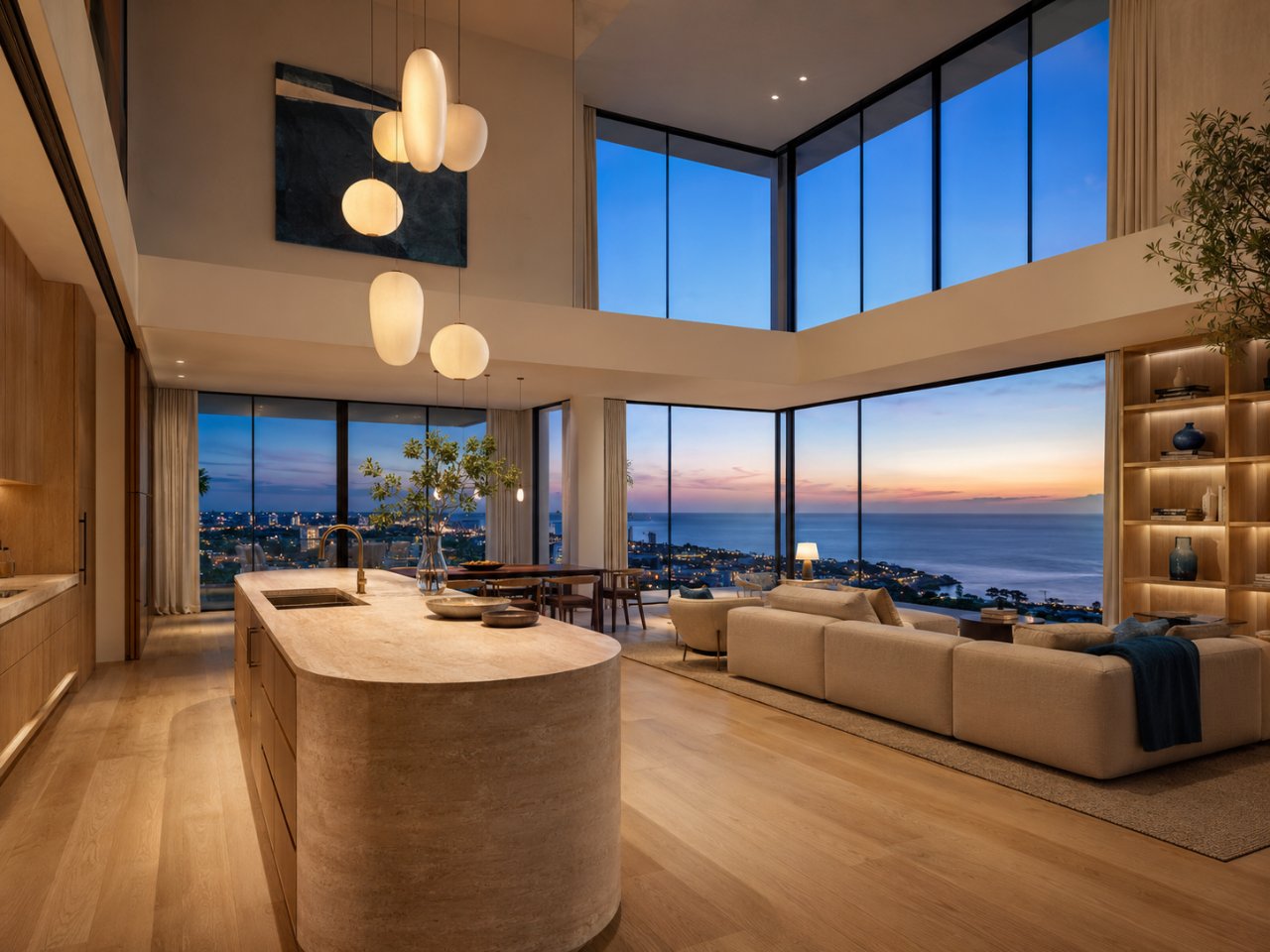
The word "luxury" is stamped on almost every new apartment brochure in Israel, and precisely because it is everywhere it has stopped meaning anything. This guide takes it back. Real luxury in a 2026 Tel Aviv tower is not a marble lobby or a brand name on the kitchen. It is a way of living: a home that gives you back time, protects your money, sits in the right square kilometer of a small and crowded country, and can be understood completely before a single wall exists. For a buyer sitting in Paris, New York, London or Johannesburg, that last point matters more than any chandelier. You are being asked to commit millions of shekels to an apartment you cannot walk through, in a language you may not read, under a tax and finance system built for residents. This guide exists to close that gap.
We built nad-lan around a simple idea: you should be able to choose your apartment from inside the building, in three dimensions, in your own language, before you ever fly in. Everything below is written to make you a sharper buyer, whether you buy from us or not. We will define what an elevated apartment actually contains, walk the Tel Aviv luxury map neighborhood by neighborhood with real price ranges, compare value across the flagship towers rising on the old Sde Dov airfield, and lay out exactly how a foreign resident buys, is taxed, is financed, and is legally protected when purchasing on paper.
What is a luxury apartment in Israel?
A luxury apartment in Israel is a residence where location, building services, and interior specification combine to remove friction from daily life rather than simply signal wealth. In practice it means a prime, walkable address near the sea, transport, and employment; a building that runs like a hotel with a staffed lobby, security, and resort-style amenities; and an apartment finished to a standard, with smart-home control, a comfortable reinforced safe room, generous outdoor space, and light. Price alone does not define it. A three-room apartment beside a light-rail station with a well-run building committee can deliver more genuine luxury than a larger unit stranded on a car-dependent ring road.
The Israeli context adds two features you will not find in most Western markets. The first is the mamad, the reinforced safe room required by law in new construction. Once treated as a utilitarian box, in 2025 and 2026 it has become a design centerpiece: buyers now expect it to double as a quiet home office or a childs bedroom, finished to the same standard as the rest of the home. The second is the sheer verticality of the new supply. Israel is a small country building upward fast, and the modern luxury home is increasingly a high floor in a slender residential tower with a view corridor to the Mediterranean.
What does an elevated apartment include?
Strip away the marketing and a genuinely elevated apartment delivers on three layers. Miss any one of them and you are paying luxury prices for an ordinary home.
Prime location and the life around it
The most valuable thing a luxury apartment owns is its address, because that is the one thing that can never be renovated. In Tel Aviv the premium ladder runs from the seafront inward: a beachfront or park-facing position, then a short walk to a Red Line light-rail station, then proximity to cafes, employment hubs, and green space. The Red Line, running since August 2023 and already carrying more than 100,000 riders a day, has quietly rewritten the value map. An apartment within walking distance of a station now commands a premium and resells faster, and every future line extends that logic. When you evaluate a tower, evaluate its ten-minute walking radius as carefully as its floor plan.
Building amenities and services that run like a hotel
The second layer is the building itself. A premium Tel Aviv tower is expected to offer a package that would have been exceptional a decade ago and is now close to standard at the top of the market:
- A rooftop or resort-style swimming pool, frequently with a sun deck and a Mediterranean view.
- A spa and wellness suite: sauna, treatment rooms, and a fully equipped gym so residents rarely need to leave the building to train.
- A staffed, double-height lobby with a concierge and around-the-clock security.
- A residents lounge and, increasingly, a co-working space, reflecting how many owners now work from home for part of the week.
- Secure underground parking, valuable and scarce in central Tel Aviv, now often with electric-vehicle charging.
- Landscaped shared gardens, a childrens area, and sometimes a private cinema or wine room in the most ambitious projects.
Amenities are only half the story. The quieter half is management: a professional building committee, responsive maintenance, and reserve funds that keep the pool warm and the lobby immaculate in year twelve, not just at the launch party. When you assess a building, ask who manages it and how, because service quality is what separates a tower that ages into a landmark from one that ages into a liability.
Interior specification, smart home, and the safe room
The third layer is the apartment itself: ceiling heights, natural light on more than one aspect, a functional and generous balcony, and a kitchen and bathrooms finished in stone, quality joinery, and premium fittings. At the top of the market, developers commission internationally recognized interior designers to set the specification, which both raises quality and signals prestige. Increasingly the whole home is wired for smart control of lighting, electric shades, climate, and secure access from a phone. And the mamad, as noted, is now a designed room rather than a concrete afterthought. The technical detail that captures all of this is the mefrat mechr, the legally required sale specification, and reading it line by line is one of the most important things a buyer ever does. We return to it in the buying section.
The single most useful habit a foreign buyer can build: judge the apartment on location, building management, and the written specification, in that order. Finishes can be upgraded. A weak address or an under-funded building committee cannot.
Who are elevated apartments for?
The buyer pool for Israeli luxury towers is unusually international, and understanding who you are standing beside in the room helps you price and negotiate with clarity.
- The diaspora buyer with a foot in two countries. Families in France, the United States, Britain, and elsewhere who want a secure, low-maintenance base in Israel they can lock and leave, and a home that is ready the moment they land. A hotel-serviced tower is close to ideal for a home used part of the year.
- The pre-aliyah buyer. Those planning to move to Israel who buy before or around their immigration, where timing the purchase against the reduced new-immigrant tax track can save a great deal.
- The pure investor. Buyers focused on capital preservation and long-term appreciation in one of the developed worlds most resilient property markets, who value a new-build in a landmark location that lets and resells easily.
- The local upgrader and downsizer. Israeli families trading up into more space and services, and empty-nesters trading a house and its upkeep for a lock-and-go apartment with a pool, a gym, and a concierge downstairs.
Luxury versus a standard apartment: the honest comparison
The gap between a genuine luxury tower and a well-located standard apartment is real, but it is not always where buyers assume. It sits less in the size of the living room and more in location resilience, building services, and how a home holds its value.
| Dimension | Elevated tower apartment | Standard apartment |
|---|---|---|
| Location | Prime, walkable, near sea and light rail; view corridors protected by height | Variable; often car-dependent, view not guaranteed |
| Building services | Concierge, security, pool, spa, gym, professional management | Basic or none; self-managed committee |
| Specification | Designer-led, stone and quality joinery, smart home, designed safe room | Builder-standard finishes, functional safe room |
| Resale and liquidity | Strong demand, international buyer pool, resells faster | Local demand, slower in soft markets |
| Cost of ownership | Higher building fees, offset by services and value retention | Lower fees, fewer services, more owner upkeep |
| Entry price per sqm | Premium, driven by view, floor, and brand | Closer to the city average |
The lesson is not that luxury is always the right buy. It is that you should pay the premium only for the layers that hold value, location and building quality, and be sceptical of paying it for finishes you could add yourself later.
The Tel Aviv luxury map, neighborhood by neighborhood
Tel Aviv is not one market but a handful of micro-markets, each with its own price logic. Prices below are broad market ranges in new shekels per square meter and should be read as estimates for orientation, not quotes; the market softened through 2025, so treat the top of each range as peak-deal pricing and verify against a live offer before you commit.
Sde Dov: the coast Tel Aviv is building from scratch
The single most important story in Tel Aviv real estate is the old Sde Dov airfield. This was Dov Hoz municipal airport, on roughly 1,300 dunams of prime Mediterranean coastline in the north of the city; it closed in 2019, and its master plan turns it into a new seafront quarter of around 16,000 homes and some 35,000 residents, with mid-rise buildings and residential towers reaching around forty floors. It is the largest release of central Tel Aviv land in living memory, delivered in phases from roughly 2026 and 2027 through the middle of the next decade, with the Eshkol sub-district furthest along. For a foreign buyer this is the defining on-paper opportunity: a brand-new beachfront neighborhood, bought early, in a city that almost never creates new coastline. New-build pricing here broadly runs from around NIS 80,000 to NIS 130,000 and higher per square meter depending on the sea view and the floor. Our flagship towers, including Rainbow, Ashira, Dimri Yama and DUO, sit in and around this quarter, which is why we let you tour them in 3D before the concrete is poured.
City center and the Rothschild axis
The historic prestige core runs along Rothschild Boulevard and the surrounding city center, where preserved Bauhaus architecture meets a small number of trophy towers. This is the top of the Tel Aviv market, where new luxury commonly trades from around NIS 88,000 to NIS 150,000 per square meter, and where record penthouse deals have pushed well beyond that. Buyers here pay for address and scarcity above all.
Neve Tzedek and the old south
Neve Tzedek, the first neighborhood built outside old Jaffa, offers a low-rise, village-like character that is impossible to replicate, which is exactly why it commands a premium. Standard buildings trade well below the trophy tier, while restored and boutique new stock reaches from roughly NIS 120,000 to NIS 180,000 per square meter. This is a lifestyle purchase more than a yield play.
Park Bavli and northern Tel Aviv
North of the Yarkon, positions facing the greenery of Park Bavli and the newer northern towers offer a calmer, family-oriented version of luxury with strong access to parks and the coast. Premium new stock here broadly overlaps the Sde Dov range, with green views and quiet as the local price levers rather than the boulevard buzz of the center.
Prices, yields, and value for money
Israel is an appreciation-driven property market, not a yield market, and a foreign investor who understands that from day one makes better decisions. Gross rental yields in Tel Aviv are modest, broadly in the region of three to three and a half percent, and after building fees, municipal tax, maintenance, and management the net figure typically lands closer to one and a half to two percent. Nobody buys a Tel Aviv luxury tower for the rent check. They buy it for capital preservation and long-run growth in a supply-starved city: a well-located Tel Aviv apartment rose on the order of eighty-five percent in shekel terms across the decade to 2024. That said, 2025 delivered a visible correction, with average prices reported down in the region of thirteen percent year on year, a reminder that momentum is never guaranteed in the short term and that entry price and holding power matter.
So where does value actually sit? It concentrates in a short list of durable multipliers: a prime, walkable location near the sea and a light-rail station; an efficient layout that wastes no square meter; a real balcony; secure parking, which is scarce and independently valuable; a well-designed safe room; a healthy, professionally run building; and a developer with a track record of delivering on time and to specification. A larger apartment that misses these is worse value than a smaller one that hits them all.
Below is an orientation comparison of the four flagship towers we let you tour in 3D. Unit counts and floors are project facts; pricing is deliberately shown as guidance only, because a real number is set by the developer against the specific unit and the current sale specification, and we will never invent one. Use it to frame the conversation, then open the 3D catalog to walk each building.
| Project | Character | Scale | Signature | Pricing |
|---|---|---|---|---|
| Rainbow | Seafront tower, Sde Dov | High-rise, boutique podium buildings | The reference-grade 3D model and sea-facing lines | On developer proposal, per unit |
| Ashira | Stepped complex set back from the shore | Four buildings, 8 to 35 floors | Realistic massing, garden-to-sky range of homes | On developer proposal, per unit |
| Dimri Yama | Seafront tower with podium | Around 39 floors | Interior specification in the spirit of international designer luxury | On developer proposal, per unit |
| DUO | Twin towers, city and sea | Two towers to around 50 floors | High-floor panoramic living | On developer proposal, per unit |
The developers behind the towers
In an off-plan purchase you are buying a promise, and the identity of the party making it is a core part of the value. These are the names that recur across premium central Tel Aviv, described in plain factual terms.
- Israel Canada is a publicly traded developer known for high-profile luxury towers in central Israel and on the Sde Dov coast.
- Y.H. Dimri is one of the countrys largest homebuilders and a listed company, active from broad residential to premium projects with designer-led interiors.
- Avisror is an established contractor and developer active in winning and delivering Sde Dov Eshkol tenders at scale.
- Azorim is a large publicly traded developer with a heavy focus on urban-renewal, demolish-and-rebuild towers.
- Ashtrom and its residential arm Ashdar sit among Israels biggest construction groups, known for quality housing delivery.
- Mivne, Levinstein and Metropolis are major property groups partnering on premium Sde Dov residential.
- Gindi is known for large mixed-use Tel Aviv complexes and has launched a multi-tower Sde Dov project with five-star amenities.
When you shortlist a project, treat the developer as part of the specification. A reputable, well-capitalized developer with a delivery record is itself a form of buyer protection, on top of the legal protections we turn to next.
Buying as a foreign investor: tax, finance, and legal protection
Foreigners can buy residential property in Israel freely, with no citizenship or residency requirement. The complexity is not permission; it is the tax, finance, and legal machinery, all of which treat a non-resident differently from a local first-home buyer. Handle these four items well and the rest of the transaction is straightforward.
Purchase tax: budget eight to ten percent from the first shekel
This is the single largest surprise for foreign buyers. Israel taxes property purchases on a progressive scale, but the gentle low-rate bands are reserved for an Israeli buying their only home. A foreign resident, and indeed anyone not buying a sole Israeli home, pays the higher investor schedule from the first shekel: eight percent on the portion of the price up to roughly NIS 6,055,070, and ten percent on the portion above it. These residential brackets are frozen through the middle of January 2028, so they will not drift with inflation, but the investor schedule itself runs under a temporary order that should be checked for renewal. On a NIS 6,000,000 apartment, that is close to NIS 480,000 in tax alone. If you plan to make aliyah, a reduced new-immigrant track exists and the timing of your purchase against your immigration can materially change the bill. We keep the live brackets and a working calculator on our purchase tax calculator, and the full mechanics in our guide to purchase tax for foreign residents.
Financing: plan for at least half in cash
Israeli banks treat non-residents as investors, and that pushes the available loan down. A non-resident can typically borrow up to around fifty percent of the property value, against up to roughly seventy-five percent for a resident or someone entitled to Israeli citizenship. Expect to bring at least half the price in cash, plus costs, and foreign-buyer mortgage rates that in recent times have run roughly in the region of five to six and a half percent. The full picture, including which banks lend to foreign buyers and the documents you will need, is in our guide to getting an Israeli mortgage as a non-resident, and you can model the monthly figure on our mortgage calculator.
All-in costs: add roughly twelve to fourteen percent
Beyond the price, a foreign buyer should budget in the region of twelve to fourteen percent of the purchase price for the full transaction: purchase tax at eight to ten percent, legal fees of around one and a half percent plus VAT, a buyer-side agent fee where used of around two percent plus VAT, and registration costs. Building this in from the start prevents the most common and most painful late-stage shock.
Legal protection when buying on paper
Most of the exciting new supply, and all of Sde Dov, is sold off-plan, which means you are paying in stages for a home that does not yet exist. Israels Sale Law protects you here, and understanding it converts a scary purchase into a controlled one. Every payment you make above a modest threshold must be secured, most commonly by an arvut bankit, a bank guarantee issued in your name for the full sum you have paid, or by an approved insurance policy. If the developer fails or becomes insolvent, you recover your money. The law also grants a statutory grace period of around sixty days past the contractual delivery date before delay compensation begins to accrue to you. Two cautions: the guarantee protects your money, not your timeline, so budget for the multi-year waits that large phased projects like Sde Dov can involve; and you should always engage your own Israeli real estate lawyer rather than relying solely on the developers lawyer. Your lawyer reads the contract and the mefrat mechr, the technical sale specification that legally defines every finish, dimension, and inclusion, and confirms your guarantees are correctly issued before you release funds.
The off-plan journey: how payment and time actually work
Buying on paper follows a rhythm that is worth internalizing before you sign, because it governs your cash flow for years. Most Israeli off-plan contracts are structured around a staged payment schedule, often loosely described as a twenty-eighty split: a meaningful deposit on signing, then the balance released against construction milestones or dates, with the largest tranches falling as the building rises and the final payment at handover. Each of those payments, as covered above, must be secured by a bank guarantee in your name. The practical consequence is that your capital goes out gradually, which eases financing but also means your money is committed and working for the developer long before you hold keys. On a large phased quarter like Sde Dov, the gap between first payment and delivery can run several years, and infrastructure such as roads, schools, and the promised light-rail connection arrives on its own government timetable. A disciplined foreign buyer plans for this explicitly: they hold a currency buffer, they diarize each milestone, and they never assume the marketing delivery date is the real one. The reward for that patience is buying tomorrows finished neighborhood at todays off-plan price, which is precisely why early buyers in a landmark scheme have historically done well.
Moving money and managing currency as a foreign buyer
One quiet detail separates smooth foreign purchases from stressful ones: the mechanics of moving large sums into shekels. Israeli banks and lawyers operate under strict anti-money-laundering rules, and a foreign buyer should expect to document the source of funds clearly and early. Because payments are staged over years, the shekel-to-dollar or shekel-to-euro exchange rate becomes a real variable in your total cost; a move of a few percent on a multi-million-shekel purchase is a meaningful sum. Sophisticated buyers decide in advance whether to convert in stages as milestones fall due or to hedge, and they build a small buffer for currency drift into the twelve-to-fourteen-percent cost envelope. None of this is difficult, but it rewards planning, and it is one more reason a foreign buyer benefits from an Israeli lawyer and, where relevant, a cross-border tax adviser from the outset rather than mid-transaction.
How to choose the right apartment: a six-step framework
With the machinery understood, the decision itself becomes a sequence. Work it in order and you will not be swept along by a show apartment.
- Define how you will actually live in it. A part-year lock-and-go base, a full-time family home, and a pure rental investment lead to different floors, layouts, and buildings. Decide this before you look at a single plan.
- Judge the location first and hardest. Walk, or virtually walk, the ten-minute radius. Sea, light rail, green space, cafes, and quiet all price in. The address is the one thing you cannot change.
- Evaluate the specific unit. Floor, aspect, natural light on more than one side, a genuinely usable balcony, the position and quality of the safe room, and an efficient layout with no wasted meters.
- Assess the building and its services. Amenities matter, but management matters more. Ask who runs the building, what the monthly fees buy, and how the reserves are structured for year ten and beyond.
- Weigh the developer and the money. Track record, capitalization, and delivery history on one side; your tax, financing, and all-in cost on the other, modeled honestly with the calculators before you fall in love.
- Confirm the full lifestyle fit. The right apartment is the one whose location, services, and specification match the life you described in step one, at a price whose value you can defend on the durable multipliers, not the finishes.
Tel Aviv in a global context: why foreign capital keeps coming
Foreign buyers weighing Tel Aviv against London, Miami, Lisbon, or Dubai are really asking one question: what does this market give me that the others do not? The honest answer is a specific combination. Tel Aviv is a small, supply-constrained coastal city in a country with strong long-term population growth, a deep and returning diaspora demand base, and a technology economy that keeps generating high-income local buyers. That structural scarcity is why the city has appreciated so powerfully over the long run even through cycles. On a pure price-per-square-meter basis, prime Tel Aviv now sits in the same conversation as major Western capitals, so the value is not that it is cheap; it is that the demand underneath it is unusually durable and personal. For a diaspora buyer, an apartment in Tel Aviv is rarely only a financial position. It is a foothold, a place to land, a plan for the family, and that dual nature, part investment and part belonging, is exactly why this market behaves differently from a purely speculative one and why it has proven resilient when others corrected harder. The 2025 softening is best understood in that light: a cyclical breath in a structurally tight market, and for a patient buyer with the cash to enter, arguably an opportunity rather than a warning.
Five mistakes foreign buyers make, and how to avoid them
Most foreign-buyer regret in Israel traces back to a short list of avoidable errors. Naming them is the fastest way to skip them.
- Underbudgeting the tax. Arriving with a price in mind and only later discovering the eight-to-ten-percent purchase tax and the wider twelve-to-fourteen-percent cost envelope. Model it first, with a calculator, not last.
- Assuming resident financing. Planning around a seventy-five-percent mortgage that a non-resident cannot get. Confirm your fifty-percent cap and your rate before you commit, using our non-resident mortgage guide.
- Relying on the developers lawyer. The developers lawyer represents the developer. A foreign buyer needs independent Israeli legal counsel to read the contract and the sale specification and to verify the bank guarantee.
- Trusting the marketing delivery date. Off-plan timelines slip, especially on large phased schemes. Budget your time and your currency for a realistic, not an optimistic, handover.
- Buying finishes instead of fundamentals. Falling for a beautiful show apartment while ignoring a weak address or an under-managed building. Pay the premium for location and building quality, which hold value, not for finishes you could add yourself.
The 3D advantage: choose your apartment from inside the building
Everything above collides with one hard reality for the foreign buyer: the best new homes are sold before they are built, from a two-dimensional plan, in a country you may visit only occasionally. That is the exact problem we set out to solve. On nad-lan you can open a project, rotate its true-to-massing 3D model, select a specific apartment on the facade or the building, and see its floor, orientation, room count, and the direction it faces, with the surrounding map turning to show you what that apartment actually looks out on, how far the sea is, and what sits around the entrance. You can compare units, view a representative interior, and, when you are ready, build a personalized request that assembles your chosen finish level and the advisors you want, an interior designer, a real estate lawyer, a mortgage advisor, an inspector, into a single organized document, with no payment and no obligation. It is the closest thing to walking the apartment before it exists, and for a buyer abroad it turns an act of faith into an informed decision. Start in the 3D catalog, and if you want to pressure-test the numbers first, run a scenario through our buy-or-rent and deal-check tools.
Frequently asked questions
Can a foreigner buy an apartment in Israel?
Yes. Foreign residents can buy residential property in Israel freely, with no citizenship or residency requirement. The differences are in tax, financing, and process, not in permission.
How much purchase tax does a foreign buyer pay in Israel?
A foreign resident, and anyone not buying a sole Israeli home, pays the investor schedule from the first shekel: about eight percent up to roughly NIS 6,055,070 and ten percent above it. These residential brackets are frozen through mid-January 2028.
How much can a non-resident borrow for an Israeli apartment?
Israeli banks typically finance up to around fifty percent of the value for a non-resident, versus up to about seventy-five percent for a resident or someone entitled to Israeli citizenship. Plan to bring at least half the price in cash plus costs.
What are the total costs of buying property in Israel as a foreigner?
Budget roughly twelve to fourteen percent of the price on top of the price itself: purchase tax of eight to ten percent, legal fees around one and a half percent plus VAT, an agent fee where used of about two percent plus VAT, and registration.
Is it safe to buy an apartment on paper in Israel?
It is, when the legal protections are in place. Under the Sale Law, every stage payment above a modest threshold must be secured by a bank guarantee in your name or approved insurance, so your money is recoverable if the developer fails. Always use your own lawyer, and remember the guarantee protects your funds, not the delivery timeline.
What is Sde Dov and why do investors care?
Sde Dov is the former Dov Hoz airport in northern Tel Aviv, roughly 1,300 dunams of prime coastline being redeveloped into a new seafront quarter of around 16,000 homes with towers up to about forty floors. It is the largest release of central Tel Aviv land in generations and the main pipeline of new beachfront luxury towers, which is why so much foreign interest concentrates there.
What rental yield can I expect in Tel Aviv?
Gross yields are modest, broadly three to three and a half percent, and net figures typically fall closer to one and a half to two percent after costs. Israel is an appreciation-driven market; the case for a Tel Aviv luxury apartment rests on long-term capital growth and preservation, not on rent.
What is a mamad and does every apartment have one?
A mamad is a reinforced safe room required by law in new Israeli construction. Every new apartment has one, and in the current market luxury buyers expect it to double as a comfortable office or bedroom, finished to the same standard as the rest of the home.
Should I buy near the light rail?
Proximity to a Red Line station is a recognized value driver. The line has carried more than one hundred thousand riders a day since opening, and apartments within walking distance command a premium and resell faster. Weigh the walking radius as seriously as the floor plan.
Can I really choose my apartment before the building exists?
Yes. On nad-lan you can tour a project in an accurate 3D model, select a specific unit, see its view and orientation on a synchronized map, compare homes, and assemble a no-obligation request document, all before construction. It is how a buyer abroad turns an on-paper purchase into an informed one.
Ready to see it for yourself? Open the 3D premium catalog and walk Tel Avivs new seafront towers from wherever you are, then model your tax and your financing before you decide. When a home feels right, build a free, no-obligation offer request in minutes.