מחבר: בן בטש

  • תמ"א 38 פוקעת במאי 2026: מה עושים דיירים ויזמים עכשיו

    תמ"א 38 פוקעת במאי 2026: מה עושים דיירים ויזמים עכשיו

    עידן שלם בהתחדשות העירונית בישראל מגיע לסיומו. תוכנית תמ"א 38, שאושרה ב-2005 כדי לחזק מבנים ישנים מפני רעידות אדמה והפכה למנוע ההתחדשות הגדול של מרכזי הערים, פוקעת סופית ברוב הארץ במאי 2026, כפי שמפורט באתרי מידע משפטיים ובראשם כל זכות.

    מה קורה לפרויקטים שכבר בדרך

    הכלל המרכזי פשוט: פרויקט שקיבל היתר בנייה ממשיך כרגיל. פרויקט שעדיין לא קיבל היתר עומד בפני החלטה: להאיץ את ההיתר לפני הפקיעה, לעבור למסלול חלופי, או לעצור. לבעלי דירות בבניינים כאלה מומלץ לברר מול היזם באיזה שלב תכנוני בדיוק נמצא הפרויקט שלהם, ולקבל את זה בכתב.

    מה מחליף את תמ"א 38

    הכלי המרכזי שנכנס לנעליה הוא חוק פינוי-בינוי המעודכן, והשינוי הדרמטי בו נוגע להסכמת דיירים: במקום 80% הסכמה כבעבר, מספיקה כיום הסכמה של 67% מבעלי הדירות בבניין. המשמעות היא שמיעוט מתנגדים כבר לא יכול לתקוע מתחם שלם. במקביל, התמריצים עודכנו כך שהם קטנים במרכז הארץ וגדלים בפריפריה, מהלך שנועד להסיט התחדשות גם לערים שבהן היא כמעט לא קרתה.

    מה זה אומר לבעלי דירות ישנות

    אם אתם גרים בבניין ישן באזור ביקוש, השווי של הדירה שלכם תלוי יותר מתמיד במסלול ההתחדשות של הבניין. שלושה צעדים מומלצים: בדקו אם הבניין שלכם נמצא במתחם מוכרז או מקודם. בקטלוג שלנו מרוכזים מאות מתחמי פינוי-בינוי ופרויקטים בתמ"א 38 מכל הארץ, לפי נתוני מאגרי המידע הממשלתיים. שנית, אל תחתמו על מסמך ראשון בלי עורך דין מקרקעין שמייצג את הדיירים. ושלישית, הבינו את המושגים לפני הפגישה עם היזם: מילון המונחים שלנו מסביר בעברית פשוטה מה זה מקדם חיזוק, הערת אזהרה ודירת תמורה.

    המידע כללי ואינו ייעוץ משפטי. מקורות: כל זכות, פרסומי משרד המשפטים ומרכז הנדל"ן.

  • רובע שדה דב: הריביירה החדשה של תל אביב יוצאת לדרך

    רובע שדה דב: הריביירה החדשה של תל אביב יוצאת לדרך

    על הקרקע שעליה פעל עד 2020 שדה התעופה שדה דב קם בימים אלה הרובע החדש והמדובר ביותר בישראל. רצועת חוף של ממש בצפון תל אביב, תכנון עירוני חדש מהיסוד, ורשימת יזמים שנקראת כמו מדריך היוקרה של הענף. לפי נתונים שפורסמו באתרי הרובע, המחיר הממוצע למ"ר עומד בתחילת 2026 על כ-81 אלף שקל, מהגבוהים בישראל.

    מי בונה שם עכשיו

    אשירה של אביסרור מביא לרובע מגדל בוטיק עם דגש על עיצוב ואיכות גימור. בעמוד הפרויקט שלנו אפשר לסייר במגדל ולבחור דירה מתוך הבניין: רואים קומה, כיוון אוויר ונוף, ובודקים אומדן מחיר לפני שמרימים טלפון.

    SHE Rainbow של ישראל קנדה מביא לשדה דב את תפיסת הריזורט: מגורים עם שירותים ברמת מלון. גם אותו אפשר לראות אצלנו בתצוגה תלת-ממדית.

    קבוצת חג'ג' השיקה לאחרונה, לפי דיווח כלכליסט, פרויקט בקו ראשון לים בתכנון משרד ODA הבינלאומי. גינדי החזקות מקדמת את VOGUE עם בריכות, ספא ומתקני כושר.

    מה הופך את שדה דב לשונה

    שלושה דברים: מיקום על הים בתוך תל אביב, תכנון של רובע שלם מאפס במקום בנייה נקודתית, וביקוש בינלאומי. חלק ניכר מהרוכשים ברובע הם תושבי חוץ, והיזמים בונים את חוויית המכירה בהתאם. זה בדיוק סוג המקום שבו כדאי להגיע לפגישת מכירות אחרי שכבר ראיתם את הבניין, את הקומות ואת הנוף מכל דירה, ולא לפני.

    למי זה מתאים

    שדה דב הוא השקעת יוקרה לכל דבר: מחירי הכניסה גבוהים, אבל כך גם פוטנציאל הביקוש לטווח ארוך. מי שבודק את הרובע צריך להשוות בין הפרויקטים על בסיס מחיר למ"ר, מפרט, קומה וכיוון, ולקחת ליווי מקצועי. במאגר שלנו תמצאו עורכי דין מומחי מקרקעין ויועצי משכנתאות שמלווים עסקאות מהסוג הזה.

    האומדנים אינם מחייבים ומבוססים על פרסומים גלויים. מקורות: כלכליסט, אתרי הרובע והיזמים.

  • שוק הנדל"ן 2026: לראשונה מזה עשור, שוק של קונים

    שוק הנדל"ן 2026: לראשונה מזה עשור, שוק של קונים

    אחרי שנים של עליות מחירים כמעט רצופות, שוק הדיור הישראלי נכנס ב-2026 לשלב חדש. לפי נתוני הלשכה המרכזית לסטטיסטיקה שפורסמו בתקשורת, מחירי הדירות רשמו ירידות קלות במשך תשעה מדדים רצופים עד תחילת השנה, ובפועל השוק מתייצב. סוכני נדל"ן ותיקים מגדירים את התקופה, בפרסומים כמו Times of Israel, כשוק הקונים הראשון מזה יותר מעשור.

    למה דווקא עכשיו יש לקונים כוח

    שלושה גורמים נפגשים בבת אחת. ראשית, מלאי הדירות החדשות שלא נמכרו נמצא ברמות שיא אחרי ההאטה של 2025, והיזמים משווקים במרץ כדי לשחרר מלאי. שנית, פערי המחיר בין המחיר המבוקש למחיר הסגירה עומדים לפי הערכות בענף על 5% עד 9%, כלומר יש מקום אמיתי למשא ומתן. שלישית, סביבת הריבית מתחילה להתמתן, מה שמחזיר קונים שהמתינו בצד.

    איפה ההזדמנויות מתרכזות

    אזורי הבנייה החדשה הגדולים הם המקום שבו הגמישות הכי מורגשת: מתחמי ההתחדשות בדרום תל אביב, פרויקטים לאורך החוף בנתניה, סביבת תחנות המטרו העתידיות בפתח תקווה, ומתחמים גדולים בבאר שבע. דווקא בפרויקטים יוקרתיים באזורי ביקוש, כמו רובע שדה דב בתל אביב, המחירים נשארים יציבים יותר, אבל גם שם מרווח התמרון גדל.

    איך מנצלים את זה נכון

    שוק של קונים לא אומר שכל דירה היא מציאה. הוא אומר שיש לכם זמן לבדוק, להשוות ולהתמקח. שלושה צעדים פשוטים: בדקו את היצע הפרויקטים החדשים באזור שלכם והשוו מחיר למ"ר בין פרויקטים סמוכים. הריצו את המספרים על מחשבון המשכנתא לפני שנכנסים למשא ומתן, כדי לדעת בדיוק מה התקציב האמיתי שלכם. ואל תשכחו את מס הרכישה ואת ההוצאות הנלוות, שיכולות להוסיף אחוזים ניכרים לעלות העסקה.

    מי ששוקל למכור דווקא עכשיו צריך לתמחר בצורה ריאלית מהיום הראשון. דירה שמתומחרת נכון מושכת קונים רציניים גם בשוק איטי, ודירה שמתומחרת לפי מחירי 2022 פשוט יושבת. אפשר לפרסם דירה למכירה בחינם ולקבל חשיפה מיידית לקונים פעילים.

    המידע כללי ואינו ייעוץ השקעות או ייעוץ משפטי. מקורות: פרסומי הלשכה המרכזית לסטטיסטיקה בתקשורת, Times of Israel, סקירות שוק פומביות.

  • Buying Property in Israel: The Complete 2026 Guide for Foreign Buyers

    Buying Property in Israel: The Complete 2026 Guide for Foreign Buyers

    Foreign buyers purchased thousands of Israeli homes in recent years, and 2026 rules make the process more structured than most investors expect: a dedicated purchase-tax track for non-residents, bank financing capped at lower loan-to-value ratios, and anti-money-laundering checks on every shekel you transfer. This guide walks through the full path, from choosing a city and a lawyer to signing at the Land Registry (Tabu), with the official numbers and none of the folklore.

    Why Israel, why now: the 2026 market in numbers

    Foreign buyers do not buy Israeli property only for yield. They buy because Israel is a family anchor, a future Aliyah base, a currency hedge, a place for children to study, a retirement option, or a long-term holding in a market where supply is physically constrained in the central cities. That emotional layer matters, but the purchase still has to pass a hard financial test. The right starting question is not whether Israel feels familiar. It is whether the city, tax bill, financing structure and ownership status fit your money.

    The national market was not moving as one block in 2026. The Central Bureau of Statistics May to June 2026 releases reported that the national average home price in Q1 2026 was NIS 2,332,800, down 0.8% from Q1 2025, when the national average was NIS 2,350,900. The same CBS May to June 2026 release set also reported that the home price index fell 1.2% year over year in February to March 2026 compared with a year earlier. Inside that national picture, the city split mattered: Jerusalem rose 4.2% year over year while Tel Aviv fell 3.5% year over year, according to those CBS May to June 2026 releases.

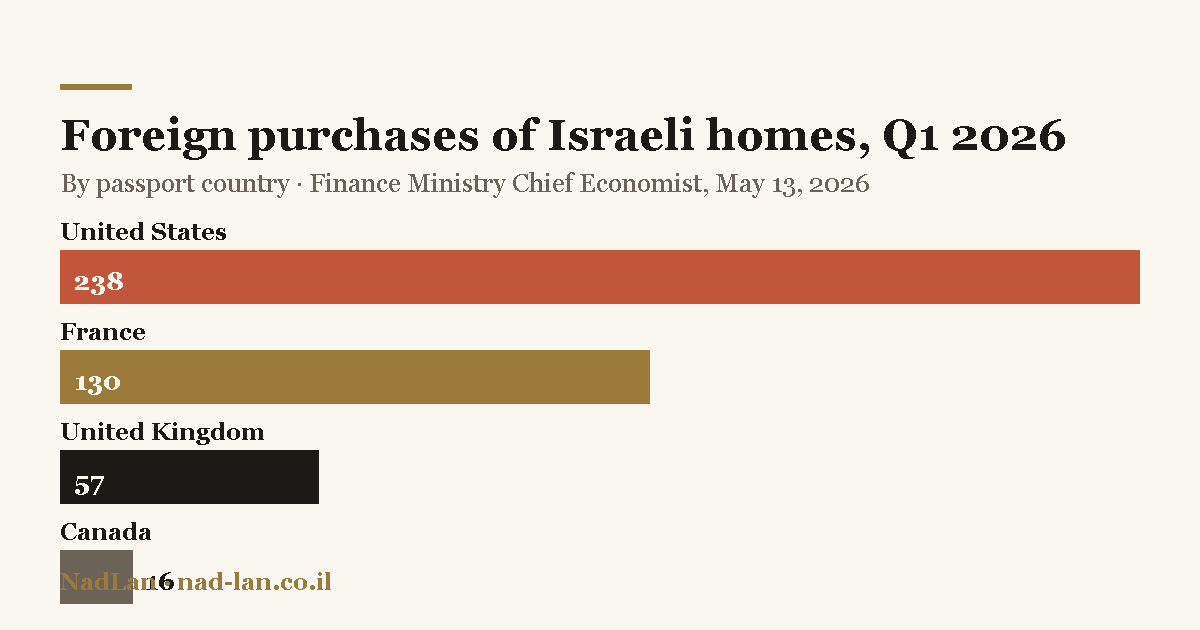
    The foreign-buyer pattern in Q1 2026 was also visible in the Finance Ministry Chief Economist residential review for March 2026, published May 13, 2026. The review reported 487 foreign-resident purchases in Q1 2026, compared with 413 in Q1 2025, an 18% rise. It also gave the first-ever breakdown by passport country: US passports accounted for 238 purchases, or 49%; France accounted for 130 purchases, or 26.7%; and UK passports accounted for 57 purchases. Together, those three passport groups accounted for 87% of all foreign purchases in that review. Canada accounted for 16 purchases and Australia for 10 purchases, according to the same Finance Ministry Chief Economist review published May 13, 2026.

    Passport country Q1 2026 foreign-resident purchases Share of foreign-resident purchases Source and date
    United States 238 49% Finance Ministry Chief Economist residential review, March 2026, published May 13, 2026
    France 130 26.7% Finance Ministry Chief Economist residential review, March 2026, published May 13, 2026
    United Kingdom 57 Included in the three-country total of 87% Finance Ministry Chief Economist residential review, March 2026, published May 13, 2026
    Canada 16 Not separately stated in the review Finance Ministry Chief Economist residential review, March 2026, published May 13, 2026
    Australia 10 Not separately stated in the review Finance Ministry Chief Economist residential review, March 2026, published May 13, 2026

    The country mix also tells you where to look first. The same Finance Ministry Chief Economist residential review for March 2026, published May 13, 2026, reported that 52.5% of American purchases were in Jerusalem, equal to 125 homes. Netanya was second for American buyers with 27 homes, followed by Beit Shemesh with 24, Kiryat Gat with 11 and Tel Aviv with 10. The median price Americans paid in Jerusalem was above NIS 5 million, according to that review. The currency backdrop was not neutral: over the same year, the dollar weakened 13.6% against the shekel and the euro weakened 4%, according to the Finance Ministry Chief Economist review published May 13, 2026.

    For a foreign buyer, this means the search should start with purpose and cash, then move to city. Jerusalem may fit diaspora families who want community depth, religious infrastructure and long-term use. Netanya may fit French-speaking buyers and coastal use. Tel Aviv may fit lifestyle buyers, but the 2026 CBS data showed a softer year-over-year price direction there than in Jerusalem. For a broader city comparison, use the site guide to where foreign investors buy in Israel alongside the tax and financing checks below.

    Step 1: Budget - purchase tax brackets for foreign residents

    Purchase tax is the first Israeli cost foreign buyers usually underestimate. In Israel, the tax is imposed on the buyer and is calculated from the purchase price under the applicable bracket. A foreign resident is not placed in the Israeli sole-home track merely because the property will be the only property they own in Israel. For purchase-tax purposes, the foreign-buyer track is generally the same as the track for a person who is not buying a sole home as an Israeli resident.

    The tax rule itself is precise. For a foreign resident, and for anyone not buying a sole home as an Israeli resident, the purchase tax is 8% on the part of the price up to NIS 6,055,070 and 10% on the part above NIS 6,055,070. This rule is in force from January 16, 2024 through December 31, 2026, according to Israel Tax Authority rates via the official Kol Zchut guide, checked July 2026.

    That simple rule can change the entire budget. A buyer comparing two apartments should compare the total acquisition cost, not only the seller's asking price. Your working budget should include the contract price, purchase tax under the correct resident status, legal work, bank conditions if borrowing, renovation or furniture needs, exchange-rate exposure, management costs and a cash buffer for transfer questions. Professional fees vary by transaction and should be confirmed in writing before you sign. The practical point is still clear: tax is not a side item. It is part of the property price.

    Buyer tax track Bracket Rate Source and date
    Foreign resident, and anyone not buying a sole home as an Israeli resident Part of the price up to NIS 6,055,070 8% Israel Tax Authority rates via Kol Zchut, in force January 16, 2024 through December 31, 2026, checked July 2026
    Foreign resident, and anyone not buying a sole home as an Israeli resident Part of the price above NIS 6,055,070 10% Israel Tax Authority rates via Kol Zchut, in force January 16, 2024 through December 31, 2026, checked July 2026
    Israeli-resident sole-home buyer Up to NIS 1,978,745 0% Israel Tax Authority rates via Kol Zchut, brackets frozen January 16, 2024 to January 15, 2028, checked July 2026
    Israeli-resident sole-home buyer Above NIS 1,978,745 and up to NIS 2,347,040 3.5% Israel Tax Authority rates via Kol Zchut, brackets frozen January 16, 2024 to January 15, 2028, checked July 2026
    Israeli-resident sole-home buyer Above NIS 2,347,040 and up to NIS 6,055,070 5% Israel Tax Authority rates via Kol Zchut, brackets frozen January 16, 2024 to January 15, 2028, checked July 2026
    Israeli-resident sole-home buyer Above NIS 6,055,070 and up to NIS 20,183,565 8% Israel Tax Authority rates via Kol Zchut, brackets frozen January 16, 2024 to January 15, 2028, checked July 2026
    Israeli-resident sole-home buyer Above NIS 20,183,565 10% Israel Tax Authority rates via Kol Zchut, brackets frozen January 16, 2024 to January 15, 2028, checked July 2026

    There is a resident-status planning point for future olim and returning residents. A foreign buyer who becomes an Israeli resident or returning resident can qualify for the sole-home brackets. For purchases signed between February 28, 2024 and May 30, 2026, the deadline is 27 months from purchase or August 31, 2026, whichever is later, under the war-related extension described in the official Kol Zchut guide checked July 2026. This is not a reason to improvise. It is a reason to put your immigration timing, tax status and purchase date in front of an Israeli real estate lawyer before signing.

    New immigrants also have a dedicated rule. Under regulation 12A for aliyah from August 15, 2024, a new immigrant buying a single home they will live in pays 0% up to NIS 1,978,745 based on the 2024 index, 0.5% from there up to NIS 6 million, and regular sole-home rates above that level. The source is the gov.il announcement of July 29, 2024 on the Ministry of Aliyah and Integration page. Because this depends on status, timing and intended use, future olim should read the full guide to purchase tax for foreign residents and run the numbers in the purchase tax calculator before choosing a property.

    Step 2: Financing - what Israeli banks lend non-residents

    Many foreign buyers assume that an Israeli bank will finance the purchase in the same way a bank would finance a local first home. The Bank of Israel rules say otherwise. The lending ceiling is based on buyer type, and non-residents are treated by banks as investors. That places the non-resident buyer in the lowest loan-to-value category in the rules.

    Under Bank of Israel Proper Conduct of Banking Business Directive 329, the loan-to-value cap is 75% for an Israeli resident's first and only home, 70% for a replacement home, and 50% for an investment home. Non-residents are treated by the banks as investors, which means up to 50% of the lower of the purchase price or the bank's own appraisal. The source for these caps is Bank of Israel Proper Conduct of Banking Business Directive 329, checked July 2026.

    Buyer type Maximum LTV cap Calculation base Source and date
    Israeli resident, first and only home 75% Bank policy under the applicable lending rules Bank of Israel Proper Conduct of Banking Business Directive 329, checked July 2026
    Israeli resident, replacement home 70% Bank policy under the applicable lending rules Bank of Israel Proper Conduct of Banking Business Directive 329, checked July 2026
    Investment home 50% Bank policy under the applicable lending rules Bank of Israel Proper Conduct of Banking Business Directive 329, checked July 2026
    Non-resident buyer Up to 50% Lower of the purchase price or the bank's own appraisal Bank of Israel Proper Conduct of Banking Business Directive 329 and bank treatment of non-residents as investors, checked July 2026

    The words lower of the purchase price or the bank's own appraisal are critical. If the contract price is above the bank valuation, the mortgage base may be the bank valuation. The buyer then has to bring more equity than expected. For foreign buyers, the cleanest path is to speak with a mortgage adviser or bank before signing a binding contract, submit identity documents and income materials early, and make sure the payment schedule in the contract matches realistic bank timing.

    Financing also interacts with currency. A buyer earning dollars, euros, pounds, Canadian dollars or Australian dollars is buying a shekel asset and may be borrowing in Israel. The Finance Ministry Chief Economist review for March 2026, published May 13, 2026, reported that the dollar weakened 13.6% against the shekel over that year and the euro weakened 4%. This is not a forecast. It is a reminder that exchange-rate movement can change your effective purchase price before closing. For the dedicated financing path, read getting an Israeli mortgage as a non-resident.

    Step 3: The team - lawyer, agent, appraiser (who is mandatory)

    Every foreign buyer needs an independent Israeli real estate lawyer. The seller's lawyer does not represent you, even if that lawyer prepares the contract or communicates politely in English. Your lawyer checks the title, seller identity, rights status, tax exposure, payment schedule, warning note, mortgage conditions, power of attorney and closing mechanics. For a non-resident, the lawyer also becomes the person who keeps the transaction connected when you are outside Israel.

    The lawyer should be independent from the seller, developer, broker and marketing company. In a second-hand purchase, the lawyer checks the Land Registry extract or the relevant rights register, confirms whether the seller can transfer what they claim to own, reviews liens or restrictions, and drafts protective conditions for payments. In a new-construction purchase, the lawyer reviews the developer contract, Sale Law guarantee mechanism, linkage, delivery terms, plan documents, specifications and the timing of registration.

    An agent is not mandatory in every transaction, but a good buyer-side agent can save time in a market where listings may be duplicated, outdated, partly marketed through networks or priced with negotiation space. For a foreign buyer, the agent's value is highest when they know the target neighborhood at building level and are willing to reject unsuitable listings. The wrong agent adds noise. The right agent narrows the search and gets you into the right apartment types quickly.

    An appraiser is usually required by the bank when there is financing, because the bank needs its own collateral value. Even when paying cash, a private appraisal can help with second-hand property, unusual rights, large renovation needs, luxury pricing or a purchase in an area with thin comparable sales. The lending rule makes the appraisal even more practical for non-residents, because the 50% financing ceiling is applied to the lower of the purchase price or the bank's own appraisal under Bank of Israel Directive 329, checked July 2026.

    A power of attorney can let a buyer complete the whole purchase without flying to Israel. This can cover signing, tax filings, registration steps, bank coordination and closing actions, depending on how it is drafted and accepted. It is useful for buyers in the United States, France, the United Kingdom, Canada or Australia, but it should be prepared by your Israeli lawyer so it matches the transaction and registration requirements.

    Step 4: New construction vs second-hand

    Foreign buyers often start with new construction because the sales material is clearer, the building is modern, and the purchase can sometimes be coordinated from abroad with structured documents. New projects may offer parking, elevators, balconies, protected rooms and building systems that fit buyer expectations. They can also carry risks that need contract-level attention: delivery timing, specification changes, linkage, registration timing and the exact identity of the rights being purchased.

    Buyers of new construction are protected by Sale Law guarantees, including a bank guarantee for every payment. That protection is central. Payments to a developer should follow the legal protection mechanism, and the buyer's lawyer should confirm the guarantee documents, account details and project status before money moves. Contract prices are usually linked to the Building Cost Index, so the headline price is not always the final shekel amount paid by delivery. This guide does not add an index forecast. Check the current index track in the contract before signing.

    Second-hand property is different. The apartment exists, the building can be inspected, neighbors and noise can be observed, and the buyer can see the actual condition. The legal work focuses on ownership, liens, building irregularities, rights register, municipal files where relevant, mortgage discharge, possession date, fixtures and defects. A second-hand purchase can be faster than a project purchase, but speed is not a substitute for title work.

    Foreigners of any nationality or religion can buy property built on privately owned land in Israel with no citizenship or residency requirement. A large share of Israeli land is state land managed by the Israel Land Authority under long leases, where foreign buyers may face extra steps. That distinction is one of the first issues your lawyer should identify. The buyer does not need to solve the entire Israeli land system alone. The buyer needs to know, before signing, what type of rights are being purchased and what approvals or registrations are needed.

    If you are choosing between a project and an existing apartment, compare control. New construction gives you modern standards and a developer process, but you are buying a future asset. Second-hand gives you a real apartment now, but it may need repairs, upgrades or legal cleanup. Use buying new construction in Israel for the project path and check current new projects only after your tax and financing budget is clear.

    Step 5: Money transfer and AML compliance

    The money path is not a technical afterthought. Israeli banks must verify source of funds under Israel's Prohibition on Money Laundering Law before accepting transfers from abroad. That means a foreign buyer should expect questions about where the money came from, how it was earned, how it moved, and whether the sender, buyer and transaction documents match. A clean contract is not enough if the receiving bank is not comfortable with the funds.

    Prepare the paper trail early. Typical explanations may involve salary savings, sale of another property, investment liquidation, inheritance, business proceeds or family support, but the bank will care about documents, not stories. The practical package may include bank statements, sale contracts, tax records, inheritance documents, proof of identity, company documents or other materials requested by the Israeli bank or lawyer. This article avoids listing a fixed checklist as a rule, because requirements differ by bank, country, account history and buyer profile.

    Coordinate the transfer route before the contract creates a tight payment obligation. If the buyer has to move money from a foreign bank, convert currency, satisfy compliance checks and meet an Israeli payment date, the timing should be realistic. Your lawyer should review the seller's or developer's payment instructions, and the bank or receiving account details should be verified carefully. For new construction, payments should move through the protected mechanism tied to the Sale Law guarantee process, not through informal instructions.

    Currency is part of compliance planning because the buyer may convert funds before transfer or hold shekels in Israel before payment. The Finance Ministry Chief Economist residential review for March 2026, published May 13, 2026, reported that the dollar weakened 13.6% against the shekel over that year and the euro weakened 4%. That historical context does not tell you what the exchange rate will do next, but it shows why transfer timing and currency exposure belong in the purchase plan. For the dedicated operational path, read transferring money to Israel for a property purchase.

    Step 6: Signing, Tabu registration and warning notes

    The Israeli purchase process becomes serious before signing, not after. By the time you sign, your lawyer should have checked the rights, reviewed the contract, negotiated protections, confirmed the payment schedule and identified the registration route. A buyer who signs first and investigates later has reversed the order of protection. In Israel, the legal structure of the property matters as much as the apartment itself.

    After signing a second-hand purchase contract, a warning note, known in Hebrew as he'arat azhara, is registered at the Land Registry to block conflicting deals. The warning note tells the world that the seller has made a binding commitment to the buyer. It is one of the key early protections in a Tabu-registered transaction. Your lawyer should handle the filing quickly and confirm that the note was registered correctly.

    Tabu is the common name for the Land Registry. Some properties are registered directly there. Others may involve the Israel Land Authority, a housing company register, a developer register before final condominium registration, or another rights-management path. A foreign buyer should not assume that every property has the same registration status. The lawyer's job is to identify where the rights are recorded today and how the buyer will be registered after closing.

    The final transfer is usually tied to payment completion, tax confirmations, mortgage discharge if the seller has a loan, possession delivery and registration documents. If the buyer is abroad, a power of attorney can let the lawyer sign and complete many actions without the buyer flying to Israel. The exact authority must be drafted correctly. A vague overseas authorization can cause delays with a bank, tax office or registry.

    For new construction, the path can be longer. The buyer may receive guarantees during construction, possession at delivery, and final registration only later when the building and condominium registration process are completed. The buyer's lawyer should explain what you own at each stage, what proof you receive, and what has to happen before the apartment is fully registered in your name or in the relevant rights record.

    Ongoing: taxes, management and renting out

    Owning an Israeli property from abroad is an operating decision. The purchase is only the first event. After closing, the owner has to manage municipal bills, building payments, insurance, repairs, tenant questions, rent collection, tax reporting, bank access, keys and emergency decisions. If the property is for family use only, the tasks may be lighter. If it will be rented out, the owner needs a system.

    The first decision is who has authority on the ground. Some owners rely on relatives, but that can become uncomfortable when a tenant calls, a leak appears, or a building committee needs payment. A professional manager can coordinate rent, repairs, access and reports, but the owner should understand exactly what the manager is authorized to do. The management agreement should define approvals, spending limits, reporting, tenant screening and emergency handling.

    Renting out an apartment also changes the practical profile of the purchase. A property that is perfect for occasional family visits may not be ideal as a rental. The rental market cares about transport, condition, building quality, maintenance, tenant demand and ease of showing. For a non-resident, simplicity has value. A well-located, easily managed apartment may outperform a more complicated asset that constantly requires overseas decisions.

    Tax reporting should be planned with an Israeli professional who understands non-resident ownership and the owner's home-country obligations. This guide does not list rental tax rates or treaty rules, because they depend on each owner's status and home country. The correct move is to set the reporting structure before rent begins, not after income has already been received. For the operating side, use managing an Israeli rental property from abroad.

    FAQ for foreign buyers

    Can foreigners buy property in Israel?

    Yes. Foreigners of any nationality can buy property built on privately owned land in Israel with no citizenship or residency requirement. The main issues are not permission in principle, but title type, tax status, bank financing, money-transfer compliance and the quality of the buyer's independent Israeli legal representation.

    A large share of Israeli land is state land managed by the Israel Land Authority under long leases, where foreign buyers may face extra steps. Your lawyer should identify the rights type before signing and explain whether any approval, lease condition or registration path affects the deal.

    Can non-Jews buy property in Israel?

    Yes. Foreigners of any nationality or religion can buy property built on privately owned land in Israel with no citizenship or residency requirement. The process is legal and commercial, not religious. The buyer still needs proper title checks, tax planning, source-of-funds compliance and an independent Israeli real estate lawyer.

    The same caution about land type applies. Private land is usually the cleaner legal category for foreign buyers, while state land managed by the Israel Land Authority may involve extra steps. The question should be checked property by property, not guessed from the city or neighborhood.

    How much is purchase tax for a foreign buyer?

    For a foreign resident, purchase tax is 8% on the part of the price up to NIS 6,055,070 and 10% on the part above NIS 6,055,070. Those rates are in force January 16, 2024 through December 31, 2026, according to Israel Tax Authority rates via Kol Zchut, checked July 2026.

    A foreign buyer who becomes an Israeli resident or returning resident can qualify for the sole-home brackets. New immigrant rules may also apply in the circumstances described by the gov.il announcement of July 29, 2024. Status and timing should be checked before signing.

    Can a non-resident get an Israeli mortgage?

    Yes, but the Bank of Israel framework means the ceiling is lower than for a local first-home buyer. Non-residents are treated by banks as investors, with financing up to 50% of the lower of the purchase price or the bank's own appraisal, under Directive 329 checked July 2026.

    Approval also depends on bank underwriting, documents, income evidence, source-of-funds checks and the property itself. Speak with the bank or adviser before signing, because a lower appraisal can require more equity than the buyer expected.

    Do I have to be in Israel to complete the purchase?

    No. A properly drafted power of attorney can let a foreign buyer complete the whole purchase without flying to Israel. Your Israeli lawyer can use it for signing and closing actions within the authority granted, provided the document is prepared correctly and accepted by the relevant bank, tax and registration bodies.

    This is common for overseas buyers, but it should not be treated as a casual form. The power of attorney must match the transaction, the buyer identity documents, the financing structure and the registration route.

    How much does a home in Israel cost in 2026?

    The CBS May to June 2026 releases reported that the national average home price in Q1 2026 was NIS 2,332,800, down 0.8% from Q1 2025, when the average was NIS 2,350,900. The same CBS data reported a 1.2% year-over-year fall in the home price index.

    National averages are only a starting point. The CBS May to June 2026 data showed Jerusalem rising 4.2% year over year while Tel Aviv fell 3.5% year over year. If Aliyah is part of the plan, pair the property search with the Aliyah housing checklist.

    Sources

    Next step: choose the buyer status that fits you today, run the purchase tax, then ask your Israeli lawyer to confirm the land-rights path and the exact documents the bank will need before any binding offer is signed.


    This guide is general information, not legal advice. Every transaction requires its own review of the specific facts. For an initial consultation on a purchase in Israel, contact the office.
  • Investing in Israeli Real Estate in 2026: Israel vs. Dubai vs. Cyprus for the Foreign Buyer

    The most interesting money in the Eastern Mediterranean is not looking for a home. It is looking for a position. Investors who bought Dubai between 2020 and 2023 have taken their yield, watched the boom mature, and started asking where the next long hold sits. For a growing share of them, and for the global Jewish diaspora that never left the question alone, the answer runs through Tel Aviv. This guide compares the three markets that dominate that decision, Israel, Dubai, and Cyprus, on the numbers that actually move capital: entry cost, yield, appreciation, ownership rights, currency, and tax. It then lays out exactly how a foreign investor buys, finances, and protects an Israeli asset in 2026.

    The 2026 capital-allocation question

    Three markets sit on the shortlist of most internationally mobile buyers with a Mediterranean thesis.

    • Dubai is the yield-and-liquidity trade: low entry tax, high gross rents, and a fast, frictionless market.
    • Cyprus is the EU-foothold trade: European Union membership, a mild tax regime, and prices climbing fast on the back of foreign, largely Israeli, capital.
    • Israel is the preservation-and-growth trade: a hard, appreciating currency, a rule-of-law ownership framework, and a housing market held tight by chronic undersupply.

    None of the three is the correct answer in the abstract. The right choice depends on the mandate: current income, European access, or long-run capital protection. What follows is the honest version of each, built from 2026 market data rather than brochure copy.

    Israel vs. Dubai vs. Cyprus at a glance

    Dimension Israel (Tel Aviv prime) Dubai (prime) Cyprus (Limassol / Paphos)
    Price per sqm €8,000–€12,000 €4,000–€6,000 Rising fast; below Tel Aviv
    Gross rental yield 3–4% net 5–7% gross Mid-single digits
    10-year capital appreciation 5–8% a year, consistent Volatile (boom and bust) Double-digit recent growth in hotspots
    Entry tax for a foreign buyer 8% purchase tax (10% above ₪6.05M) 4% transfer fee + ~2% agency Efficient; land-sale rules under review
    Annual property tax Arnona, modest None Modest
    Rental income tax 15% flat to a threshold None Favorable
    Capital gains on sale 25% on the real gain None Favorable
    Ownership and residency Full legal ownership, OECD rule of law Freehold in zones; no residency by right EU access; regulation risk rising
    Currency Shekel, floating and appreciating Dirham, pegged to the US dollar Euro

    Figures are 2026 market ranges compiled from the sources listed at the end and are directional, not a valuation of any specific property. Tax numbers require confirmation with the Israel Tax Authority and a qualified adviser before you act.

    Price and the cost of entry

    Tel Aviv is expensive. Prime residential in the old north, the beachfront, Ramat Aviv, and the emerging tech district trades at roughly €8,000 to €12,000 per square metre, which puts the city among the twenty most expensive residential markets in the world. Dubai's prime addresses, Marina, Downtown, Palm Jumeirah, sit around €4,000 to €6,000, and mid-tier Dubai runs lower still. On the sticker, Dubai wins the entry-price contest outright.

    Entry tax widens the gap at the door and then narrows it over the hold. A foreign buyer in Israel pays 8% purchase tax on most properties, so a ₪3.5 million apartment carries ₪280,000 in tax before a single other cost. Dubai's combined entry costs, a 4% Dubai Land Department transfer fee plus around 2% in agency fees, come in lower. Israel front-loads the friction. What it gives back is the absence of annual property tax beyond a modest arnona bill and a flat, capped rental-income rate, so the holding-cost structure closes much of the distance across a five to ten year hold.

    Yield versus appreciation: read the total return

    This is where headline numbers mislead. Dubai delivers 5% to 7% gross rental yield in established areas, among the highest for prime residential anywhere, and it is the reason yield-first buyers keep choosing it. Tel Aviv delivers 3% to 4% net, lower on its face, though the gap tightens once Dubai's service charges, agency fees, and vacancy are netted off.

    The number that decides a five-year outcome is not yield. It is what the asset does underneath the yield. Tel Aviv prime residential has appreciated at roughly 5% to 8% a year over the past decade, compounding on an already high base. Dubai's capital appreciation has swung with its cycle, strong in the booms and negative in the corrections. On a total-return basis over a multi-year hold, Tel Aviv has frequently matched or beaten Dubai despite the thinner rent. An investor optimising for monthly cash flow should look hard at Dubai. An investor optimising for the value of the asset in 2031 should look hard at Israel.

    Ownership, residency, and the rule of law

    Buying in Dubai gives you a property right. It does not give you residency or a path to citizenship. The UAE Golden Visa, which requires roughly €550,000 of property, grants a ten-year residency visa that the government can revoke at its discretion. Buying in Israel gives a foreign national full legal ownership under the same law that protects an Israeli citizen, registered in your own name in the Land Registry (Tabu), with no nominee or trust workaround required. Ownership sits inside an OECD democracy with an independent judiciary. For a buyer eligible under the Law of Return, the asset can also anchor a longer personal strategy rather than a purely financial one.

    Cyprus is the counter-story on this axis. Its appeal is EU membership, but its parliament spent 2024 and 2025 debating limits on land sales to foreign buyers, with a leasehold model, long-term leases that revert to the state after fifty to seventy years, floated as the compromise. Regulation risk is now part of the Cyprus thesis and belongs in the underwriting.

    Currency is a return, not a footnote

    The shekel is a fully convertible, independently managed currency that has appreciated meaningfully against the euro and the dollar over two decades. A shekel-denominated asset has therefore carried a currency return on top of the property return for euro and dollar investors. The dirham is pegged to the US dollar, which gives dollar buyers certainty and everyone else a dollar bet with no upside. The euro is the euro. For a diaspora investor holding dollars or euros, the Israeli currency history is a real, if not guaranteed, part of the case.

    Tax, side by side

    Tax Israel Dubai Cyprus
    Purchase / transfer (foreign) 8% (10% above ₪6.05M) 4% transfer + ~2% agency Under review
    Annual property tax Arnona (municipal), modest None Modest
    Rental income 15% flat to a threshold None Favorable
    Capital gains 25% on the real gain None Favorable
    VAT 0% on residential resale; new-build VAT in price 5% on first new-build sale Varies

    Dubai is the low-tax jurisdiction and does not pretend otherwise. Israel taxes entry and exit but keeps the annual carry light and the rental rate flat. The right way to read this table is over your intended holding period, not at the closing table.

    Why foreign capital is moving into Israeli real estate

    The investment case for Israel is not sentiment. It rests on four structural facts.

    • Chronic undersupply. Israel builds fewer homes than its household formation requires, year after year. A structural shortage against steady demand is the single most reliable support under a property price.
    • Demographics. Population growth is among the fastest in the OECD, which keeps that demand pipeline full rather than fading.
    • A high-value economy. Israel's output is driven by technology exports, not commodities, which has produced repeated recoveries after shocks that would have flattened a thinner economy.
    • Demonstrated resilience. Prices have absorbed multiple conflict periods and rebounded, which is why the security risk, real and to be priced, has not translated into the sustained price weakness outsiders often expect.

    Most analysts entering 2026 expect flat to modestly positive movement in Israeli prices, with a sharp correction seen as unlikely while the supply deficit persists. That is the profile of a preservation asset with a growth tilt, which is precisely what a buyer rotating out of a yield trade tends to be looking for.

    Cyprus: the EU foothold and its new risk

    Cyprus deserves its own read because Israeli capital is not just present there, it is reshaping the market. Activity concentrates in three cities. In Paphos, at least five large development companies backed by Israeli capital have appeared, and hotels have moved into foreign hands through banking and distressed-asset channels. In Limassol, the dominant magnet, developers build apartment blocks of seventy to eighty two-bedroom units aimed at Israeli buyers paying in a lump sum for stable monthly income; after EU sanctions cut Russian money out, Israeli capital filled the vacuum. Along the Larnaca coast, most hotel property already sits with foreign, predominantly Israeli, owners.

    That concentration is exactly what has put regulation on the table. The upside of Cyprus is genuine: EU membership, climate, and a friendly tax regime. The risk is equally genuine: a legislative move to restrict foreign land ownership, possibly through leasehold, would change the terms for the next buyer. Cyprus is a strong play for European access and growth, underwritten with the regulatory question priced in.

    The cost of entry in Israel, in full

    For the investor who has decided Israel earns a place, model the whole stack before you fall for a specific apartment.

    • Purchase tax (mas rechisha): 8% up to ₪6,055,070 and 10% above, with no zero-rate bracket for a non-resident. On ₪3 million that is about ₪240,000; on ₪5 million, about ₪400,000.
    • Legal fees: roughly 0.5% to 1.5% plus VAT.
    • Agent commission where used: up to 2% plus VAT, and in Israel it is usually the buyer who pays it.
    • Bank, appraisal, and registration fees: several thousand shekels each.
    • Annual carry: arnona of roughly ₪8,000 to ₪15,000 a year depending on city and size, plus building committee (va'ad bayit) of roughly ₪3,000 to ₪8,000.

    Total transaction costs typically land between 10% and 13% of the price, reaching 13% to 16% at the top of the market. Run your own figure against the current brackets with our purchase-tax calculator, and read the deeper mechanics on the foreign-buyers hub.

    One exception worth knowing: Olim

    If the buyer is making Aliyah rather than investing as a pure non-resident, the maths changes. New immigrants receive a purchase-tax exemption on the first tranche of value (around ₪1.9 million, updated annually), qualify as residents for a 75% mortgage rather than the non-resident 50%, may access reduced VAT on a new build, and enjoy a ten-year holiday on foreign income for Israeli tax. These benefits are time-limited from the Aliyah date and condition-bound, so confirm eligibility with a tax adviser before you plan around them.

    Foreign buyer mortgages in Israel

    Financing is where the non-resident rules bite hardest, and where good advice pays for itself. Israeli banks lend to foreign nationals, but the ceiling is lower than for locals.

    • Loan-to-value: roughly 50% for a non-resident, against up to 75% for an Israeli resident or an Oleh on a first home. Plan for at least half the price in cash, before tax and costs.
    • Rates: generally in the 4.5% to 6.5% range in 2026, built as a mix of fixed, prime-linked, and index-linked tracks rather than one flat rate.
    • Currency: loans are issued and repaid in shekels; some banks offer a dollar or euro component. A dollar earner still carries shekel exposure on a shekel loan.
    • Documents: two years of home-country tax returns, six to twelve months of bank statements, proof of income, and a home-country credit report, often with certified Hebrew translation.
    • Timeline: four to eight weeks for a non-resident, longer than a local file, because the bank verifies international income and runs enhanced due diligence.

    Model a first payment with the mortgage calculator, then get the structure pressure-tested by a professional.

    Speak to a Mortgage Advisor (יועץ משכנתאות). A licensed Israeli mortgage advisor who runs non-resident files will compare products across the major banks, assemble the foreign-income documentation, and shape the track mix around your currency and horizon. On a shekel loan against foreign income, the track structure is where money is won or lost. Get matched with a mortgage advisor →

    De-risking the purchase: law, valuation, and the bank guarantee

    Israel builds its transactions around the attorney, and that structure is what makes a cross-border purchase safe rather than speculative. Three professionals carry the risk.

    The attorney

    Every Israeli property transaction runs through a lawyer. Yours checks title at the Land Registry, confirms there are no liens or debts, reviews the contract and the developer's obligations, files the purchase tax, and registers the property in your name. For a foreign buyer the lawyer is also the holder of your power of attorney, which is what lets the deal complete while you are abroad.

    Consult a Real Estate Lawyer (עורך דין מקרקעין). Do not sign a letter of intent or move funds before an Israeli real-estate attorney has run due diligence. This is the one professional the market treats as non-negotiable. Talk to a real-estate lawyer →

    The appraiser

    Price discipline is harder from another country, where you cannot walk the street or read the block. An independent valuation converts a listing price into a defensible number and is often required by the bank in any case.

    Request an Appraiser (שמאי מקרקעין). An independent appraiser confirms the property is worth what you are about to pay and flags condition or planning issues a photograph hides. On a remote purchase, the valuation is your eyes on the ground. Request an appraisal →

    The bank guarantee

    For a new-build, Israeli law does something most markets do not. Under the Sale Law (Chok HaMechira, 1974), a developer must secure every off-plan instalment with a full bank guarantee from a licensed Israeli bank. Payments release against construction milestones, foundation, frame, roofing, finishing, handover, and the guarantee covers 100% of each payment until the property is delivered. If the developer fails, the bank returns your money. Your attorney confirms the guarantee is live before authorising each transfer. It is one of the strongest off-plan protections anywhere, and it is statutory, not a favor.

    Buying remotely, and seeing what you actually buy

    A full purchase completes from abroad. You grant a limited power of attorney to your Israeli lawyer, signed at an Israeli consulate or before a local notary, then notarised and apostilled for use in Israel. From there the attorney handles the contract, the registry, the tax, and the staged, guaranteed payments.

    The weak point in remote investing has always been trust in what you cannot see, and it is the point NadLan is built to remove. On a NadLan project page you open an interactive 3D model of the building, move to a specific floor, and read orientation, height, and outlook before any money moves. Where a project ships an official developer model, the apartment table ties to the model, so selecting a unit shows its real facing and floor rather than a flattering render, and every asset carries a provenance label so you know whether you are looking at verified developer material or an illustration. Tour and shortlist on the projects hub, model the full cost with the tax and mortgage tools, then complete through an attorney under the bank guarantee.

    The verdict: match the market to the mandate

    • Choose Dubai if the objective is maximum current yield with minimal tax, and you are comfortable with a dollar-pegged currency and an ownership framework set by policy rather than an independent court.
    • Choose Cyprus if the objective is European access and growth, and you can underwrite the rising risk of foreign-ownership regulation.
    • Choose Israel if the objective is long-term capital protection in a hard, appreciating currency and a rule-of-law market held tight by a structural housing shortage, and you accept the higher entry tax and lower yield as the price of that protection.

    The international buyer reshaping the Israeli market in 2026 is, more often than not, someone who already did the Dubai trade, banked the gains, and is now buying the position they intend to hold. Israel's mix of appreciation history, legal stability, and currency strength is what makes it that position.

    Frequently asked questions

    Is Israeli real estate a good investment in 2026?
    For capital preservation and long-term appreciation, the structural case is strong: chronic undersupply, fast population growth, and a resilient tech economy support prices, and analysts broadly expect flat to modestly positive movement in 2026. For high current yield, Israel trails Dubai. The answer depends on your mandate.

    Israel vs. Dubai: which is the better property investment?
    Dubai for yield, Israel for long-term wealth protection. Dubai pays 5% to 7% gross with almost no tax; Israel pays 3% to 4% net but has appreciated 5% to 8% a year over the past decade in a hard currency and under an independent judiciary.

    Why are Israeli investors buying in Cyprus?
    EU membership, tax advantages, and proximity, with Israeli capital now dominant in Limassol, Paphos, and Larnaca. The emerging risk is legislation to restrict foreign land ownership, which any buyer should price in.

    Can a foreigner get a mortgage in Israel?
    Yes, usually up to about 50% loan-to-value for a non-resident, at roughly 4.5% to 6.5%, with a document-heavy approval of four to eight weeks. Olim qualify for up to 75% as residents.

    Do I have to fly to Israel to buy?
    No. A notarised and apostilled power of attorney lets your Israeli lawyer complete the entire purchase on your behalf.

    How much tax does a foreign buyer pay on entry?
    8% purchase tax up to ₪6,055,070 and 10% above, with no zero-rate bracket for non-residents. Confirm current brackets with the Israel Tax Authority.

    Before you allocate

    Israel is not the cheapest door in the Mediterranean, and it is not the highest-yield one. It is the one that pairs a hard, appreciating currency with a rule-of-law title and a market that structural scarcity keeps bid. Price the full entry stack honestly, weigh it against Dubai's yield and Cyprus's EU access, and if Israel fits the mandate, de-risk the purchase the way the market is built to be de-risked: an attorney on title, an appraiser on price, and a statutory bank guarantee on every payment. Then use a verified 3D view to buy the exact apartment from wherever you are.


    Written by the NadLan editorial team and reviewed by a licensed Israeli real-estate attorney. This is general information for international investors, not legal, tax, or investment advice, and it promises no outcome. Tax rates, mortgage rules, and market figures change; verify current numbers with the Israel Tax Authority, the Bank of Israel, and your own advisers before acting.

  • Buying Real Estate in Israel as a Foreign Investor: The Definitive 2026 Guide

    A buyer in London can open a 3D model of a Tel Aviv tower tonight, walk the ninth floor, check which windows face the sea, reserve a specific apartment, and sign the purchase through an Israeli lawyer without ever booking a flight. That is the state of foreign investment in Israeli real estate in 2026. The doors are open. What separates a good purchase from an expensive mistake is not access. It is understanding the cost structure, the financing limits, and the legal mechanics that Israel builds around every deal.

    This guide is written for the non-resident investor: someone who is not an Israeli citizen, may never have lived in the country, and wants a clear, numbers-first view before committing capital. It covers who is allowed to buy, the full cost of entry, how a 50% mortgage works for a non-resident, what you owe every year, how Israel measures up against the Dubai and Cyprus markets drawing Israeli money abroad, and how a purchase actually closes when you are seven time zones away.

    Can a foreigner actually buy property in Israel?

    Yes. Israel places no ownership quota on apartments or houses for foreign buyers. You do not need citizenship, residency, or any religious status to hold title to an Israeli home. This is a meaningful contrast with markets that cap foreign ownership by percentage or restrict non-citizens to specific zones.

    The exceptions are narrow and rarely touch a residential investor. Certain parcels administered by the Jewish National Fund and a small number of plots in border and security zones carry restrictions. The overwhelming majority of apartments, new-project units, and private homes in cities such as Tel Aviv, Jerusalem, Herzliya, Netanya, and Bat Yam are freely purchasable by a non-resident.

    Two practical points shape everything that follows. First, your tax status, resident versus non-resident, sets your purchase tax rate and your access to exemptions. Second, Israeli banks treat cross-border money movement seriously, so a foreign buyer should expect deeper documentation than a local buyer at every stage.

    The real cost of entry: purchase tax and the non-resident premium

    The single largest surprise for foreign buyers is purchase tax, known in Hebrew as mas rechisha. Israel taxes the buyer, not the seller, on acquisition. An Israeli buying a first and only home enjoys a zero-rate first bracket and a gentle rising scale. A non-resident does not. Because a non-resident is generally treated as acquiring an additional property regardless of what they own elsewhere, the tax-free bracket disappears and the effective rate roughly doubles at the same price point.

    As of 2026, the foreign and investor purchase-tax scale is set at 8% on value up to ₪6,055,070 and 10% on every shekel above that threshold, with these rates held through the end of the year. Confirm the current brackets against the Israel Tax Authority before you transact, because thresholds are updated periodically and political proposals to change the investor rate appear regularly.

    Buyer profile Purchase tax on a ₪4,000,000 apartment Notes
    Israeli resident, first home Low, partly zero-rated Progressive scale with a tax-free first bracket
    Non-resident / investor 8% (₪320,000) No zero bracket; treated as an additional property
    Non-resident, above ₪6.05M 8% to the threshold, 10% above Applies to higher-value and luxury purchases

    Purchase tax is only the headline. Total transaction costs for a foreign buyer usually land between 10% and 13% of the price, and can reach 13% to 16% on higher-value properties once every line is counted:

    • Legal fees, commonly around 0.5% to 1.5% plus VAT, higher for complex or off-plan deals.
    • Agent or buyer-representation fees where used, typically up to 2% plus VAT.
    • Appraisal, inspection, and translation of foreign documents.
    • Bank and mortgage arrangement fees where financing is involved.
    • Anti-money-laundering compliance work, including certified source-of-funds evidence.

    Model the whole stack before you fall in love with a listing. On a ₪4 million apartment, a foreign buyer should budget for roughly ₪400,000 to ₪520,000 in taxes and costs on top of the price. Our purchase-tax calculator lets you run your own number against the current brackets.

    Financing as a non-resident: the 50% mortgage

    Foreign buyers can borrow from Israeli banks, but the ceiling is lower than for locals. The Bank of Israel caps the loan-to-value ratio for non-residents at roughly 50%, against 75% for an Israeli resident buying a first home. In plain terms, a non-resident needs at least half the purchase price in cash, before taxes and costs.

    Rates in 2026 for foreign buyers generally sit between about 4.5% and 6.5%, depending on the blend of fixed, prime-linked, and CPI-linked tracks you choose. Israeli mortgages are typically built as a mix of these tracks rather than a single rate, which gives you control over risk but demands real attention to the structure.

    Factor Israeli resident, first home Non-resident foreign buyer
    Maximum loan-to-value Up to 75% Around 50%
    Minimum cash down 25% 50%
    Indicative 2026 rate range From roughly 4% Roughly 4.5% to 6.5%
    Repayment currency Shekel Shekel, with foreign-income FX risk
    Approval timeline 2 to 4 weeks 4 to 8 weeks

    Expect to supply a thick file: two years of home-country tax returns, six to twelve months of bank statements, proof of income and employment, and a credit report from your country of residence. Documents from abroad often need certified Hebrew translation, and in some cases notarization or an apostille.

    Two realities deserve emphasis. Your loan is issued and repaid in shekels, so if your income is in dollars, euros, pounds, or roubles, currency movement changes the real weight of your monthly payment. And the process runs longer for a non-resident because the bank verifies international income and runs enhanced due diligence. A specialist mortgage broker who works with foreign buyers usually pays for themselves by managing the documentation and negotiating the track mix. Run a first estimate with the mortgage calculator, then get a broker to pressure-test it.

    What you owe every year: arnona and holding costs

    Israel's recurring municipal property tax is arnona, billed by the local authority and calculated per square meter with rates that vary sharply by city and neighborhood. In Tel Aviv, residential arnona commonly runs in the range of ₪70 to ₪120 per square meter per year, so a 90-square-meter apartment can carry an annual bill in the low thousands of shekels. Rates in peripheral cities are lower.

    A non-resident owner pays arnona at the standard rate with no personal exemptions, even if the Israeli apartment is the only property they own anywhere. Budget also for building committee dues (va'ad bayit), insurance, and property management if you intend to let the apartment while living abroad. These holding costs are modest against the asset value, but they compress net rental yield, which matters when you compare Israel to higher-yield markets below.

    Israel vs. Dubai vs. Cyprus: what the money is really buying

    Israeli capital has been moving abroad, and any honest guide has to address why. Two destinations dominate the conversation: Dubai and Cyprus. The right comparison is not which market is best in the abstract, but what each one is actually for.

    Market Typical rental yield Entry tax / fees What it is for
    Israel (Tel Aviv) About 2.2%; roughly 2% to 4% nationally 8% to 10% purchase tax for foreign buyers Capital preservation and long-run appreciation in a supply-short market
    Dubai About 5% to 9%, often tax-free Around 4% one-time transfer fee Cash yield and low friction
    Cyprus Mid-single digits, with strong recent price growth Efficient structure, no inheritance tax Growth and a European foothold near Israel

    Dubai is a yield-and-tax story. Long-term apartment yields commonly land between 5% and 9%, rental income is frequently untaxed, and the main acquisition cost is a single transfer fee near 4%. That combination has pulled Israeli investors toward the Gulf, and the flow has continued even through periods of regional tension.

    Cyprus is a growth-and-proximity story. Prices in key districts have climbed at double-digit rates in places such as Larnaca, with Limassol and Paphos also rising, and the island offers a favorable tax environment including no inheritance tax. A wave of Israeli buyers, motivated by wealth preservation and strengthening Cyprus-Israel ties, has reshaped that market at speed.

    Israel plays a different game. Tel Aviv rental yields near 2.2% look thin next to Dubai, and that gap is real. What Israel offers instead is a structural housing shortage against continued population growth, which has historically supported prices and produced strong rebounds after shocks. Most analysts expect flat to modestly positive movement in 2026, with a sharp correction seen as unlikely given the supply deficit. For a certain investor, particularly one with family, identity, or long-horizon reasons to hold an Israeli asset, the trade is capital security and appreciation rather than monthly cash yield.

    The sophisticated position is not loyalty to one flag. It is clarity about the mandate. If the goal is maximum tax-efficient cash flow, Dubai is hard to beat. If the goal is European growth exposure near Israel, Cyprus is compelling. If the goal is owning a resilient asset in a supply-constrained market with deep personal and long-term value, Israel earns its place, provided the buyer prices in the higher entry tax and the lower yield honestly. Our investment hub breaks these scenarios down further.

    Buying without a boarding pass: the remote-purchase playbook

    The most important shift for foreign buyers is that a full purchase can be completed from abroad. Israel builds its transactions around the attorney, and that structure is what makes remote buying safe rather than reckless.

    The mechanism is power of attorney. You appoint a trusted Israeli real-estate lawyer and grant them a specific, limited power of attorney to act on the defined transaction. You sign either at an Israeli consulate in your home country or in front of a local notary, with the document notarized and apostilled so it is recognized in Israel. From there, your attorney handles the contract, the land registry checks, the tax filing, and the staged payments on your behalf.

    New-project purchases add a layer of protection that foreign buyers should understand and demand. Off-plan payments are released in tranches tied to construction milestones, commonly foundation, frame, roofing, finishing, and handover. Each tranche is secured by a developer bank guarantee under Israel's Sale Law (חוק המכר). Your attorney confirms that the guarantee is in force before authorizing each transfer, so your money is protected against developer failure at every stage. This is the same technical diligence a local buyer receives, delivered without your physical presence.

    A clean remote purchase therefore rests on three pillars: a specialist attorney who represents you and only you, a notarized and apostilled power of attorney, and, for new builds, verified bank guarantees released against real construction progress. Get those right and the distance stops mattering. Our legal hub explains how representation works and what to require from your attorney.

    How NadLan closes the distance

    The weakest point in remote investing has always been trust in what you cannot see. A photograph flatters. A brochure omits. A floor plan hides the view. NadLan is built to remove that blind spot.

    On a NadLan project page, an investor abroad can open an interactive 3D model of the building, move to a specific floor, and understand orientation, height, and outlook before any money moves. Where a project ships an official developer model, the apartment table is tied to the model, so selecting a unit shows its real facing and floor rather than a marketing render. Every asset carries a provenance label, official, conceptual, or unavailable, so you always know whether you are looking at verified developer material or an illustration. That honesty is the point. It lets a buyer in Paris, Moscow, or New York shortlist with the same confidence as someone standing in the sales office.

    Around the model sits the rest of the decision: verified developer profiles, neighborhood and price context, purchase-tax and mortgage calculators, and a clear path to legal representation. You tour and select remotely on the projects hub, model the full cost with the tax and mortgage tools, and complete the purchase through an attorney under a bank guarantee. The 3D model is not a gimmick. It is the first link in a chain that ends with a protected, remotely executed transaction.

    A realistic timeline and budget

    Set expectations with a worked example. Consider a ₪4,000,000 apartment bought by a non-resident with a 50% mortgage.

    • Cash for the property: ₪2,000,000 down, ₪2,000,000 financed.
    • Purchase tax at 8%: ₪320,000.
    • Legal, appraisal, translation, and compliance: roughly ₪60,000 to ₪120,000.
    • Total cash needed at entry: approximately ₪2.4 million, with the balance mortgaged.

    On timing, a well-prepared foreign buyer moves from offer to signed contract in a few weeks, then works through mortgage approval over four to eight weeks. New-project handovers follow the construction schedule and can span months or years, with payments protected by the bank guarantee throughout. The investors who move fastest are the ones who assemble their document file, appoint their attorney, and pre-qualify their mortgage before they fall for a specific apartment.

    Selling and taking your money home: exit tax and repatriation

    An investment is not complete until you can exit it cleanly, and foreign buyers should model the sale on the day they buy. When you sell Israeli property, the seller pays betterment tax, known as mas shevach, on the real gain. For individuals the headline rate is generally 25% on the inflation-adjusted profit, with the purchase price, purchase tax, legal fees, agent fees, and documented improvements deducted from the gain before the rate applies. The exemptions available to a resident selling a single home usually do not extend to a non-resident, so plan on paying the tax on the gain. Confirm the current rate and any withholding at source with the Israel Tax Authority or your adviser, because the mechanics are updated periodically.

    Repatriating the proceeds is permitted, and this is where preparation at purchase pays off. Israeli banks release funds abroad against a clean paper trail, so the same source-of-funds discipline that got your money into the country is what gets it back out. Keep every record: the original transfer evidence, the purchase and sale contracts, the tax filings, and the attorney's ledger. Investors from countries with an Israel tax treaty should ask their adviser how the treaty allocates the gain, since a treaty can prevent the same profit being taxed twice. The clean exit is designed at entry, not improvised at sale.

    Frequently asked questions

    Can foreigners buy property in Israel?
    Yes. There is no ownership quota or citizenship requirement for residential property. Only rare categories of land, some Jewish National Fund parcels and certain border-zone plots, carry restrictions.

    How much purchase tax does a foreign buyer pay?
    As of 2026, 8% up to ₪6,055,070 and 10% above that, with no tax-free first bracket, because non-residents are treated as buying an additional property. Confirm current brackets with the Israel Tax Authority.

    Can a non-resident get an Israeli mortgage?
    Yes, usually up to about 50% of the value, with rates roughly between 4.5% and 6.5% and a document-heavy approval that runs four to eight weeks. The loan is in shekels, so foreign-currency earners carry exchange-rate risk.

    Do I have to visit Israel to buy?
    No. You can complete the purchase remotely by granting a notarized and apostilled power of attorney to an Israeli lawyer, signed at a consulate or before a local notary.

    Is a new-project purchase safe from abroad?
    When structured correctly, yes. Payments are staged against construction milestones and secured by a developer bank guarantee under the Sale Law, and your attorney verifies each guarantee before releasing funds.

    Is 2026 a good time to buy in Israel?
    Analysts broadly expect flat to modestly positive prices, supported by a structural housing shortage. Israel favors capital preservation and appreciation over the high cash yields available in Dubai, so the answer depends on your mandate.

    Before you commit

    Foreign ownership in Israel is open, but it rewards preparation. Price the full cost stack, not just the sticker: purchase tax at the non-resident rate, closing costs of 10% to 16%, a 50% financing ceiling, and annual arnona with no exemption. Weigh Israel's capital-preservation case honestly against Dubai's yield and Cyprus's growth. Then use the tools that make distance irrelevant: a verified 3D view of the exact apartment, transparent developer data, and an attorney-led, bank-guaranteed close. That is how a serious investor turns an Israeli address from an aspiration into a protected asset.


    Written by the NadLan editorial team and reviewed by a licensed Israeli real-estate attorney. This guide is general information, not legal, tax, or investment advice, and does not promise any outcome. Tax brackets, mortgage rules, and market figures change; verify current numbers with the Israel Tax Authority, the Bank of Israel, and your own advisers before acting.

מפת האתר המלאה: כל הכלים, המדריכים והמאגרים ←