Non-residents pay Israeli purchase tax from the first shekel. There is no exempt bracket like the one Israeli residents get on a single home. The 2026 brackets for foreign buyers start at 8% and climb to 10%, which on a Tel Aviv apartment can mean hundreds of thousands of shekels. Here are the exact brackets, the legal ways families reduce them (Aliyah benefits, becoming a resident), and the calculator to run your own number.
- The 2026 brackets for non-residents
- Worked example: a NIS 4 million apartment
- Aliyah and returning-resident tracks
- Resident vs non-resident: who counts
- How and when the tax is paid
- FAQ: purchase tax for foreign buyers
- Sources
The 2026 brackets for non-residents
For a foreign buyer, purchase tax is not a rounding error. It is one of the largest cash items in the transaction and it must be budgeted before making an offer. The tax is paid by the buyer, calculated on the purchase price, and handled separately from the mortgage. A foreign buyer who has enough equity for the down payment but not enough cash for the tax bill can still run into a closing problem.
The rule for foreign residents is direct. A foreign resident, and anyone not buying a sole home as an Israeli resident, pays 8% on the part of the price up to NIS 6,055,070 and 10% on the part above NIS 6,055,070. Those brackets are in force from January 16, 2024 through December 31, 2026, according to Israel Tax Authority rates via the official Kol Zchut guide, checked July 2026.
An Israeli-resident sole-home buyer is in a different bracket system. The sole-home brackets are frozen from January 16, 2024 to January 15, 2028: 0% up to NIS 1,978,745; 3.5% up to NIS 2,347,040; 5% up to NIS 6,055,070; 8% up to NIS 20,183,565; and 10% above NIS 20,183,565, according to Israel Tax Authority rates via the official Kol Zchut guide, checked July 2026.
This is the first reason a foreign buyer should compute tax before negotiating price. A small change in price can matter, but the larger issue is status. The same apartment can produce a very different tax bill depending on whether the buyer is treated as a foreign resident, an Israeli-resident sole-home buyer, a returning resident, or a new immigrant under the special Aliyah track.
| Buyer track | Price bracket | Purchase tax rate | Source and date |
|---|---|---|---|
| Foreign resident, and anyone not buying a sole home as an Israeli resident | Part of the price up to NIS 6,055,070 | 8% | Israel Tax Authority rates via Kol Zchut, in force January 16, 2024 through December 31, 2026, checked July 2026 |
| Foreign resident, and anyone not buying a sole home as an Israeli resident | Part of the price above NIS 6,055,070 | 10% | Israel Tax Authority rates via Kol Zchut, in force January 16, 2024 through December 31, 2026, checked July 2026 |
| Israeli-resident sole-home buyer | Up to NIS 1,978,745 | 0% | Israel Tax Authority rates via Kol Zchut, frozen January 16, 2024 to January 15, 2028, checked July 2026 |
| Israeli-resident sole-home buyer | Above NIS 1,978,745 and up to NIS 2,347,040 | 3.5% | Israel Tax Authority rates via Kol Zchut, frozen January 16, 2024 to January 15, 2028, checked July 2026 |
| Israeli-resident sole-home buyer | Above NIS 2,347,040 and up to NIS 6,055,070 | 5% | Israel Tax Authority rates via Kol Zchut, frozen January 16, 2024 to January 15, 2028, checked July 2026 |
| Israeli-resident sole-home buyer | Above NIS 6,055,070 and up to NIS 20,183,565 | 8% | Israel Tax Authority rates via Kol Zchut, frozen January 16, 2024 to January 15, 2028, checked July 2026 |
| Israeli-resident sole-home buyer | Above NIS 20,183,565 | 10% | Israel Tax Authority rates via Kol Zchut, frozen January 16, 2024 to January 15, 2028, checked July 2026 |
Budgeting for tax also affects financing. Foreign buyers should budget the purchase tax as part of the equity, since Israeli banks do not finance the tax bill. The mortgage conversation should therefore happen after tax is modeled, not before. For the lending side, read getting an Israeli mortgage as a non-resident alongside the broader complete guide to buying property in Israel as a foreign buyer.
Market context should not drive the tax calculation, but it explains why this issue matters commercially: the Finance Ministry Chief Economist review for March 2026, published May 13, 2026, counted 487 foreign-resident purchases in Q1 2026, an 18% rise year over year.
Worked example: a NIS 4 million apartment
The cleanest way to understand Mas Rechisha is to run the same apartment through each track. The example below uses a NIS 4,000,000 apartment and applies the official brackets described above, using Israel Tax Authority rates via Kol Zchut checked July 2026, plus the new-immigrant rule under regulation 12A sourced to the gov.il announcement of July 29, 2024 and Ministry of Aliyah and Integration page updated November 14, 2024.
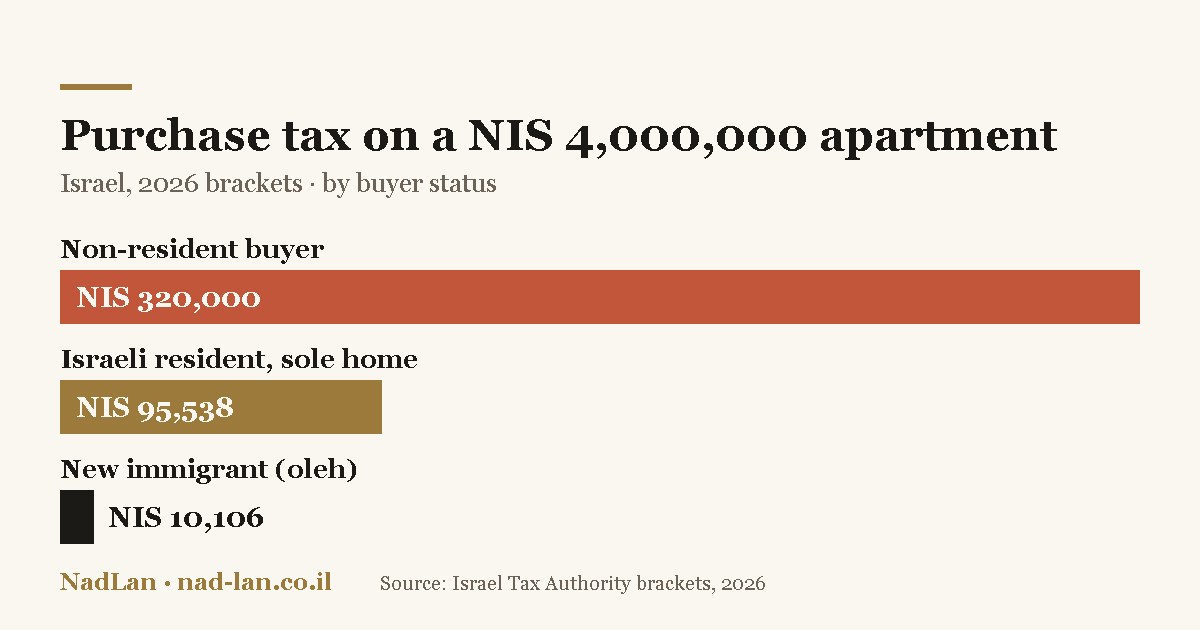
For the non-resident track, the arithmetic is simple because the entire NIS 4,000,000 purchase price is below NIS 6,055,070. The buyer pays 8% on the full NIS 4,000,000, which equals NIS 320,000. That calculation follows the foreign-resident bracket in force January 16, 2024 through December 31, 2026, according to the official Kol Zchut guide checked July 2026.
For the Israeli-resident sole-home track, the same NIS 4,000,000 apartment is split across the resident brackets frozen January 16, 2024 to January 15, 2028, according to the official Kol Zchut guide checked July 2026. The buyer pays NIS 0 on the first NIS 1,978,745, then NIS 12,890 at 3.5% on the next NIS 368,295, then NIS 82,648 at 5% on the remaining NIS 1,652,960. The total is NIS 95,538.
For a new immigrant under regulation 12A, the same NIS 4,000,000 apartment can produce a much lower tax bill if the conditions are met. Under the rule for aliyah from August 15, 2024, on a single home the oleh will live in, the buyer pays NIS 0 up to NIS 1,978,745 and 0.5% on the remaining NIS 2,021,255, for a total of NIS 10,106. The source is the gov.il announcement of July 29, 2024 and Ministry of Aliyah and Integration page updated November 14, 2024.
| Status | Calculation | Total tax |
|---|---|---|
| Non-resident buyer | 8% on the full NIS 4,000,000, using the foreign-resident brackets in force January 16, 2024 through December 31, 2026 via Kol Zchut, checked July 2026 | NIS 320,000 |
| Israeli-resident sole-home buyer | NIS 0 on NIS 1,978,745; NIS 12,890 at 3.5% on NIS 368,295; NIS 82,648 at 5% on NIS 1,652,960, using resident brackets frozen January 16, 2024 to January 15, 2028 via Kol Zchut, checked July 2026 | NIS 95,538 |
| New immigrant under regulation 12A | NIS 0 up to NIS 1,978,745, then 0.5% on NIS 2,021,255, under the gov.il announcement of July 29, 2024 and Ministry of Aliyah and Integration page updated November 14, 2024 | NIS 10,106 |
The gap is the point. On this NIS 4,000,000 apartment, the non-resident pays NIS 224,462 more than a sole-home resident and NIS 309,894 more than an oleh under regulation 12A, using the official bracket calculations described above and checked July 2026. If the buyer is close to Aliyah, returning residency or Israeli-resident status, this is not a side issue. It is a transaction decision.
For your own price, use the purchase tax calculator before sending an offer. Do not wait until the lawyer sends the tax estimate. The buyer needs to know the total cash needed for contract payments, tax, equity transfer and bank requirements before signing.
Aliyah and returning-resident tracks
Aliyah planning can change the tax result if the buyer qualifies for the relevant track and meets the conditions. The major special rule in this guide is regulation 12A. For aliyah from August 15, 2024, a new immigrant buying a single home they will live in pays 0% up to NIS 1,978,745 based on the 2024 index, 0.5% from there to NIS 6 million, and regular sole-home rates above NIS 6 million. The source is the gov.il announcement of July 29, 2024 and Ministry of Aliyah and Integration page updated November 14, 2024.
The words single home they will live in matter. The benefit is not a general discount for every asset a new immigrant may want to buy. It is a tax track tied to the home, the buyer's Aliyah status and intended residential use. A buyer who is comparing investment property, family-use property and future residence should separate those use cases before signing.
A foreign buyer who becomes an Israeli resident or returning resident can qualify retroactively for the sole-home brackets. The baseline window is two years from the purchase. For purchases signed between February 28, 2024 and May 30, 2026, it was extended to 27 months from purchase or August 31, 2026, whichever is later, under the war-related extension. The source is the Kol Zchut purchase tax guide, checked July 2026.
Returning-resident planning is not only a tax label. The buyer has to understand whether they can meet the residency condition in time, how the family unit is treated, whether another home affects the sole-home position, and which declarations will be made. A buyer who signs first and asks later may lose options that could have been structured correctly in advance.
| Status track | What the buyer pays | Key condition | Source and date |
|---|---|---|---|
| Foreign resident | 8% up to NIS 6,055,070 and 10% above NIS 6,055,070 | Buyer is not buying as an Israeli-resident sole-home buyer | Israel Tax Authority rates via Kol Zchut, in force January 16, 2024 through December 31, 2026, checked July 2026 |
| Become-resident within window | Can qualify retroactively for the Israeli-resident sole-home brackets | Baseline window is two years from purchase; for purchases signed between February 28, 2024 and May 30, 2026, extended to 27 months from purchase or August 31, 2026, whichever is later | Kol Zchut purchase tax guide, checked July 2026 |
| Returning resident | Can qualify retroactively for the Israeli-resident sole-home brackets if conditions are met | Resident status and sole-home conditions must be reviewed before signing | Kol Zchut purchase tax guide, checked July 2026 |
| New immigrant under regulation 12A | 0% up to NIS 1,978,745, 0.5% from there to NIS 6 million, regular sole-home rates above NIS 6 million | Aliyah from August 15, 2024, single home the buyer will live in | gov.il announcement July 29, 2024; Ministry of Aliyah and Integration page updated November 14, 2024 |
Mixed-status families should not guess. One spouse may be an Israeli resident, another may be foreign, and the family may already hold property abroad or in Israel. The family unit rule can pull facts together in a way the buyer did not expect. Before relying on a lower track, ask an Israeli real estate tax advisor to review the family status, ownership history and timing.
Resident vs non-resident: who counts
The purchase-tax question is not only what passport the buyer holds. It is how the buyer is treated for the relevant Israeli purchase-tax track at the time of the transaction and under any applicable become-resident or returning-resident rule. A foreign passport does not automatically block every benefit, and an emotional connection to Israel does not automatically create the resident bracket. The legal status has to be checked.
The family unit rule is one of the practical traps. A buyer, their spouse living with them and their minor unmarried children are treated as one purchaser, so a home owned by one spouse counts for both. This can affect whether the purchase is treated as a sole home or not. It can also complicate planning when one spouse has Israeli status and the other does not.
Mixed-status couples need individual review before signing. If one buyer is an Israeli resident and the other is foreign, the result can depend on the facts: marital status, residence, existing homes, intended use, timing, family unit treatment and the declarations made to the Land Taxation office. A tax result that looks obvious from one fact may change once the whole family picture is reviewed.
Another common mistake is assuming that the Israeli Tax Authority and the bank use the same categories. They do not necessarily ask the same question. A buyer may be treated one way for mortgage LTV and another way for purchase tax. For a clean budget, tax status, bank treatment and residency plan should be reviewed together before the contract is signed.
Foreign buyers should also think about proof. If the plan depends on becoming an Israeli resident or returning resident within the allowed window, the buyer should know what documents will be needed, who will file them, and how the refund or adjustment process is handled. Planning is useful only if the facts can be documented.
How and when the tax is paid
Purchase tax timing is strict. The buyer files a declaration, form 7000, with the Land Taxation office within 30 days of the transaction day, and pays the purchase tax by self-assessment within 60 days of the transaction day. The transaction day is the contract signing date, not the delivery date. The sources are the gov.il form 7000 service page and Kol Zchut payment-of-purchase-tax page, checked July 2026.
In practice, the buyer's lawyer usually files the declaration through the online reporting system. The buyer still needs to understand the timing and the cash requirement. If the tax is not paid on time, late declaration can trigger fines and late payment carries interest and linkage. This is a cash-flow issue, not just an administrative issue.
The tax is also connected to registration. A tax payment confirmation is needed for Tabu registration, so the tax is a condition for registering the purchase. A buyer who delays the payment can delay the legal completion of registration. For a foreign buyer, that can become especially uncomfortable if the buyer is abroad, documents are being signed by power of attorney and the bank is also waiting for closing confirmations.
When buying from a developer, the purchase price for tax includes VAT. That matters because new-construction contracts often show a price that already includes VAT, and the tax is calculated on the purchase price used for the transaction. If the buyer is comparing developer projects, the tax computation should be part of the project comparison before looking at current new projects.
The equity transfer should also be planned in advance. Foreign buyers should budget the tax as part of the equity because Israeli banks do not finance the tax bill. Anti-money-laundering checks may apply to the equity portion transferred from abroad, and payment deadlines do not wait for a foreign bank to move slowly. For the money path, read transferring money to Israel for a property purchase.
A practical purchase file should therefore include a tax calendar. Put the signing date, the declaration deadline, the self-assessment payment deadline, the expected mortgage drawdown date and the equity-transfer date in one place. If one piece moves, the buyer should know which other obligation is affected.
FAQ: purchase tax for foreign buyers
How much is purchase tax in Israel for foreigners?
Foreign residents pay 8% on the part of the price up to NIS 6,055,070 and 10% on the part above NIS 6,055,070. These brackets are in force January 16, 2024 through December 31, 2026, according to Israel Tax Authority rates via Kol Zchut, checked July 2026.
The tax starts from the first shekel. A foreign buyer should calculate it before signing, because Israeli banks do not finance the tax bill and the money must be available as part of the buyer's equity.
Do foreigners pay more purchase tax than Israelis?
Usually yes, when compared with an Israeli-resident sole-home buyer. The resident sole-home brackets frozen January 16, 2024 to January 15, 2028 start at 0% up to NIS 1,978,745, while the foreign-resident track starts at 8%, according to Kol Zchut, checked July 2026.
The difference depends on price and status. A foreign buyer who becomes an Israeli resident or returning resident may be able to qualify retroactively for the resident sole-home brackets if the conditions and timing are met.
Can I get the purchase tax back if I make Aliyah after buying?
Possibly. A buyer who becomes an Israeli resident or returning resident can qualify retroactively for the sole-home brackets. The baseline window is two years from purchase, with the war-related extension for purchases signed between February 28, 2024 and May 30, 2026, according to Kol Zchut, checked July 2026.
New immigrants may also have the regulation 12A track for a single home they will live in, under the gov.il announcement of July 29, 2024 and Ministry of Aliyah and Integration page updated November 14, 2024. Get status advice before signing.
When do I have to pay the purchase tax?
The buyer files form 7000 with the Land Taxation office within 30 days of the transaction day and pays purchase tax by self-assessment within 60 days of the transaction day. The transaction day is the contract signing date, according to the gov.il form 7000 page and Kol Zchut payment page, checked July 2026.
Your lawyer usually files online, but the buyer must have the funds ready. Late declaration can trigger fines, late payment carries interest and linkage, and tax confirmation is needed for Tabu registration.
Does buying with an Israeli-resident spouse change the tax?
It can, but the answer is case-specific. The family unit rule treats a buyer, their spouse living with them and their minor unmarried children as one purchaser. A home owned by one spouse counts for both, and mixed-status couples need individual legal review before signing.
Do not rely on a general answer from a friend or broker. A mixed-status purchase should be reviewed against resident status, existing homes, family-unit treatment, intended use and the declarations that will be filed.
Sources
- Israel Tax Authority real estate taxation portal
- Purchase tax simulator
- Kol Zchut purchase tax pages
- Ministry of Aliyah and Integration purchase tax discount page
- Form 7000 service page
- Chief Economist residential review March 2026
Next step: calculate the tax for the exact contract price, then ask your lawyer or tax advisor to confirm the buyer-status track before the purchase agreement is signed.
This guide is general information, not legal or tax advice. Every transaction requires its own review of the specific facts. For an initial consultation on a purchase in Israel, contact the office.