קטגוריה: English

English-language guides for foreign buyers

  • Affordable Apartments in Israel 2026: Where 690,000 Shekels Still Buys a Full 3-Room Home

    Affordable Apartments in Israel 2026: Where 690,000 Shekels Still Buys a Full 3-Room Home

    A 3-room, 67 square meter apartment on the 5th floor of an elevator building just changed hands for 690,000 shekels, roughly 187,000 US dollars, in Beer Sheva, southern Israel. The sale, reported in Maariv's real estate review, captures something most international coverage of Israeli property misses entirely: while Tel Aviv averages over a million dollars per apartment, whole functioning homes in Israel's south still trade below the price of a parking spot in Manhattan. This article breaks the deal down with full tables: price per square meter city by city, rental yields, the mortgage math, exactly what a foreign buyer pays in purchase tax, and why urban renewal could reshape these numbers. If you are researching an affordable entry into Israeli real estate, start here.

    The deal, and the two-market reality behind it

    The apartment sits in one of Beer Sheva's established older neighborhoods: 67 sqm, three rooms (which in Israeli terms means two bedrooms plus a living room), two balconies, an elevator, fifth floor of eight. Comparable transactions have been recorded in the city repeatedly in recent months, including a 3-room sale at 665,000 shekels.

    Israel in 2026 effectively runs two housing markets in parallel. The center, even after the cooling we analyzed in our buyer's market review (published in Hebrew), remains among the most expensive urban markets in the world. The southern periphery trades at a fraction of those prices, with materially higher rental yields. Understanding which market you are actually buying into is the single most important decision, before any specific property.

    Table 1: What 690,000 shekels buys, city by city

    We divided the money by the average price per square meter in each area. Central figures draw on citywide transaction averages and on the new-build prices we track in our projects catalog, including the Sde Dov luxury quarter:

    Location Avg price per sqm (estimate) What 690,000 ILS buys
    Beer Sheva (the reported deal) ~10,300 ILS (~$2,780) A complete 67 sqm 3-room apartment with elevator
    Haifa (city average) ~21,500 ILS (~$5,800) ~32 sqm, a small 1.5-room flat
    Tel Aviv (city average) ~49,000 ILS (~$13,200) ~14 sqm, a single bedroom
    Tel Aviv, Sde Dov new-builds 62,000-81,000 ILS ~9-11 sqm, a bathroom

    Same money, entirely different products: a complete home in the south, or a bathroom's worth of floor area in a Tel Aviv luxury tower. Neither is wrong. They serve different goals, and mixing them up is the most common mistake foreign buyers make.

    Table 2: Average apartment prices in Israel's major cities

    Based on Q4 2025 transaction data reported by Ynet and Israeli data services (USD at ~3.7 ILS):

    City Avg apartment price (Q4 2025) In USD (approx) vs the deal
    Tel Aviv ~4,160,000 ILS ~$1,124,000 6.0x
    Haifa ~1,830,000 ILS ~$495,000 2.7x
    Beer Sheva ~1,280,000 ILS ~$346,000 1.9x
    The reported deal 690,000 ILS ~$187,000 1.0x

    Read the last column carefully: one average Tel Aviv apartment equals six apartments like the reported deal. That arithmetic is what pushes yield-focused investors south, but the yield side deserves its own honest table.

    Table 3: Rental yields, computed from real rents

    Average monthly rents for 3-room apartments, per current Israeli rental surveys: 3,200 ILS in Beer Sheva, 3,450 in Haifa, 6,718 in Tel Aviv. Annual rent divided by price gives gross yield, before costs, tax and vacancies:

    City Avg monthly rent, 3 rooms Apartment price Gross annual yield (est.)
    Beer Sheva 3,200 ILS 690,000 ILS (deal) ~5.6%
    Haifa 3,450 ILS ~1,830,000 ILS ~2.3%
    Tel Aviv 6,718 ILS ~4,160,000 ILS ~1.9%

    A 5.6% gross yield is nearly triple Tel Aviv's. The trade-off is real: central Israel has historically stronger appreciation and deeper liquidity, while older peripheral buildings carry higher maintenance and tenant-turnover risk. Serious buyers model both scenarios, ideally with a licensed appraiser who knows the specific neighborhood.

    Table 4: Purchase tax, where foreign buyers must pay attention

    Israel taxes property purchases on a progressive scale that treats resident first-home buyers, investors and non-residents very differently. On a 690,000 ILS purchase:

    Buyer type Purchase tax on 690,000 ILS (est.) Note
    Israeli resident, only home 0 ILS Price is below the exempt bracket
    Israeli investor (2nd home+) 55,200 ILS 8% from the first shekel
    Non-resident foreign buyer 55,200 ILS (~$14,900) 8% from the first shekel

    The full brackets, worked examples at higher price points and the special rules for new immigrants are covered in our complete guide to Israeli purchase tax for foreign residents, and you can run your own numbers in the purchase tax calculator. Budget also for legal fees, appraisal and translation costs; the full transaction cost calculator aggregates them.

    The mortgage math: when owning beats renting

    At 25% down (172,500 ILS, about $46,600) and a 30-year mortgage at an illustrative 5% annual rate, the monthly payment on the reported deal comes to roughly 2,800 ILS. That is below the 3,200 ILS average rent for the same apartment type in the same city. On pure monthly cash flow, owning this apartment costs less than renting it, a relationship that inverted years ago in central Israel, where the payment on an average Tel Aviv apartment runs about 2.5 times its achievable rent.

    Non-resident buyers face different loan-to-value caps and documentation requirements at Israeli banks, typically financing 50% rather than 75%. The full picture, banks, rates, the approval process and a document checklist, is in our dedicated guide to getting an Israeli mortgage as a non-resident, and the mortgage calculator accepts any equity structure.

    Urban renewal: the variable that could rewrite these prices

    Beer Sheva's older neighborhoods are increasingly covered by urban renewal programs. Israel's updated pinui-binui framework (demolish-and-rebuild) now requires consent from only 67% of a building's owners, and the government's incentive structure deliberately favors peripheral cities. An older apartment bought today inside a declared renewal compound can eventually be exchanged for a brand-new unit in a modern tower, a materially different asset.

    Our catalog, built from official government registries, tracks hundreds of pinui-binui compounds nationwide and the full projects database. Checking whether a specific building sits inside a declared compound is a five-minute step that can change the entire investment thesis.

    How to approach a purchase like this from abroad

    • Verify title. A clean land-registry extract (nesach tabu) is non-negotiable, and it is in Hebrew: work with an independent Israeli real estate lawyer representing you, not the seller.
    • Inspect the building, not just the unit. In decades-old buildings, a professional structural inspection is the best money in the deal.
    • Appraise before you commit. A local licensed appraiser confirms the price reflects the market rather than a hidden defect.
    • Plan currency and financing early. Transfer timing and bank pre-approval shape your real cost; our non-resident mortgage guide covers the sequence.
    • Start with the full picture. Our complete 2026 guide for foreign buyers walks the entire process, and the English hub gathers projects and tools in one place.

    One budget, three different strategies

    The same 690,000 shekels can play three different roles in an Israeli property plan, and they behave nothing alike:

    Strategy What $187,000 becomes Capital required Monthly cash flow profile
    Full ownership, south A complete 3-room apartment ~$46,600 equity (75% loan) or all cash Positive from day one at market rent
    25% down payment, center A quarter of a ~$750,000 Gush Dan apartment ~$187,000 equity Deeply negative monthly cash flow
    Split strategy Southern apartment + liquidity reserve ~$46,600 + reserve Positive, with a safety cushion

    Yield-focused buyers usually land on the first or third row; appreciation-focused buyers on the second, accepting negative carry as the price of Tel Aviv exposure. The mistake is drifting between strategies mid-purchase. Decide first, then shop, and pressure-test every scenario in the mortgage calculator and value estimator.

    The currency dimension foreign buyers underestimate

    Every figure in this article moves with the shekel-dollar rate. At 3.7 ILS to the dollar the deal costs about $187,000; a five percent currency swing shifts your effective price by nearly $10,000 before you have negotiated a single shekel. Practical implications: agree with your bank or a licensed transfer service on the conversion mechanics BEFORE signing a contract with fixed shekel milestones; keep a shekel buffer for taxes and fees so a rate move does not force a rushed conversion; and remember that rental income arrives in shekels, which is a natural hedge if your costs are in shekels too but an open currency position if you measure returns in dollars or euros. Israeli banks also apply enhanced verification to inbound property transfers, so the money trail documentation (source of funds, tax residency forms) is worth preparing in parallel with the property search, not after it.

    The process from abroad, step by step

    A realistic sequence for a purchase like this, without flying in more than once:

    1. Define the strategy and budget (this article's tables are the starting point), then get bank pre-approval terms in writing; non-residents typically finance up to 50%.
    2. Retain an independent Israeli real estate lawyer early. They will verify the land-registry extract, draft a power of attorney so you can sign remotely, and hold funds in escrow. Choose from the verified directory.
    3. Shortlist remotely. Listings and projects on the board and in the projects catalog carry the data these tables are built from; our English hub concentrates the English-ready material.
    4. Inspect and appraise locally through a structural inspector and a licensed appraiser; both produce written reports you can read before wiring anything.
    5. Sign, register a caution note (he'arat azhara), pay purchase tax within the statutory window, then complete registration. Your lawyer drives this; your job is to have the funds and forms ready.
    6. Set up management if renting out: a local manager typically costs one month's rent per year and turns a 5.6% gross yield into a genuinely passive net figure.

    What this deal says about Israel's 2026 market

    Three larger currents run through this single transaction. First, Israel's affordability gap has widened into two distinct markets, and the periphery is where first-time buyers and yield investors still clear the math. Second, the country's updated urban renewal framework, which lowered the owner-consent threshold to 67%, is aimed squarely at cities like Beer Sheva, meaning today's cheapest stock is also tomorrow's redevelopment pipeline. Third, developer inventory nationwide sits at record levels, which strengthens buyers in new-build negotiations too, a dynamic we covered for Hebrew readers and that applies equally to foreign purchasers negotiating through counsel. For the deeper foundations, start with the complete foreign buyer's guide and the purchase tax deep dive.

    Can I complete the entire purchase without visiting Israel?

    Legally yes, through a notarized and apostilled power of attorney held by your Israeli lawyer. Practically, one visit for the inspection stage is money well spent, especially for older buildings where condition varies dramatically between properties that look identical on paper.

    How liquid is an apartment like this if I need to sell?

    Less liquid than central Israel: marketing times in peripheral cities run longer and the buyer pool is thinner. Price realistically against recent registered transactions (your appraiser will pull them) and treat this as a multi-year hold, not a trading position.

    Frequently asked questions

    Can foreigners really buy apartments in Israel at these prices?

    Yes. There are no citizenship restrictions on buying Israeli residential property. Apartments in the 600,000-700,000 ILS range (roughly $160,000-190,000) trade regularly in southern cities such as Beer Sheva, as documented in the Israeli financial press.

    What taxes does a foreign buyer pay on a 690,000 ILS apartment?

    Purchase tax of 8% from the first shekel, about 55,200 ILS ($14,900), since non-residents do not receive the resident first-home exemption. Ongoing municipal tax applies; rental income is taxable in Israel with treaty relief in many home countries. Details and worked examples are in our purchase tax guide.

    What rental yield should I expect?

    At average rents, roughly 5.6% gross annually on the reported deal, before expenses, management and vacancy. Net yields run meaningfully lower; a local appraiser and property manager can turn this into a realistic projection for a specific street.

    Is the south riskier than Tel Aviv?

    Different, rather than simply riskier: lower entry price and higher yield, against slower historical appreciation, thinner resale liquidity and older building stock. Urban renewal programs are the main upside variable. Model both markets before choosing.

    This article is general information, not investment, tax or legal advice. Figures are non-binding estimates from cited public sources and the NadLan catalog. Sources: Maariv, Ynet.

  • Israel Purchase Tax (Mas Rechisha) for Foreign Residents: 2026 Brackets

    Israel Purchase Tax (Mas Rechisha) for Foreign Residents: 2026 Brackets

    Non-residents pay Israeli purchase tax from the first shekel. There is no exempt bracket like the one Israeli residents get on a single home. The 2026 brackets for foreign buyers start at 8% and climb to 10%, which on a Tel Aviv apartment can mean hundreds of thousands of shekels. Here are the exact brackets, the legal ways families reduce them (Aliyah benefits, becoming a resident), and the calculator to run your own number.

    The 2026 brackets for non-residents

    For a foreign buyer, purchase tax is not a rounding error. It is one of the largest cash items in the transaction and it must be budgeted before making an offer. The tax is paid by the buyer, calculated on the purchase price, and handled separately from the mortgage. A foreign buyer who has enough equity for the down payment but not enough cash for the tax bill can still run into a closing problem.

    The rule for foreign residents is direct. A foreign resident, and anyone not buying a sole home as an Israeli resident, pays 8% on the part of the price up to NIS 6,055,070 and 10% on the part above NIS 6,055,070. Those brackets are in force from January 16, 2024 through December 31, 2026, according to Israel Tax Authority rates via the official Kol Zchut guide, checked July 2026.

    An Israeli-resident sole-home buyer is in a different bracket system. The sole-home brackets are frozen from January 16, 2024 to January 15, 2028: 0% up to NIS 1,978,745; 3.5% up to NIS 2,347,040; 5% up to NIS 6,055,070; 8% up to NIS 20,183,565; and 10% above NIS 20,183,565, according to Israel Tax Authority rates via the official Kol Zchut guide, checked July 2026.

    This is the first reason a foreign buyer should compute tax before negotiating price. A small change in price can matter, but the larger issue is status. The same apartment can produce a very different tax bill depending on whether the buyer is treated as a foreign resident, an Israeli-resident sole-home buyer, a returning resident, or a new immigrant under the special Aliyah track.

    Buyer track Price bracket Purchase tax rate Source and date
    Foreign resident, and anyone not buying a sole home as an Israeli resident Part of the price up to NIS 6,055,070 8% Israel Tax Authority rates via Kol Zchut, in force January 16, 2024 through December 31, 2026, checked July 2026
    Foreign resident, and anyone not buying a sole home as an Israeli resident Part of the price above NIS 6,055,070 10% Israel Tax Authority rates via Kol Zchut, in force January 16, 2024 through December 31, 2026, checked July 2026
    Israeli-resident sole-home buyer Up to NIS 1,978,745 0% Israel Tax Authority rates via Kol Zchut, frozen January 16, 2024 to January 15, 2028, checked July 2026
    Israeli-resident sole-home buyer Above NIS 1,978,745 and up to NIS 2,347,040 3.5% Israel Tax Authority rates via Kol Zchut, frozen January 16, 2024 to January 15, 2028, checked July 2026
    Israeli-resident sole-home buyer Above NIS 2,347,040 and up to NIS 6,055,070 5% Israel Tax Authority rates via Kol Zchut, frozen January 16, 2024 to January 15, 2028, checked July 2026
    Israeli-resident sole-home buyer Above NIS 6,055,070 and up to NIS 20,183,565 8% Israel Tax Authority rates via Kol Zchut, frozen January 16, 2024 to January 15, 2028, checked July 2026
    Israeli-resident sole-home buyer Above NIS 20,183,565 10% Israel Tax Authority rates via Kol Zchut, frozen January 16, 2024 to January 15, 2028, checked July 2026

    Budgeting for tax also affects financing. Foreign buyers should budget the purchase tax as part of the equity, since Israeli banks do not finance the tax bill. The mortgage conversation should therefore happen after tax is modeled, not before. For the lending side, read getting an Israeli mortgage as a non-resident alongside the broader complete guide to buying property in Israel as a foreign buyer.

    Market context should not drive the tax calculation, but it explains why this issue matters commercially: the Finance Ministry Chief Economist review for March 2026, published May 13, 2026, counted 487 foreign-resident purchases in Q1 2026, an 18% rise year over year.

    Worked example: a NIS 4 million apartment

    The cleanest way to understand Mas Rechisha is to run the same apartment through each track. The example below uses a NIS 4,000,000 apartment and applies the official brackets described above, using Israel Tax Authority rates via Kol Zchut checked July 2026, plus the new-immigrant rule under regulation 12A sourced to the gov.il announcement of July 29, 2024 and Ministry of Aliyah and Integration page updated November 14, 2024.

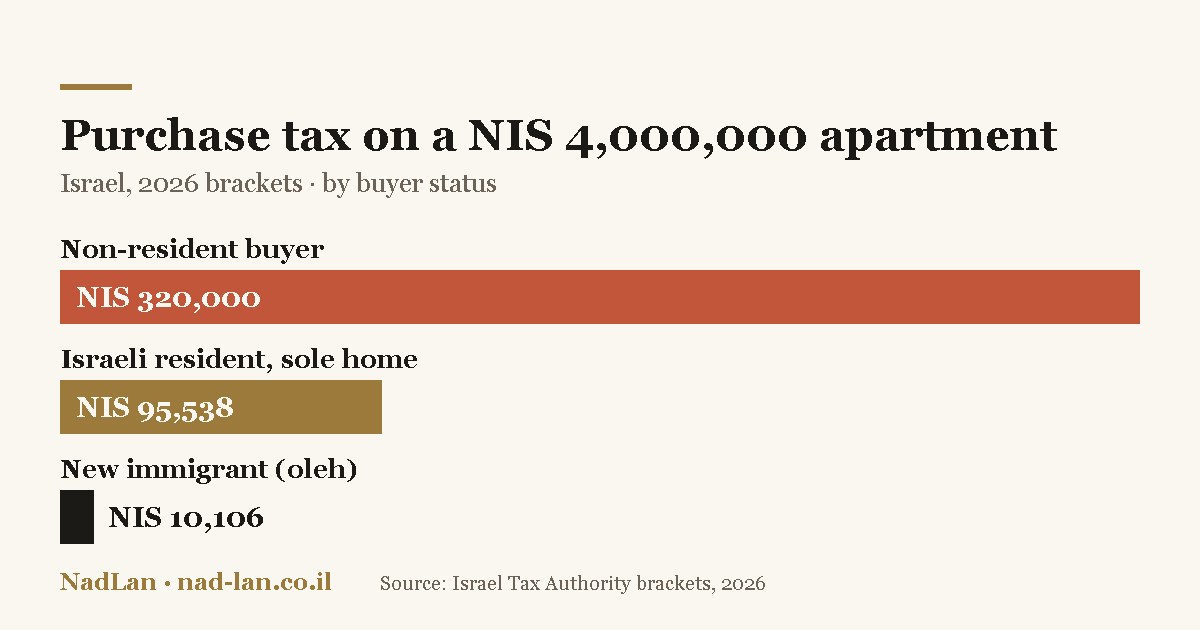
    For the non-resident track, the arithmetic is simple because the entire NIS 4,000,000 purchase price is below NIS 6,055,070. The buyer pays 8% on the full NIS 4,000,000, which equals NIS 320,000. That calculation follows the foreign-resident bracket in force January 16, 2024 through December 31, 2026, according to the official Kol Zchut guide checked July 2026.

    For the Israeli-resident sole-home track, the same NIS 4,000,000 apartment is split across the resident brackets frozen January 16, 2024 to January 15, 2028, according to the official Kol Zchut guide checked July 2026. The buyer pays NIS 0 on the first NIS 1,978,745, then NIS 12,890 at 3.5% on the next NIS 368,295, then NIS 82,648 at 5% on the remaining NIS 1,652,960. The total is NIS 95,538.

    For a new immigrant under regulation 12A, the same NIS 4,000,000 apartment can produce a much lower tax bill if the conditions are met. Under the rule for aliyah from August 15, 2024, on a single home the oleh will live in, the buyer pays NIS 0 up to NIS 1,978,745 and 0.5% on the remaining NIS 2,021,255, for a total of NIS 10,106. The source is the gov.il announcement of July 29, 2024 and Ministry of Aliyah and Integration page updated November 14, 2024.

    Status Calculation Total tax
    Non-resident buyer 8% on the full NIS 4,000,000, using the foreign-resident brackets in force January 16, 2024 through December 31, 2026 via Kol Zchut, checked July 2026 NIS 320,000
    Israeli-resident sole-home buyer NIS 0 on NIS 1,978,745; NIS 12,890 at 3.5% on NIS 368,295; NIS 82,648 at 5% on NIS 1,652,960, using resident brackets frozen January 16, 2024 to January 15, 2028 via Kol Zchut, checked July 2026 NIS 95,538
    New immigrant under regulation 12A NIS 0 up to NIS 1,978,745, then 0.5% on NIS 2,021,255, under the gov.il announcement of July 29, 2024 and Ministry of Aliyah and Integration page updated November 14, 2024 NIS 10,106

    The gap is the point. On this NIS 4,000,000 apartment, the non-resident pays NIS 224,462 more than a sole-home resident and NIS 309,894 more than an oleh under regulation 12A, using the official bracket calculations described above and checked July 2026. If the buyer is close to Aliyah, returning residency or Israeli-resident status, this is not a side issue. It is a transaction decision.

    For your own price, use the purchase tax calculator before sending an offer. Do not wait until the lawyer sends the tax estimate. The buyer needs to know the total cash needed for contract payments, tax, equity transfer and bank requirements before signing.

    Aliyah and returning-resident tracks

    Aliyah planning can change the tax result if the buyer qualifies for the relevant track and meets the conditions. The major special rule in this guide is regulation 12A. For aliyah from August 15, 2024, a new immigrant buying a single home they will live in pays 0% up to NIS 1,978,745 based on the 2024 index, 0.5% from there to NIS 6 million, and regular sole-home rates above NIS 6 million. The source is the gov.il announcement of July 29, 2024 and Ministry of Aliyah and Integration page updated November 14, 2024.

    The words single home they will live in matter. The benefit is not a general discount for every asset a new immigrant may want to buy. It is a tax track tied to the home, the buyer's Aliyah status and intended residential use. A buyer who is comparing investment property, family-use property and future residence should separate those use cases before signing.

    A foreign buyer who becomes an Israeli resident or returning resident can qualify retroactively for the sole-home brackets. The baseline window is two years from the purchase. For purchases signed between February 28, 2024 and May 30, 2026, it was extended to 27 months from purchase or August 31, 2026, whichever is later, under the war-related extension. The source is the Kol Zchut purchase tax guide, checked July 2026.

    Returning-resident planning is not only a tax label. The buyer has to understand whether they can meet the residency condition in time, how the family unit is treated, whether another home affects the sole-home position, and which declarations will be made. A buyer who signs first and asks later may lose options that could have been structured correctly in advance.

    Status track What the buyer pays Key condition Source and date
    Foreign resident 8% up to NIS 6,055,070 and 10% above NIS 6,055,070 Buyer is not buying as an Israeli-resident sole-home buyer Israel Tax Authority rates via Kol Zchut, in force January 16, 2024 through December 31, 2026, checked July 2026
    Become-resident within window Can qualify retroactively for the Israeli-resident sole-home brackets Baseline window is two years from purchase; for purchases signed between February 28, 2024 and May 30, 2026, extended to 27 months from purchase or August 31, 2026, whichever is later Kol Zchut purchase tax guide, checked July 2026
    Returning resident Can qualify retroactively for the Israeli-resident sole-home brackets if conditions are met Resident status and sole-home conditions must be reviewed before signing Kol Zchut purchase tax guide, checked July 2026
    New immigrant under regulation 12A 0% up to NIS 1,978,745, 0.5% from there to NIS 6 million, regular sole-home rates above NIS 6 million Aliyah from August 15, 2024, single home the buyer will live in gov.il announcement July 29, 2024; Ministry of Aliyah and Integration page updated November 14, 2024

    Mixed-status families should not guess. One spouse may be an Israeli resident, another may be foreign, and the family may already hold property abroad or in Israel. The family unit rule can pull facts together in a way the buyer did not expect. Before relying on a lower track, ask an Israeli real estate tax advisor to review the family status, ownership history and timing.

    Resident vs non-resident: who counts

    The purchase-tax question is not only what passport the buyer holds. It is how the buyer is treated for the relevant Israeli purchase-tax track at the time of the transaction and under any applicable become-resident or returning-resident rule. A foreign passport does not automatically block every benefit, and an emotional connection to Israel does not automatically create the resident bracket. The legal status has to be checked.

    The family unit rule is one of the practical traps. A buyer, their spouse living with them and their minor unmarried children are treated as one purchaser, so a home owned by one spouse counts for both. This can affect whether the purchase is treated as a sole home or not. It can also complicate planning when one spouse has Israeli status and the other does not.

    Mixed-status couples need individual review before signing. If one buyer is an Israeli resident and the other is foreign, the result can depend on the facts: marital status, residence, existing homes, intended use, timing, family unit treatment and the declarations made to the Land Taxation office. A tax result that looks obvious from one fact may change once the whole family picture is reviewed.

    Another common mistake is assuming that the Israeli Tax Authority and the bank use the same categories. They do not necessarily ask the same question. A buyer may be treated one way for mortgage LTV and another way for purchase tax. For a clean budget, tax status, bank treatment and residency plan should be reviewed together before the contract is signed.

    Foreign buyers should also think about proof. If the plan depends on becoming an Israeli resident or returning resident within the allowed window, the buyer should know what documents will be needed, who will file them, and how the refund or adjustment process is handled. Planning is useful only if the facts can be documented.

    How and when the tax is paid

    Purchase tax timing is strict. The buyer files a declaration, form 7000, with the Land Taxation office within 30 days of the transaction day, and pays the purchase tax by self-assessment within 60 days of the transaction day. The transaction day is the contract signing date, not the delivery date. The sources are the gov.il form 7000 service page and Kol Zchut payment-of-purchase-tax page, checked July 2026.

    In practice, the buyer's lawyer usually files the declaration through the online reporting system. The buyer still needs to understand the timing and the cash requirement. If the tax is not paid on time, late declaration can trigger fines and late payment carries interest and linkage. This is a cash-flow issue, not just an administrative issue.

    The tax is also connected to registration. A tax payment confirmation is needed for Tabu registration, so the tax is a condition for registering the purchase. A buyer who delays the payment can delay the legal completion of registration. For a foreign buyer, that can become especially uncomfortable if the buyer is abroad, documents are being signed by power of attorney and the bank is also waiting for closing confirmations.

    When buying from a developer, the purchase price for tax includes VAT. That matters because new-construction contracts often show a price that already includes VAT, and the tax is calculated on the purchase price used for the transaction. If the buyer is comparing developer projects, the tax computation should be part of the project comparison before looking at current new projects.

    The equity transfer should also be planned in advance. Foreign buyers should budget the tax as part of the equity because Israeli banks do not finance the tax bill. Anti-money-laundering checks may apply to the equity portion transferred from abroad, and payment deadlines do not wait for a foreign bank to move slowly. For the money path, read transferring money to Israel for a property purchase.

    A practical purchase file should therefore include a tax calendar. Put the signing date, the declaration deadline, the self-assessment payment deadline, the expected mortgage drawdown date and the equity-transfer date in one place. If one piece moves, the buyer should know which other obligation is affected.

    FAQ: purchase tax for foreign buyers

    How much is purchase tax in Israel for foreigners?

    Foreign residents pay 8% on the part of the price up to NIS 6,055,070 and 10% on the part above NIS 6,055,070. These brackets are in force January 16, 2024 through December 31, 2026, according to Israel Tax Authority rates via Kol Zchut, checked July 2026.

    The tax starts from the first shekel. A foreign buyer should calculate it before signing, because Israeli banks do not finance the tax bill and the money must be available as part of the buyer's equity.

    Do foreigners pay more purchase tax than Israelis?

    Usually yes, when compared with an Israeli-resident sole-home buyer. The resident sole-home brackets frozen January 16, 2024 to January 15, 2028 start at 0% up to NIS 1,978,745, while the foreign-resident track starts at 8%, according to Kol Zchut, checked July 2026.

    The difference depends on price and status. A foreign buyer who becomes an Israeli resident or returning resident may be able to qualify retroactively for the resident sole-home brackets if the conditions and timing are met.

    Can I get the purchase tax back if I make Aliyah after buying?

    Possibly. A buyer who becomes an Israeli resident or returning resident can qualify retroactively for the sole-home brackets. The baseline window is two years from purchase, with the war-related extension for purchases signed between February 28, 2024 and May 30, 2026, according to Kol Zchut, checked July 2026.

    New immigrants may also have the regulation 12A track for a single home they will live in, under the gov.il announcement of July 29, 2024 and Ministry of Aliyah and Integration page updated November 14, 2024. Get status advice before signing.

    When do I have to pay the purchase tax?

    The buyer files form 7000 with the Land Taxation office within 30 days of the transaction day and pays purchase tax by self-assessment within 60 days of the transaction day. The transaction day is the contract signing date, according to the gov.il form 7000 page and Kol Zchut payment page, checked July 2026.

    Your lawyer usually files online, but the buyer must have the funds ready. Late declaration can trigger fines, late payment carries interest and linkage, and tax confirmation is needed for Tabu registration.

    Does buying with an Israeli-resident spouse change the tax?

    It can, but the answer is case-specific. The family unit rule treats a buyer, their spouse living with them and their minor unmarried children as one purchaser. A home owned by one spouse counts for both, and mixed-status couples need individual legal review before signing.

    Do not rely on a general answer from a friend or broker. A mixed-status purchase should be reviewed against resident status, existing homes, family-unit treatment, intended use and the declarations that will be filed.

    Sources

    Next step: calculate the tax for the exact contract price, then ask your lawyer or tax advisor to confirm the buyer-status track before the purchase agreement is signed.


    This guide is general information, not legal or tax advice. Every transaction requires its own review of the specific facts. For an initial consultation on a purchase in Israel, contact the office.
  • Getting an Israeli Mortgage as a Non-Resident: Banks, LTV, Rates

    Getting an Israeli Mortgage as a Non-Resident: Banks, LTV, Rates

    Israeli banks do lend to non-residents, but at a maximum of roughly 50% loan-to-value, with income documented abroad and a local bank account opened before the loan. The process differs from a US or European mortgage in ways that surprise buyers: consumer price index linkage on some tracks, mixed fixed-variable structures, and life insurance requirements. This guide covers which banks are active, realistic 2026 rates, and the document checklist.

    LTV: what non-residents can actually borrow

    The first number to understand is the loan-to-value cap. It controls how much of the property price an Israeli bank may finance and how much equity the buyer must bring. For a non-resident, the practical starting point is usually not the same as for an Israeli resident buying a first home. Banks treat non-residents as investors, and that pushes the available financing down.

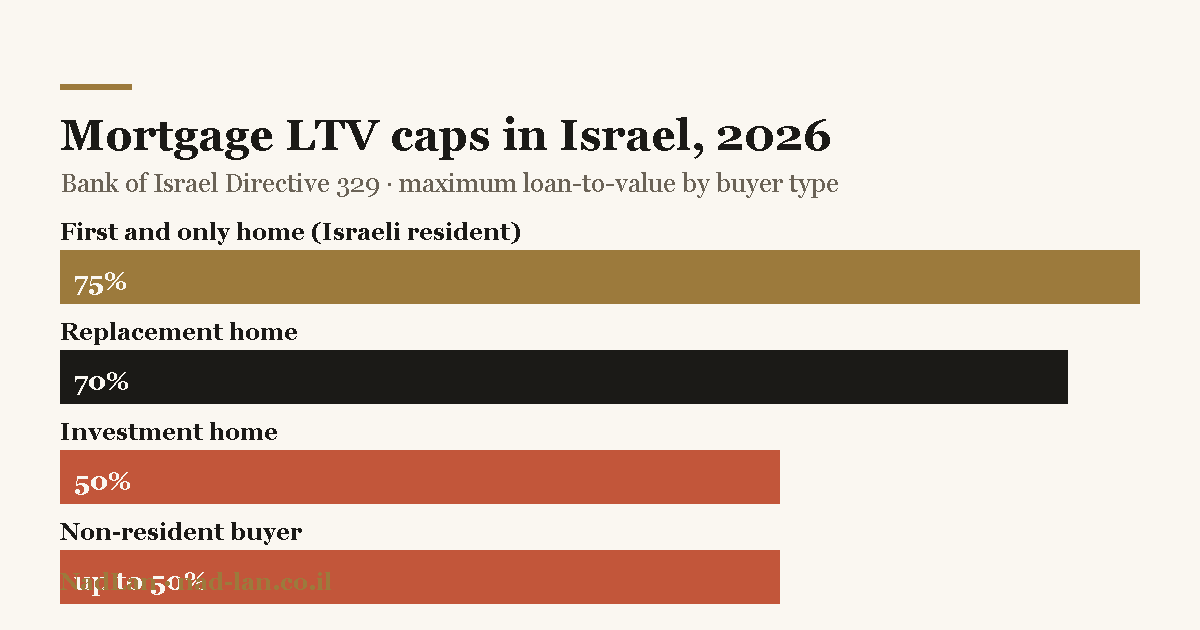
    Under Bank of Israel Proper Conduct of Banking Business Directive 329, the LTV cap is 75% for an Israeli resident's first and only home, 70% for a replacement home, and 50% for an investment home. Banks treat non-residents as investors, so a non-resident mortgage is up to 50% of the lower of the purchase price or the bank's own appraisal, according to Bank of Israel Directive 329, checked July 2026 for this guide.

    The phrase lower of the purchase price or the bank's own appraisal is where buyers get surprised. If the contract price is higher than the bank's valuation, the bank does not have to lend against the contract price. The bank can calculate the loan against its appraisal instead. The buyer then needs more equity, even if the buyer already agreed to pay the seller a higher amount.

    This is why financing should be checked before signing. A buyer who has only modeled a 50% loan against the purchase price may still face a shortfall if the bank valuation comes in lower. That problem is sharper for foreign buyers because the equity portion must also pass source-of-funds checks when transferred from abroad. For the full purchase process around tax, legal checks and registration, read the complete guide to buying property in Israel as a foreign buyer.

    Buyer type LTV cap How the cap is applied Source and date
    Israeli resident, first and only home 75% Applied under the Bank of Israel housing-loan framework Bank of Israel Proper Conduct of Banking Business Directive 329, checked July 2026
    Israeli resident, replacement home 70% Applied under the Bank of Israel housing-loan framework Bank of Israel Proper Conduct of Banking Business Directive 329, checked July 2026
    Investment home 50% Applied under the Bank of Israel housing-loan framework Bank of Israel Proper Conduct of Banking Business Directive 329, checked July 2026
    Non-resident foreign buyer Up to 50% Calculated on the lower of the purchase price or the bank's own appraisal Bank of Israel Proper Conduct of Banking Business Directive 329 and bank treatment of non-residents as investors, checked July 2026

    Mizrahi-Tefahot adds a useful status distinction on its official English mortgage QA page. The bank states that a buyer who is an Israeli citizen or entitled to Israeli citizenship can borrow up to 75% LTV instead of the 50% available to a foreign resident, according to mizrahi-tefahot.co.il, checked July 2026. For future olim and diaspora buyers, this can make status planning part of mortgage planning, not only a tax question.

    Do not confuse mortgage LTV with purchase tax. The bank may treat a non-resident as an investor for financing, while the Tax Authority applies its own purchase-tax rules. The two systems affect the same budget but are not the same rulebook. A buyer should model equity, mortgage size and purchase tax together. For the tax side, read purchase tax for foreign residents before committing to a price.

    The Israeli mortgage tracks explained

    An Israeli mortgage is usually built from tracks rather than one simple fixed-rate loan. A bank may combine fixed non-linked debt, CPI-linked debt, prime-variable debt, variable-rate tracks and sometimes foreign-currency borrowing. The exact mix matters because the lowest initial payment is not always the safest structure. Non-resident buyers need to understand what changes the payment, what changes the outstanding principal and what creates currency exposure.

    The Bank of Israel directives require at least one third of every mortgage at a fixed rate, and the variable-rate portion may not exceed two thirds, according to Bank of Israel banking supervision directives checked July 2026. That rule limits how aggressively a borrower can load the loan with variable-rate exposure. It still leaves a wide range of possible structures, so the buyer has to compare the effect of each track on future payments.

    A fixed non-linked track gives more clarity because the principal is not adjusted by the consumer price index. A fixed CPI-linked track may begin with a lower nominal rate, but the principal is adjusted by inflation. A prime-variable track moves with the bank's prime rate. A variable track that resets periodically can look comfortable at the start but may change later. A foreign-currency mortgage may suit a buyer whose income is in the same currency, but it can create shekel value and repayment risk if the exchange rate moves.

    Track What it means Risk note Rate anchor
    Fixed non-linked Rate is fixed and principal is not linked to the consumer price index More payment clarity, but the initial quoted rate may be higher than a linked alternative Average non-linked mortgage rate stood at about 4.79% in June 2026, per the Bank of Israel average-rate series
    Fixed CPI-linked Rate is fixed, but principal is linked to the consumer price index The balance can rise even while payments are made on time if index linkage increases the principal Weighted average rate on new CPI-linked mortgages was 3.57% in May 2026 data, published June 11, 2026 by the Bank of Israel average-rate series
    Prime-variable Rate moves with the bank prime rate Monthly payment can change when the prime rate changes Prime stood at 5.25% after the May 25, 2026 Bank of Israel decision
    Variable every 5 years Rate is fixed for a period and then resets under the loan terms Payment risk is delayed rather than removed, because the reset can change the cost later Quote depends on the bank and reset terms
    Foreign-currency Loan is connected to a foreign currency rather than only shekels Can match foreign income, but creates currency and benchmark-rate exposure Benchmark rate plus a fixed spread, per the lending bank

    The linkage trap is simple to state and easy to miss. CPI-linked tracks add the inflation adjustment to the principal, so the balance can rise even while payments are made on time. A buyer who focuses only on the opening monthly payment may understate the economic cost. This is especially relevant for non-residents who think in dollars, euros, pounds, Canadian dollars or Australian dollars but repay a shekel mortgage or hold a shekel asset.

    The right track mix depends on income currency, risk tolerance, holding period, prepayment plans and whether the property is for use, rental or future Aliyah. This article does not give a model portfolio because no single track mix is correct for every foreign buyer. The practical discipline is to ask the bank or broker for the payment behavior under each track, not only the first monthly payment.

    Which banks work with foreign buyers

    The large Israeli mortgage lenders active with foreign buyers include Mizrahi-Tefahot, Bank Leumi, Bank Hapoalim, Israel Discount Bank and Bank of Jerusalem. Mizrahi-Tefahot is the largest mortgage bank. Bank of Jerusalem is known as a specialist in foreign residents and foreign-currency loans. A buyer should not assume that every branch or every banker handles non-resident files well. The lender name matters, but the desk handling the file matters too.

    Mizrahi-Tefahot is often a first stop because of its mortgage scale and its English-language materials for overseas buyers. Its official English mortgage QA page states that a buyer who is an Israeli citizen or entitled to Israeli citizenship can borrow up to 75% LTV instead of the 50% available to a foreign resident, according to mizrahi-tefahot.co.il, checked July 2026. That makes the bank's treatment of citizenship or entitlement status a central question for some diaspora buyers.

    Leumi, Hapoalim and Discount are major banks with broad mortgage activity and the ability to underwrite larger files. For a foreign buyer, the issue is not only whether the bank has a mortgage department. It is whether the bank will understand foreign income, accept translated documents, open or coordinate the required Israeli bank account, process anti-money-laundering questions and align the loan timetable with the purchase contract.

    Bank of Jerusalem is especially relevant when foreign-currency borrowing is on the table. Bank of Jerusalem offers foreign-currency mortgages for terms of up to 20 years, based on a benchmark rate plus a fixed spread, according to bankjerusalem.co.il, checked July 2026. A foreign-currency mortgage can be useful when the buyer earns in the same currency, but it must be compared against shekel borrowing, exchange risk and the buyer's long-term plan for the property.

    New-construction financing can add timing complexity. A buyer may sign with a developer, make staged payments and draw the mortgage according to bank and project rules. The bank will want to understand the project, the developer documents, the payment schedule and the security structure. If you are comparing new apartments, review current new projects only after the mortgage ceiling and equity transfer route are realistic.

    Documents checklist

    A non-resident mortgage file is a documentation project. The bank needs to identify the borrower, assess repayment ability, understand foreign income, verify assets, confirm the property and satisfy compliance requirements. The cleaner the file, the easier it is for the bank to underwrite. The weaker the file, the more likely the bank is to delay, ask for translations or reduce the approved amount.

    A non-resident usually needs an Israeli bank account before drawdown. The account is used for loan administration and payments, and the opening process can trigger its own compliance review. Buyers should not leave account opening until the last moment. A purchase contract with a tight payment date can become stressful if the bank account, identity checks or incoming transfer review are still incomplete.

    • Passport and identity documents for every borrower.
    • Israeli identity or citizenship documents if the buyer has them or may be entitled to them.
    • Proof of address outside Israel.
    • Tax returns from the buyer's country of residence.
    • Pay slips, employer letters or accountant letters showing current income.
    • Bank statements and asset statements showing equity and reserves.
    • Documents explaining the source of funds used for the equity portion.
    • Purchase contract draft or signed contract, depending on the stage.
    • Property documents requested by the bank, lawyer or appraiser.
    • Translations where the bank requires them.
    • Life insurance documents assigning the policy to the bank.
    • Property insurance documents required by the bank.
    • Power of attorney if the buyer will sign through a lawyer or representative.

    Income earned abroad must be documented with tax returns, pay slips or accountant letters, usually translated. A salaried employee may need employer confirmation and income history. A self-employed buyer may need accountant letters and tax filings. A company owner may need company financial documents. The exact package depends on the bank, country and borrower profile, so the checklist should be confirmed before signing a binding purchase contract.

    Anti-money-laundering checks apply to the equity portion transferred from abroad. The bank may ask where the money came from, when it was earned, how it moved between accounts and whether it belongs to the buyer. This is separate from the mortgage underwriting itself. For the equity route and compliance timing, use the guide to transferring money to Israel for a property purchase.

    Banks require life insurance assigning the policy to the bank and property insurance. For older buyers or buyers with medical complexity, the insurance stage should not be treated as routine. If insurance approval is delayed or limited, it can affect loan timing. A serious mortgage plan includes the insurance question early enough to avoid a last-minute closing problem.

    Rates in 2026 and the linkage trap

    Rates in Israel need to be read through three lenses: the Bank of Israel policy rate, the bank prime rate and the actual mortgage track quoted to the borrower. A foreign buyer may see one headline rate and assume it applies to the whole loan. In practice, the mortgage may contain several tracks, each with different sensitivity to inflation, prime changes, currency movement or future reset terms.

    The Bank of Israel Monetary Committee cut the policy rate by 0.25% to 3.75% on May 25, 2026. The prime rate, defined as the policy rate plus 1.5%, now stands at 5.25%. Inflation over the previous 12 months was 1.9%, and the next rate decision is scheduled for July 6, 2026, according to the Bank of Israel press release dated May 25, 2026.

    The Bank of Israel average mortgage rate series gives useful anchors but not a personal quote. In May 2026 data published June 11, 2026, the weighted average rate on new CPI-linked mortgages was 3.57%, according to the Bank of Israel average-rate series. The average non-linked mortgage rate stood at about 4.79% in June 2026 according to trackers of the same Bank of Israel series.

    Rate anchor Value What it means Source and date
    Bank of Israel policy rate 3.75% Central policy anchor after the Monetary Committee cut Bank of Israel press release, May 25, 2026
    Prime rate 5.25% Policy rate plus 1.5% Bank of Israel press release, May 25, 2026
    Inflation over the previous 12 months 1.9% Inflation backdrop relevant to CPI-linked tracks Bank of Israel press release, May 25, 2026
    Weighted average rate on new CPI-linked mortgages 3.57% Average-rate series anchor, not a borrower-specific quote Bank of Israel average mortgage rate series, May 2026 data published June 11, 2026
    Average non-linked mortgage rate About 4.79% Average-rate series anchor, not a borrower-specific quote Bank of Israel average mortgage rate series, June 2026
    Next rate decision July 6, 2026 Scheduled policy update date Bank of Israel press release, May 25, 2026

    The headline comparison between linked and non-linked rates can be misleading. A CPI-linked mortgage may show a lower stated rate, but the principal can grow with the consumer price index. If the principal rises, the buyer's outstanding balance can increase even when payments are made on time. That is the linkage trap. It is not a technical footnote. It changes the economics of the loan.

    For a non-resident, the rate question also includes currency and income matching. A buyer earning in dollars or euros may prefer to think in foreign currency. The apartment, taxes, many costs and most shekel mortgage payments sit in Israel. A foreign-currency mortgage may reduce income-currency mismatch, but it adds its own benchmark-rate and exchange-rate risks. There is no substitute for modeling the actual monthly payment and balance behavior under each track.

    Use the mortgage calculator for a first pass, but do not stop at the first payment. Ask for a track-by-track breakdown, whether the balance can rise, which part can change with prime, which part resets later and what happens if you repay early. The lowest opening payment is not necessarily the lowest-risk mortgage.

    Using a mortgage broker vs going direct

    A non-resident can go directly to banks, but many foreign buyers use a mortgage broker who specializes in non-residents. The broker's job is not only to shop for a rate. The broker packages foreign income for Israeli underwriting, anticipates which bank will understand the file, explains track combinations and helps coordinate documents. For buyers abroad, that coordination can be valuable.

    Going direct can work when the buyer has a simple salary profile, strong documents, clear Israeli status and enough time to speak with several banks. Direct contact also helps buyers understand how each bank communicates and what it expects. The risk is that a buyer may compare incomplete quotes or lose time with a branch that is not comfortable with foreign income.

    A broker can be more useful when the buyer is self-employed, earns in several currencies, owns a company, has complex assets, needs a foreign-currency option or will sign through a power of attorney. Mortgage brokers who specialize in non-residents can package foreign income for Israeli underwriting and present the file in a form the bank can process. That does not guarantee approval, but it can reduce avoidable friction.

    The broker should not replace the buyer's lawyer. The broker handles financing. The lawyer handles rights, contract, tax filing coordination, warning notes, registration and legal risk. The two should speak before signing if the payment schedule depends on mortgage drawdown. A contract that assumes fast bank funding can create pressure if documents, appraisal, insurance or account opening move slowly.

    Ask a broker or bank for clear written answers: maximum loan amount, appraisal dependency, required documents, expected account-opening steps, insurance requirements, signing requirements, track mix, linkage exposure and drawdown timing. If an answer is vague, do not treat the mortgage as solved. In a non-resident purchase, vague financing becomes a cash problem very quickly.

    FAQ: Israeli mortgages for foreigners

    How much can a non-resident borrow for a home in Israel?

    A non-resident is generally treated by Israeli banks as an investor and can borrow up to 50% of the lower of the purchase price or the bank's own appraisal. That cap follows Bank of Israel Directive 329, checked July 2026, and means the buyer must bring substantial equity.

    The appraisal point matters. If the bank values the property below the contract price, the buyer may need more cash than expected. Check financing before signing, not after the payment schedule is already binding.

    Which Israeli bank is best for foreigners?

    There is no single best bank for every foreign buyer. Active lenders include Mizrahi-Tefahot, Bank Leumi, Bank Hapoalim, Israel Discount Bank and Bank of Jerusalem. The right choice depends on buyer status, income country, currency needs, document quality, account opening, property type and the banker's experience with non-resident files.

    Bank of Jerusalem is relevant for foreign-currency borrowing, and Mizrahi-Tefahot publishes English mortgage guidance. A broker can help compare which bank is likely to understand a specific foreign-income file.

    What is the mortgage interest rate in Israel in 2026?

    The Bank of Israel policy rate was 3.75% after the May 25, 2026 cut, and the prime rate was 5.25%. The Bank of Israel average mortgage rate series showed 3.57% for new CPI-linked mortgages in May 2026 data published June 11, 2026, and about 4.79% for non-linked mortgages in June 2026.

    Those are anchors, not personal offers. A buyer's quote depends on the bank, track mix, LTV, income profile, property, term, insurance and risk assessment. Compare track behavior, not only headline rate.

    Do new immigrants (olim) get better mortgage terms than non-residents?

    They can. Mizrahi-Tefahot states on its official English mortgage QA page that a buyer who is an Israeli citizen or entitled to Israeli citizenship can borrow up to 75% LTV instead of the 50% available to a foreign resident, according to mizrahi-tefahot.co.il, checked July 2026.

    This does not mean every oleh receives the same approval or pricing. The bank still underwrites income, property, repayment ability, insurance and documents. Status can improve the LTV framework, but it does not replace credit approval.

    Can I sign the mortgage documents without coming to Israel?

    Sometimes. A lawyer holding power of attorney can sign mortgage documents for a buyer abroad in some banks, while other banks require an in-person signature or a consular signature. The answer depends on the bank, document type, borrower status and whether the power of attorney is accepted.

    Check this before signing the purchase contract. A buyer abroad should know whether a trip, consular appointment, original documents or local bank visit will be required before drawdown.

    Sources

    Next step: ask a bank or non-resident mortgage broker for a written pre-check showing the maximum loan, expected track mix, appraisal dependency, document list and signing route before you sign a binding purchase contract.


    This guide is general information, not legal or financial advice. Every transaction requires its own review of the specific facts. For an initial consultation on a purchase in Israel, contact the office.
  • Buying Property in Israel: The Complete 2026 Guide for Foreign Buyers

    Buying Property in Israel: The Complete 2026 Guide for Foreign Buyers

    Foreign buyers purchased thousands of Israeli homes in recent years, and 2026 rules make the process more structured than most investors expect: a dedicated purchase-tax track for non-residents, bank financing capped at lower loan-to-value ratios, and anti-money-laundering checks on every shekel you transfer. This guide walks through the full path, from choosing a city and a lawyer to signing at the Land Registry (Tabu), with the official numbers and none of the folklore.

    Why Israel, why now: the 2026 market in numbers

    Foreign buyers do not buy Israeli property only for yield. They buy because Israel is a family anchor, a future Aliyah base, a currency hedge, a place for children to study, a retirement option, or a long-term holding in a market where supply is physically constrained in the central cities. That emotional layer matters, but the purchase still has to pass a hard financial test. The right starting question is not whether Israel feels familiar. It is whether the city, tax bill, financing structure and ownership status fit your money.

    The national market was not moving as one block in 2026. The Central Bureau of Statistics May to June 2026 releases reported that the national average home price in Q1 2026 was NIS 2,332,800, down 0.8% from Q1 2025, when the national average was NIS 2,350,900. The same CBS May to June 2026 release set also reported that the home price index fell 1.2% year over year in February to March 2026 compared with a year earlier. Inside that national picture, the city split mattered: Jerusalem rose 4.2% year over year while Tel Aviv fell 3.5% year over year, according to those CBS May to June 2026 releases.

    The foreign-buyer pattern in Q1 2026 was also visible in the Finance Ministry Chief Economist residential review for March 2026, published May 13, 2026. The review reported 487 foreign-resident purchases in Q1 2026, compared with 413 in Q1 2025, an 18% rise. It also gave the first-ever breakdown by passport country: US passports accounted for 238 purchases, or 49%; France accounted for 130 purchases, or 26.7%; and UK passports accounted for 57 purchases. Together, those three passport groups accounted for 87% of all foreign purchases in that review. Canada accounted for 16 purchases and Australia for 10 purchases, according to the same Finance Ministry Chief Economist review published May 13, 2026.

    Passport country Q1 2026 foreign-resident purchases Share of foreign-resident purchases Source and date
    United States 238 49% Finance Ministry Chief Economist residential review, March 2026, published May 13, 2026
    France 130 26.7% Finance Ministry Chief Economist residential review, March 2026, published May 13, 2026
    United Kingdom 57 Included in the three-country total of 87% Finance Ministry Chief Economist residential review, March 2026, published May 13, 2026
    Canada 16 Not separately stated in the review Finance Ministry Chief Economist residential review, March 2026, published May 13, 2026
    Australia 10 Not separately stated in the review Finance Ministry Chief Economist residential review, March 2026, published May 13, 2026

    The country mix also tells you where to look first. The same Finance Ministry Chief Economist residential review for March 2026, published May 13, 2026, reported that 52.5% of American purchases were in Jerusalem, equal to 125 homes. Netanya was second for American buyers with 27 homes, followed by Beit Shemesh with 24, Kiryat Gat with 11 and Tel Aviv with 10. The median price Americans paid in Jerusalem was above NIS 5 million, according to that review. The currency backdrop was not neutral: over the same year, the dollar weakened 13.6% against the shekel and the euro weakened 4%, according to the Finance Ministry Chief Economist review published May 13, 2026.

    For a foreign buyer, this means the search should start with purpose and cash, then move to city. Jerusalem may fit diaspora families who want community depth, religious infrastructure and long-term use. Netanya may fit French-speaking buyers and coastal use. Tel Aviv may fit lifestyle buyers, but the 2026 CBS data showed a softer year-over-year price direction there than in Jerusalem. For a broader city comparison, use the site guide to where foreign investors buy in Israel alongside the tax and financing checks below.

    Step 1: Budget - purchase tax brackets for foreign residents

    Purchase tax is the first Israeli cost foreign buyers usually underestimate. In Israel, the tax is imposed on the buyer and is calculated from the purchase price under the applicable bracket. A foreign resident is not placed in the Israeli sole-home track merely because the property will be the only property they own in Israel. For purchase-tax purposes, the foreign-buyer track is generally the same as the track for a person who is not buying a sole home as an Israeli resident.

    The tax rule itself is precise. For a foreign resident, and for anyone not buying a sole home as an Israeli resident, the purchase tax is 8% on the part of the price up to NIS 6,055,070 and 10% on the part above NIS 6,055,070. This rule is in force from January 16, 2024 through December 31, 2026, according to Israel Tax Authority rates via the official Kol Zchut guide, checked July 2026.

    That simple rule can change the entire budget. A buyer comparing two apartments should compare the total acquisition cost, not only the seller's asking price. Your working budget should include the contract price, purchase tax under the correct resident status, legal work, bank conditions if borrowing, renovation or furniture needs, exchange-rate exposure, management costs and a cash buffer for transfer questions. Professional fees vary by transaction and should be confirmed in writing before you sign. The practical point is still clear: tax is not a side item. It is part of the property price.

    Buyer tax track Bracket Rate Source and date
    Foreign resident, and anyone not buying a sole home as an Israeli resident Part of the price up to NIS 6,055,070 8% Israel Tax Authority rates via Kol Zchut, in force January 16, 2024 through December 31, 2026, checked July 2026
    Foreign resident, and anyone not buying a sole home as an Israeli resident Part of the price above NIS 6,055,070 10% Israel Tax Authority rates via Kol Zchut, in force January 16, 2024 through December 31, 2026, checked July 2026
    Israeli-resident sole-home buyer Up to NIS 1,978,745 0% Israel Tax Authority rates via Kol Zchut, brackets frozen January 16, 2024 to January 15, 2028, checked July 2026
    Israeli-resident sole-home buyer Above NIS 1,978,745 and up to NIS 2,347,040 3.5% Israel Tax Authority rates via Kol Zchut, brackets frozen January 16, 2024 to January 15, 2028, checked July 2026
    Israeli-resident sole-home buyer Above NIS 2,347,040 and up to NIS 6,055,070 5% Israel Tax Authority rates via Kol Zchut, brackets frozen January 16, 2024 to January 15, 2028, checked July 2026
    Israeli-resident sole-home buyer Above NIS 6,055,070 and up to NIS 20,183,565 8% Israel Tax Authority rates via Kol Zchut, brackets frozen January 16, 2024 to January 15, 2028, checked July 2026
    Israeli-resident sole-home buyer Above NIS 20,183,565 10% Israel Tax Authority rates via Kol Zchut, brackets frozen January 16, 2024 to January 15, 2028, checked July 2026

    There is a resident-status planning point for future olim and returning residents. A foreign buyer who becomes an Israeli resident or returning resident can qualify for the sole-home brackets. For purchases signed between February 28, 2024 and May 30, 2026, the deadline is 27 months from purchase or August 31, 2026, whichever is later, under the war-related extension described in the official Kol Zchut guide checked July 2026. This is not a reason to improvise. It is a reason to put your immigration timing, tax status and purchase date in front of an Israeli real estate lawyer before signing.

    New immigrants also have a dedicated rule. Under regulation 12A for aliyah from August 15, 2024, a new immigrant buying a single home they will live in pays 0% up to NIS 1,978,745 based on the 2024 index, 0.5% from there up to NIS 6 million, and regular sole-home rates above that level. The source is the gov.il announcement of July 29, 2024 on the Ministry of Aliyah and Integration page. Because this depends on status, timing and intended use, future olim should read the full guide to purchase tax for foreign residents and run the numbers in the purchase tax calculator before choosing a property.

    Step 2: Financing - what Israeli banks lend non-residents

    Many foreign buyers assume that an Israeli bank will finance the purchase in the same way a bank would finance a local first home. The Bank of Israel rules say otherwise. The lending ceiling is based on buyer type, and non-residents are treated by banks as investors. That places the non-resident buyer in the lowest loan-to-value category in the rules.

    Under Bank of Israel Proper Conduct of Banking Business Directive 329, the loan-to-value cap is 75% for an Israeli resident's first and only home, 70% for a replacement home, and 50% for an investment home. Non-residents are treated by the banks as investors, which means up to 50% of the lower of the purchase price or the bank's own appraisal. The source for these caps is Bank of Israel Proper Conduct of Banking Business Directive 329, checked July 2026.

    Buyer type Maximum LTV cap Calculation base Source and date
    Israeli resident, first and only home 75% Bank policy under the applicable lending rules Bank of Israel Proper Conduct of Banking Business Directive 329, checked July 2026
    Israeli resident, replacement home 70% Bank policy under the applicable lending rules Bank of Israel Proper Conduct of Banking Business Directive 329, checked July 2026
    Investment home 50% Bank policy under the applicable lending rules Bank of Israel Proper Conduct of Banking Business Directive 329, checked July 2026
    Non-resident buyer Up to 50% Lower of the purchase price or the bank's own appraisal Bank of Israel Proper Conduct of Banking Business Directive 329 and bank treatment of non-residents as investors, checked July 2026

    The words lower of the purchase price or the bank's own appraisal are critical. If the contract price is above the bank valuation, the mortgage base may be the bank valuation. The buyer then has to bring more equity than expected. For foreign buyers, the cleanest path is to speak with a mortgage adviser or bank before signing a binding contract, submit identity documents and income materials early, and make sure the payment schedule in the contract matches realistic bank timing.

    Financing also interacts with currency. A buyer earning dollars, euros, pounds, Canadian dollars or Australian dollars is buying a shekel asset and may be borrowing in Israel. The Finance Ministry Chief Economist review for March 2026, published May 13, 2026, reported that the dollar weakened 13.6% against the shekel over that year and the euro weakened 4%. This is not a forecast. It is a reminder that exchange-rate movement can change your effective purchase price before closing. For the dedicated financing path, read getting an Israeli mortgage as a non-resident.

    Step 3: The team - lawyer, agent, appraiser (who is mandatory)

    Every foreign buyer needs an independent Israeli real estate lawyer. The seller's lawyer does not represent you, even if that lawyer prepares the contract or communicates politely in English. Your lawyer checks the title, seller identity, rights status, tax exposure, payment schedule, warning note, mortgage conditions, power of attorney and closing mechanics. For a non-resident, the lawyer also becomes the person who keeps the transaction connected when you are outside Israel.

    The lawyer should be independent from the seller, developer, broker and marketing company. In a second-hand purchase, the lawyer checks the Land Registry extract or the relevant rights register, confirms whether the seller can transfer what they claim to own, reviews liens or restrictions, and drafts protective conditions for payments. In a new-construction purchase, the lawyer reviews the developer contract, Sale Law guarantee mechanism, linkage, delivery terms, plan documents, specifications and the timing of registration.

    An agent is not mandatory in every transaction, but a good buyer-side agent can save time in a market where listings may be duplicated, outdated, partly marketed through networks or priced with negotiation space. For a foreign buyer, the agent's value is highest when they know the target neighborhood at building level and are willing to reject unsuitable listings. The wrong agent adds noise. The right agent narrows the search and gets you into the right apartment types quickly.

    An appraiser is usually required by the bank when there is financing, because the bank needs its own collateral value. Even when paying cash, a private appraisal can help with second-hand property, unusual rights, large renovation needs, luxury pricing or a purchase in an area with thin comparable sales. The lending rule makes the appraisal even more practical for non-residents, because the 50% financing ceiling is applied to the lower of the purchase price or the bank's own appraisal under Bank of Israel Directive 329, checked July 2026.

    A power of attorney can let a buyer complete the whole purchase without flying to Israel. This can cover signing, tax filings, registration steps, bank coordination and closing actions, depending on how it is drafted and accepted. It is useful for buyers in the United States, France, the United Kingdom, Canada or Australia, but it should be prepared by your Israeli lawyer so it matches the transaction and registration requirements.

    Step 4: New construction vs second-hand

    Foreign buyers often start with new construction because the sales material is clearer, the building is modern, and the purchase can sometimes be coordinated from abroad with structured documents. New projects may offer parking, elevators, balconies, protected rooms and building systems that fit buyer expectations. They can also carry risks that need contract-level attention: delivery timing, specification changes, linkage, registration timing and the exact identity of the rights being purchased.

    Buyers of new construction are protected by Sale Law guarantees, including a bank guarantee for every payment. That protection is central. Payments to a developer should follow the legal protection mechanism, and the buyer's lawyer should confirm the guarantee documents, account details and project status before money moves. Contract prices are usually linked to the Building Cost Index, so the headline price is not always the final shekel amount paid by delivery. This guide does not add an index forecast. Check the current index track in the contract before signing.

    Second-hand property is different. The apartment exists, the building can be inspected, neighbors and noise can be observed, and the buyer can see the actual condition. The legal work focuses on ownership, liens, building irregularities, rights register, municipal files where relevant, mortgage discharge, possession date, fixtures and defects. A second-hand purchase can be faster than a project purchase, but speed is not a substitute for title work.

    Foreigners of any nationality or religion can buy property built on privately owned land in Israel with no citizenship or residency requirement. A large share of Israeli land is state land managed by the Israel Land Authority under long leases, where foreign buyers may face extra steps. That distinction is one of the first issues your lawyer should identify. The buyer does not need to solve the entire Israeli land system alone. The buyer needs to know, before signing, what type of rights are being purchased and what approvals or registrations are needed.

    If you are choosing between a project and an existing apartment, compare control. New construction gives you modern standards and a developer process, but you are buying a future asset. Second-hand gives you a real apartment now, but it may need repairs, upgrades or legal cleanup. Use buying new construction in Israel for the project path and check current new projects only after your tax and financing budget is clear.

    Step 5: Money transfer and AML compliance

    The money path is not a technical afterthought. Israeli banks must verify source of funds under Israel's Prohibition on Money Laundering Law before accepting transfers from abroad. That means a foreign buyer should expect questions about where the money came from, how it was earned, how it moved, and whether the sender, buyer and transaction documents match. A clean contract is not enough if the receiving bank is not comfortable with the funds.

    Prepare the paper trail early. Typical explanations may involve salary savings, sale of another property, investment liquidation, inheritance, business proceeds or family support, but the bank will care about documents, not stories. The practical package may include bank statements, sale contracts, tax records, inheritance documents, proof of identity, company documents or other materials requested by the Israeli bank or lawyer. This article avoids listing a fixed checklist as a rule, because requirements differ by bank, country, account history and buyer profile.

    Coordinate the transfer route before the contract creates a tight payment obligation. If the buyer has to move money from a foreign bank, convert currency, satisfy compliance checks and meet an Israeli payment date, the timing should be realistic. Your lawyer should review the seller's or developer's payment instructions, and the bank or receiving account details should be verified carefully. For new construction, payments should move through the protected mechanism tied to the Sale Law guarantee process, not through informal instructions.

    Currency is part of compliance planning because the buyer may convert funds before transfer or hold shekels in Israel before payment. The Finance Ministry Chief Economist residential review for March 2026, published May 13, 2026, reported that the dollar weakened 13.6% against the shekel over that year and the euro weakened 4%. That historical context does not tell you what the exchange rate will do next, but it shows why transfer timing and currency exposure belong in the purchase plan. For the dedicated operational path, read transferring money to Israel for a property purchase.

    Step 6: Signing, Tabu registration and warning notes

    The Israeli purchase process becomes serious before signing, not after. By the time you sign, your lawyer should have checked the rights, reviewed the contract, negotiated protections, confirmed the payment schedule and identified the registration route. A buyer who signs first and investigates later has reversed the order of protection. In Israel, the legal structure of the property matters as much as the apartment itself.

    After signing a second-hand purchase contract, a warning note, known in Hebrew as he'arat azhara, is registered at the Land Registry to block conflicting deals. The warning note tells the world that the seller has made a binding commitment to the buyer. It is one of the key early protections in a Tabu-registered transaction. Your lawyer should handle the filing quickly and confirm that the note was registered correctly.

    Tabu is the common name for the Land Registry. Some properties are registered directly there. Others may involve the Israel Land Authority, a housing company register, a developer register before final condominium registration, or another rights-management path. A foreign buyer should not assume that every property has the same registration status. The lawyer's job is to identify where the rights are recorded today and how the buyer will be registered after closing.

    The final transfer is usually tied to payment completion, tax confirmations, mortgage discharge if the seller has a loan, possession delivery and registration documents. If the buyer is abroad, a power of attorney can let the lawyer sign and complete many actions without the buyer flying to Israel. The exact authority must be drafted correctly. A vague overseas authorization can cause delays with a bank, tax office or registry.

    For new construction, the path can be longer. The buyer may receive guarantees during construction, possession at delivery, and final registration only later when the building and condominium registration process are completed. The buyer's lawyer should explain what you own at each stage, what proof you receive, and what has to happen before the apartment is fully registered in your name or in the relevant rights record.

    Ongoing: taxes, management and renting out

    Owning an Israeli property from abroad is an operating decision. The purchase is only the first event. After closing, the owner has to manage municipal bills, building payments, insurance, repairs, tenant questions, rent collection, tax reporting, bank access, keys and emergency decisions. If the property is for family use only, the tasks may be lighter. If it will be rented out, the owner needs a system.

    The first decision is who has authority on the ground. Some owners rely on relatives, but that can become uncomfortable when a tenant calls, a leak appears, or a building committee needs payment. A professional manager can coordinate rent, repairs, access and reports, but the owner should understand exactly what the manager is authorized to do. The management agreement should define approvals, spending limits, reporting, tenant screening and emergency handling.

    Renting out an apartment also changes the practical profile of the purchase. A property that is perfect for occasional family visits may not be ideal as a rental. The rental market cares about transport, condition, building quality, maintenance, tenant demand and ease of showing. For a non-resident, simplicity has value. A well-located, easily managed apartment may outperform a more complicated asset that constantly requires overseas decisions.

    Tax reporting should be planned with an Israeli professional who understands non-resident ownership and the owner's home-country obligations. This guide does not list rental tax rates or treaty rules, because they depend on each owner's status and home country. The correct move is to set the reporting structure before rent begins, not after income has already been received. For the operating side, use managing an Israeli rental property from abroad.

    FAQ for foreign buyers

    Can foreigners buy property in Israel?

    Yes. Foreigners of any nationality can buy property built on privately owned land in Israel with no citizenship or residency requirement. The main issues are not permission in principle, but title type, tax status, bank financing, money-transfer compliance and the quality of the buyer's independent Israeli legal representation.

    A large share of Israeli land is state land managed by the Israel Land Authority under long leases, where foreign buyers may face extra steps. Your lawyer should identify the rights type before signing and explain whether any approval, lease condition or registration path affects the deal.

    Can non-Jews buy property in Israel?

    Yes. Foreigners of any nationality or religion can buy property built on privately owned land in Israel with no citizenship or residency requirement. The process is legal and commercial, not religious. The buyer still needs proper title checks, tax planning, source-of-funds compliance and an independent Israeli real estate lawyer.

    The same caution about land type applies. Private land is usually the cleaner legal category for foreign buyers, while state land managed by the Israel Land Authority may involve extra steps. The question should be checked property by property, not guessed from the city or neighborhood.

    How much is purchase tax for a foreign buyer?

    For a foreign resident, purchase tax is 8% on the part of the price up to NIS 6,055,070 and 10% on the part above NIS 6,055,070. Those rates are in force January 16, 2024 through December 31, 2026, according to Israel Tax Authority rates via Kol Zchut, checked July 2026.

    A foreign buyer who becomes an Israeli resident or returning resident can qualify for the sole-home brackets. New immigrant rules may also apply in the circumstances described by the gov.il announcement of July 29, 2024. Status and timing should be checked before signing.

    Can a non-resident get an Israeli mortgage?

    Yes, but the Bank of Israel framework means the ceiling is lower than for a local first-home buyer. Non-residents are treated by banks as investors, with financing up to 50% of the lower of the purchase price or the bank's own appraisal, under Directive 329 checked July 2026.

    Approval also depends on bank underwriting, documents, income evidence, source-of-funds checks and the property itself. Speak with the bank or adviser before signing, because a lower appraisal can require more equity than the buyer expected.

    Do I have to be in Israel to complete the purchase?

    No. A properly drafted power of attorney can let a foreign buyer complete the whole purchase without flying to Israel. Your Israeli lawyer can use it for signing and closing actions within the authority granted, provided the document is prepared correctly and accepted by the relevant bank, tax and registration bodies.

    This is common for overseas buyers, but it should not be treated as a casual form. The power of attorney must match the transaction, the buyer identity documents, the financing structure and the registration route.

    How much does a home in Israel cost in 2026?

    The CBS May to June 2026 releases reported that the national average home price in Q1 2026 was NIS 2,332,800, down 0.8% from Q1 2025, when the average was NIS 2,350,900. The same CBS data reported a 1.2% year-over-year fall in the home price index.

    National averages are only a starting point. The CBS May to June 2026 data showed Jerusalem rising 4.2% year over year while Tel Aviv fell 3.5% year over year. If Aliyah is part of the plan, pair the property search with the Aliyah housing checklist.

    Sources

    Next step: choose the buyer status that fits you today, run the purchase tax, then ask your Israeli lawyer to confirm the land-rights path and the exact documents the bank will need before any binding offer is signed.


    This guide is general information, not legal advice. Every transaction requires its own review of the specific facts. For an initial consultation on a purchase in Israel, contact the office.
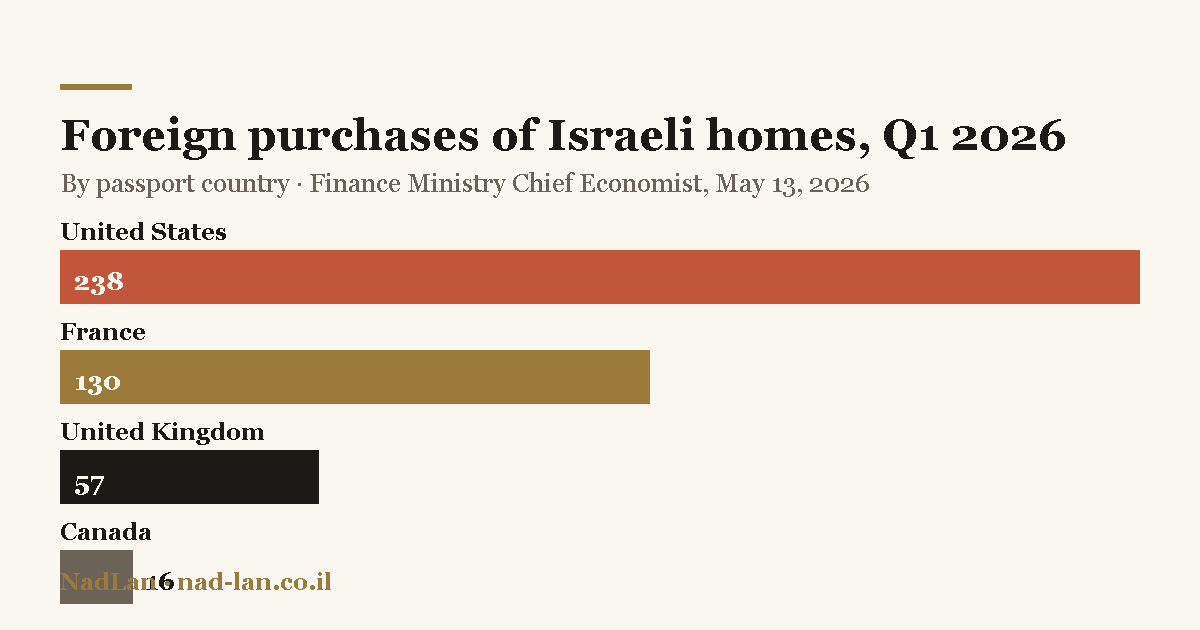
מפת האתר המלאה: כל הכלים, המדריכים והמאגרים ←