Foreign buyers purchased thousands of Israeli homes in recent years, and 2026 rules make the process more structured than most investors expect: a dedicated purchase-tax track for non-residents, bank financing capped at lower loan-to-value ratios, and anti-money-laundering checks on every shekel you transfer. This guide walks through the full path, from choosing a city and a lawyer to signing at the Land Registry (Tabu), with the official numbers and none of the folklore.
- Why Israel, why now: the 2026 market in numbers
- Step 1: Budget - purchase tax brackets for foreign residents
- Step 2: Financing - what Israeli banks lend non-residents
- Step 3: The team - lawyer, agent, appraiser (who is mandatory)
- Step 4: New construction vs second-hand
- Step 5: Money transfer and AML compliance
- Step 6: Signing, Tabu registration and warning notes
- Ongoing: taxes, management and renting out
- FAQ for foreign buyers
- Sources
Why Israel, why now: the 2026 market in numbers
Foreign buyers do not buy Israeli property only for yield. They buy because Israel is a family anchor, a future Aliyah base, a currency hedge, a place for children to study, a retirement option, or a long-term holding in a market where supply is physically constrained in the central cities. That emotional layer matters, but the purchase still has to pass a hard financial test. The right starting question is not whether Israel feels familiar. It is whether the city, tax bill, financing structure and ownership status fit your money.
The national market was not moving as one block in 2026. The Central Bureau of Statistics May to June 2026 releases reported that the national average home price in Q1 2026 was NIS 2,332,800, down 0.8% from Q1 2025, when the national average was NIS 2,350,900. The same CBS May to June 2026 release set also reported that the home price index fell 1.2% year over year in February to March 2026 compared with a year earlier. Inside that national picture, the city split mattered: Jerusalem rose 4.2% year over year while Tel Aviv fell 3.5% year over year, according to those CBS May to June 2026 releases.
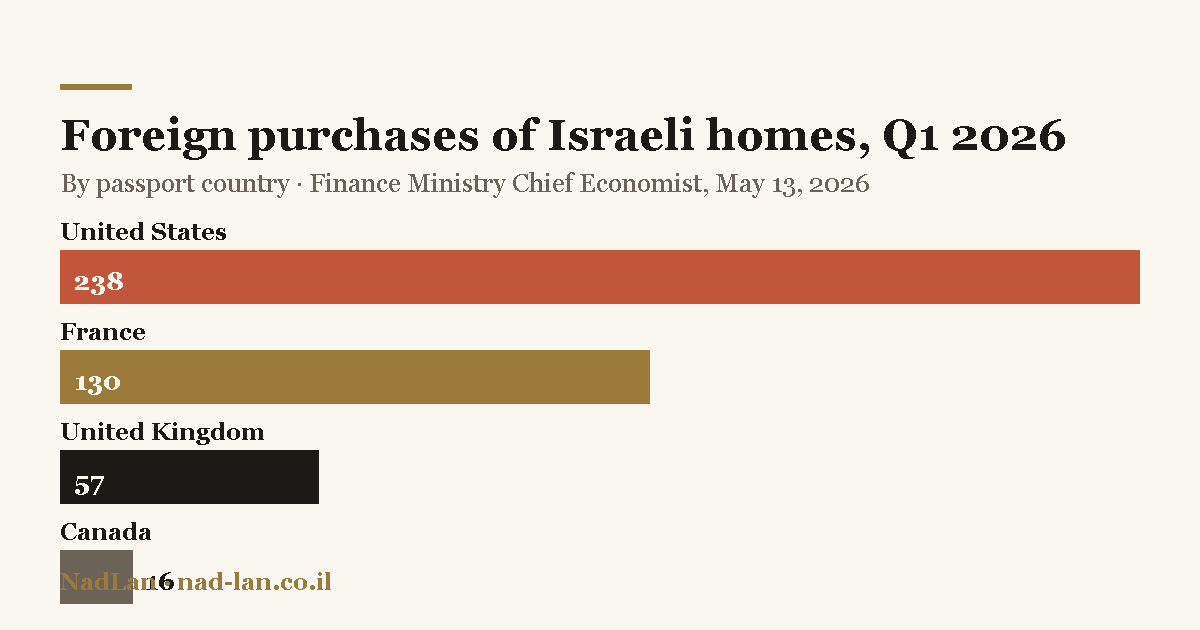
The foreign-buyer pattern in Q1 2026 was also visible in the Finance Ministry Chief Economist residential review for March 2026, published May 13, 2026. The review reported 487 foreign-resident purchases in Q1 2026, compared with 413 in Q1 2025, an 18% rise. It also gave the first-ever breakdown by passport country: US passports accounted for 238 purchases, or 49%; France accounted for 130 purchases, or 26.7%; and UK passports accounted for 57 purchases. Together, those three passport groups accounted for 87% of all foreign purchases in that review. Canada accounted for 16 purchases and Australia for 10 purchases, according to the same Finance Ministry Chief Economist review published May 13, 2026.
| Passport country | Q1 2026 foreign-resident purchases | Share of foreign-resident purchases | Source and date |
|---|---|---|---|
| United States | 238 | 49% | Finance Ministry Chief Economist residential review, March 2026, published May 13, 2026 |
| France | 130 | 26.7% | Finance Ministry Chief Economist residential review, March 2026, published May 13, 2026 |
| United Kingdom | 57 | Included in the three-country total of 87% | Finance Ministry Chief Economist residential review, March 2026, published May 13, 2026 |
| Canada | 16 | Not separately stated in the review | Finance Ministry Chief Economist residential review, March 2026, published May 13, 2026 |
| Australia | 10 | Not separately stated in the review | Finance Ministry Chief Economist residential review, March 2026, published May 13, 2026 |
The country mix also tells you where to look first. The same Finance Ministry Chief Economist residential review for March 2026, published May 13, 2026, reported that 52.5% of American purchases were in Jerusalem, equal to 125 homes. Netanya was second for American buyers with 27 homes, followed by Beit Shemesh with 24, Kiryat Gat with 11 and Tel Aviv with 10. The median price Americans paid in Jerusalem was above NIS 5 million, according to that review. The currency backdrop was not neutral: over the same year, the dollar weakened 13.6% against the shekel and the euro weakened 4%, according to the Finance Ministry Chief Economist review published May 13, 2026.
For a foreign buyer, this means the search should start with purpose and cash, then move to city. Jerusalem may fit diaspora families who want community depth, religious infrastructure and long-term use. Netanya may fit French-speaking buyers and coastal use. Tel Aviv may fit lifestyle buyers, but the 2026 CBS data showed a softer year-over-year price direction there than in Jerusalem. For a broader city comparison, use the site guide to where foreign investors buy in Israel alongside the tax and financing checks below.
Step 1: Budget - purchase tax brackets for foreign residents
Purchase tax is the first Israeli cost foreign buyers usually underestimate. In Israel, the tax is imposed on the buyer and is calculated from the purchase price under the applicable bracket. A foreign resident is not placed in the Israeli sole-home track merely because the property will be the only property they own in Israel. For purchase-tax purposes, the foreign-buyer track is generally the same as the track for a person who is not buying a sole home as an Israeli resident.
The tax rule itself is precise. For a foreign resident, and for anyone not buying a sole home as an Israeli resident, the purchase tax is 8% on the part of the price up to NIS 6,055,070 and 10% on the part above NIS 6,055,070. This rule is in force from January 16, 2024 through December 31, 2026, according to Israel Tax Authority rates via the official Kol Zchut guide, checked July 2026.
That simple rule can change the entire budget. A buyer comparing two apartments should compare the total acquisition cost, not only the seller's asking price. Your working budget should include the contract price, purchase tax under the correct resident status, legal work, bank conditions if borrowing, renovation or furniture needs, exchange-rate exposure, management costs and a cash buffer for transfer questions. Professional fees vary by transaction and should be confirmed in writing before you sign. The practical point is still clear: tax is not a side item. It is part of the property price.
| Buyer tax track | Bracket | Rate | Source and date |
|---|---|---|---|
| Foreign resident, and anyone not buying a sole home as an Israeli resident | Part of the price up to NIS 6,055,070 | 8% | Israel Tax Authority rates via Kol Zchut, in force January 16, 2024 through December 31, 2026, checked July 2026 |
| Foreign resident, and anyone not buying a sole home as an Israeli resident | Part of the price above NIS 6,055,070 | 10% | Israel Tax Authority rates via Kol Zchut, in force January 16, 2024 through December 31, 2026, checked July 2026 |
| Israeli-resident sole-home buyer | Up to NIS 1,978,745 | 0% | Israel Tax Authority rates via Kol Zchut, brackets frozen January 16, 2024 to January 15, 2028, checked July 2026 |
| Israeli-resident sole-home buyer | Above NIS 1,978,745 and up to NIS 2,347,040 | 3.5% | Israel Tax Authority rates via Kol Zchut, brackets frozen January 16, 2024 to January 15, 2028, checked July 2026 |
| Israeli-resident sole-home buyer | Above NIS 2,347,040 and up to NIS 6,055,070 | 5% | Israel Tax Authority rates via Kol Zchut, brackets frozen January 16, 2024 to January 15, 2028, checked July 2026 |
| Israeli-resident sole-home buyer | Above NIS 6,055,070 and up to NIS 20,183,565 | 8% | Israel Tax Authority rates via Kol Zchut, brackets frozen January 16, 2024 to January 15, 2028, checked July 2026 |
| Israeli-resident sole-home buyer | Above NIS 20,183,565 | 10% | Israel Tax Authority rates via Kol Zchut, brackets frozen January 16, 2024 to January 15, 2028, checked July 2026 |
There is a resident-status planning point for future olim and returning residents. A foreign buyer who becomes an Israeli resident or returning resident can qualify for the sole-home brackets. For purchases signed between February 28, 2024 and May 30, 2026, the deadline is 27 months from purchase or August 31, 2026, whichever is later, under the war-related extension described in the official Kol Zchut guide checked July 2026. This is not a reason to improvise. It is a reason to put your immigration timing, tax status and purchase date in front of an Israeli real estate lawyer before signing.
New immigrants also have a dedicated rule. Under regulation 12A for aliyah from August 15, 2024, a new immigrant buying a single home they will live in pays 0% up to NIS 1,978,745 based on the 2024 index, 0.5% from there up to NIS 6 million, and regular sole-home rates above that level. The source is the gov.il announcement of July 29, 2024 on the Ministry of Aliyah and Integration page. Because this depends on status, timing and intended use, future olim should read the full guide to purchase tax for foreign residents and run the numbers in the purchase tax calculator before choosing a property.
Step 2: Financing - what Israeli banks lend non-residents
Many foreign buyers assume that an Israeli bank will finance the purchase in the same way a bank would finance a local first home. The Bank of Israel rules say otherwise. The lending ceiling is based on buyer type, and non-residents are treated by banks as investors. That places the non-resident buyer in the lowest loan-to-value category in the rules.
Under Bank of Israel Proper Conduct of Banking Business Directive 329, the loan-to-value cap is 75% for an Israeli resident's first and only home, 70% for a replacement home, and 50% for an investment home. Non-residents are treated by the banks as investors, which means up to 50% of the lower of the purchase price or the bank's own appraisal. The source for these caps is Bank of Israel Proper Conduct of Banking Business Directive 329, checked July 2026.
| Buyer type | Maximum LTV cap | Calculation base | Source and date |
|---|---|---|---|
| Israeli resident, first and only home | 75% | Bank policy under the applicable lending rules | Bank of Israel Proper Conduct of Banking Business Directive 329, checked July 2026 |
| Israeli resident, replacement home | 70% | Bank policy under the applicable lending rules | Bank of Israel Proper Conduct of Banking Business Directive 329, checked July 2026 |
| Investment home | 50% | Bank policy under the applicable lending rules | Bank of Israel Proper Conduct of Banking Business Directive 329, checked July 2026 |
| Non-resident buyer | Up to 50% | Lower of the purchase price or the bank's own appraisal | Bank of Israel Proper Conduct of Banking Business Directive 329 and bank treatment of non-residents as investors, checked July 2026 |
The words lower of the purchase price or the bank's own appraisal are critical. If the contract price is above the bank valuation, the mortgage base may be the bank valuation. The buyer then has to bring more equity than expected. For foreign buyers, the cleanest path is to speak with a mortgage adviser or bank before signing a binding contract, submit identity documents and income materials early, and make sure the payment schedule in the contract matches realistic bank timing.
Financing also interacts with currency. A buyer earning dollars, euros, pounds, Canadian dollars or Australian dollars is buying a shekel asset and may be borrowing in Israel. The Finance Ministry Chief Economist review for March 2026, published May 13, 2026, reported that the dollar weakened 13.6% against the shekel over that year and the euro weakened 4%. This is not a forecast. It is a reminder that exchange-rate movement can change your effective purchase price before closing. For the dedicated financing path, read getting an Israeli mortgage as a non-resident.
Step 3: The team - lawyer, agent, appraiser (who is mandatory)
Every foreign buyer needs an independent Israeli real estate lawyer. The seller's lawyer does not represent you, even if that lawyer prepares the contract or communicates politely in English. Your lawyer checks the title, seller identity, rights status, tax exposure, payment schedule, warning note, mortgage conditions, power of attorney and closing mechanics. For a non-resident, the lawyer also becomes the person who keeps the transaction connected when you are outside Israel.
The lawyer should be independent from the seller, developer, broker and marketing company. In a second-hand purchase, the lawyer checks the Land Registry extract or the relevant rights register, confirms whether the seller can transfer what they claim to own, reviews liens or restrictions, and drafts protective conditions for payments. In a new-construction purchase, the lawyer reviews the developer contract, Sale Law guarantee mechanism, linkage, delivery terms, plan documents, specifications and the timing of registration.
An agent is not mandatory in every transaction, but a good buyer-side agent can save time in a market where listings may be duplicated, outdated, partly marketed through networks or priced with negotiation space. For a foreign buyer, the agent's value is highest when they know the target neighborhood at building level and are willing to reject unsuitable listings. The wrong agent adds noise. The right agent narrows the search and gets you into the right apartment types quickly.
An appraiser is usually required by the bank when there is financing, because the bank needs its own collateral value. Even when paying cash, a private appraisal can help with second-hand property, unusual rights, large renovation needs, luxury pricing or a purchase in an area with thin comparable sales. The lending rule makes the appraisal even more practical for non-residents, because the 50% financing ceiling is applied to the lower of the purchase price or the bank's own appraisal under Bank of Israel Directive 329, checked July 2026.
A power of attorney can let a buyer complete the whole purchase without flying to Israel. This can cover signing, tax filings, registration steps, bank coordination and closing actions, depending on how it is drafted and accepted. It is useful for buyers in the United States, France, the United Kingdom, Canada or Australia, but it should be prepared by your Israeli lawyer so it matches the transaction and registration requirements.
Step 4: New construction vs second-hand
Foreign buyers often start with new construction because the sales material is clearer, the building is modern, and the purchase can sometimes be coordinated from abroad with structured documents. New projects may offer parking, elevators, balconies, protected rooms and building systems that fit buyer expectations. They can also carry risks that need contract-level attention: delivery timing, specification changes, linkage, registration timing and the exact identity of the rights being purchased.
Buyers of new construction are protected by Sale Law guarantees, including a bank guarantee for every payment. That protection is central. Payments to a developer should follow the legal protection mechanism, and the buyer's lawyer should confirm the guarantee documents, account details and project status before money moves. Contract prices are usually linked to the Building Cost Index, so the headline price is not always the final shekel amount paid by delivery. This guide does not add an index forecast. Check the current index track in the contract before signing.
Second-hand property is different. The apartment exists, the building can be inspected, neighbors and noise can be observed, and the buyer can see the actual condition. The legal work focuses on ownership, liens, building irregularities, rights register, municipal files where relevant, mortgage discharge, possession date, fixtures and defects. A second-hand purchase can be faster than a project purchase, but speed is not a substitute for title work.
Foreigners of any nationality or religion can buy property built on privately owned land in Israel with no citizenship or residency requirement. A large share of Israeli land is state land managed by the Israel Land Authority under long leases, where foreign buyers may face extra steps. That distinction is one of the first issues your lawyer should identify. The buyer does not need to solve the entire Israeli land system alone. The buyer needs to know, before signing, what type of rights are being purchased and what approvals or registrations are needed.
If you are choosing between a project and an existing apartment, compare control. New construction gives you modern standards and a developer process, but you are buying a future asset. Second-hand gives you a real apartment now, but it may need repairs, upgrades or legal cleanup. Use buying new construction in Israel for the project path and check current new projects only after your tax and financing budget is clear.
Step 5: Money transfer and AML compliance
The money path is not a technical afterthought. Israeli banks must verify source of funds under Israel's Prohibition on Money Laundering Law before accepting transfers from abroad. That means a foreign buyer should expect questions about where the money came from, how it was earned, how it moved, and whether the sender, buyer and transaction documents match. A clean contract is not enough if the receiving bank is not comfortable with the funds.
Prepare the paper trail early. Typical explanations may involve salary savings, sale of another property, investment liquidation, inheritance, business proceeds or family support, but the bank will care about documents, not stories. The practical package may include bank statements, sale contracts, tax records, inheritance documents, proof of identity, company documents or other materials requested by the Israeli bank or lawyer. This article avoids listing a fixed checklist as a rule, because requirements differ by bank, country, account history and buyer profile.
Coordinate the transfer route before the contract creates a tight payment obligation. If the buyer has to move money from a foreign bank, convert currency, satisfy compliance checks and meet an Israeli payment date, the timing should be realistic. Your lawyer should review the seller's or developer's payment instructions, and the bank or receiving account details should be verified carefully. For new construction, payments should move through the protected mechanism tied to the Sale Law guarantee process, not through informal instructions.
Currency is part of compliance planning because the buyer may convert funds before transfer or hold shekels in Israel before payment. The Finance Ministry Chief Economist residential review for March 2026, published May 13, 2026, reported that the dollar weakened 13.6% against the shekel over that year and the euro weakened 4%. That historical context does not tell you what the exchange rate will do next, but it shows why transfer timing and currency exposure belong in the purchase plan. For the dedicated operational path, read transferring money to Israel for a property purchase.
Step 6: Signing, Tabu registration and warning notes
The Israeli purchase process becomes serious before signing, not after. By the time you sign, your lawyer should have checked the rights, reviewed the contract, negotiated protections, confirmed the payment schedule and identified the registration route. A buyer who signs first and investigates later has reversed the order of protection. In Israel, the legal structure of the property matters as much as the apartment itself.
After signing a second-hand purchase contract, a warning note, known in Hebrew as he'arat azhara, is registered at the Land Registry to block conflicting deals. The warning note tells the world that the seller has made a binding commitment to the buyer. It is one of the key early protections in a Tabu-registered transaction. Your lawyer should handle the filing quickly and confirm that the note was registered correctly.
Tabu is the common name for the Land Registry. Some properties are registered directly there. Others may involve the Israel Land Authority, a housing company register, a developer register before final condominium registration, or another rights-management path. A foreign buyer should not assume that every property has the same registration status. The lawyer's job is to identify where the rights are recorded today and how the buyer will be registered after closing.
The final transfer is usually tied to payment completion, tax confirmations, mortgage discharge if the seller has a loan, possession delivery and registration documents. If the buyer is abroad, a power of attorney can let the lawyer sign and complete many actions without the buyer flying to Israel. The exact authority must be drafted correctly. A vague overseas authorization can cause delays with a bank, tax office or registry.
For new construction, the path can be longer. The buyer may receive guarantees during construction, possession at delivery, and final registration only later when the building and condominium registration process are completed. The buyer's lawyer should explain what you own at each stage, what proof you receive, and what has to happen before the apartment is fully registered in your name or in the relevant rights record.
Ongoing: taxes, management and renting out
Owning an Israeli property from abroad is an operating decision. The purchase is only the first event. After closing, the owner has to manage municipal bills, building payments, insurance, repairs, tenant questions, rent collection, tax reporting, bank access, keys and emergency decisions. If the property is for family use only, the tasks may be lighter. If it will be rented out, the owner needs a system.
The first decision is who has authority on the ground. Some owners rely on relatives, but that can become uncomfortable when a tenant calls, a leak appears, or a building committee needs payment. A professional manager can coordinate rent, repairs, access and reports, but the owner should understand exactly what the manager is authorized to do. The management agreement should define approvals, spending limits, reporting, tenant screening and emergency handling.
Renting out an apartment also changes the practical profile of the purchase. A property that is perfect for occasional family visits may not be ideal as a rental. The rental market cares about transport, condition, building quality, maintenance, tenant demand and ease of showing. For a non-resident, simplicity has value. A well-located, easily managed apartment may outperform a more complicated asset that constantly requires overseas decisions.
Tax reporting should be planned with an Israeli professional who understands non-resident ownership and the owner's home-country obligations. This guide does not list rental tax rates or treaty rules, because they depend on each owner's status and home country. The correct move is to set the reporting structure before rent begins, not after income has already been received. For the operating side, use managing an Israeli rental property from abroad.
FAQ for foreign buyers
Can foreigners buy property in Israel?
Yes. Foreigners of any nationality can buy property built on privately owned land in Israel with no citizenship or residency requirement. The main issues are not permission in principle, but title type, tax status, bank financing, money-transfer compliance and the quality of the buyer's independent Israeli legal representation.
A large share of Israeli land is state land managed by the Israel Land Authority under long leases, where foreign buyers may face extra steps. Your lawyer should identify the rights type before signing and explain whether any approval, lease condition or registration path affects the deal.
Can non-Jews buy property in Israel?
Yes. Foreigners of any nationality or religion can buy property built on privately owned land in Israel with no citizenship or residency requirement. The process is legal and commercial, not religious. The buyer still needs proper title checks, tax planning, source-of-funds compliance and an independent Israeli real estate lawyer.
The same caution about land type applies. Private land is usually the cleaner legal category for foreign buyers, while state land managed by the Israel Land Authority may involve extra steps. The question should be checked property by property, not guessed from the city or neighborhood.
How much is purchase tax for a foreign buyer?
For a foreign resident, purchase tax is 8% on the part of the price up to NIS 6,055,070 and 10% on the part above NIS 6,055,070. Those rates are in force January 16, 2024 through December 31, 2026, according to Israel Tax Authority rates via Kol Zchut, checked July 2026.
A foreign buyer who becomes an Israeli resident or returning resident can qualify for the sole-home brackets. New immigrant rules may also apply in the circumstances described by the gov.il announcement of July 29, 2024. Status and timing should be checked before signing.
Can a non-resident get an Israeli mortgage?
Yes, but the Bank of Israel framework means the ceiling is lower than for a local first-home buyer. Non-residents are treated by banks as investors, with financing up to 50% of the lower of the purchase price or the bank's own appraisal, under Directive 329 checked July 2026.
Approval also depends on bank underwriting, documents, income evidence, source-of-funds checks and the property itself. Speak with the bank or adviser before signing, because a lower appraisal can require more equity than the buyer expected.
Do I have to be in Israel to complete the purchase?
No. A properly drafted power of attorney can let a foreign buyer complete the whole purchase without flying to Israel. Your Israeli lawyer can use it for signing and closing actions within the authority granted, provided the document is prepared correctly and accepted by the relevant bank, tax and registration bodies.
This is common for overseas buyers, but it should not be treated as a casual form. The power of attorney must match the transaction, the buyer identity documents, the financing structure and the registration route.
How much does a home in Israel cost in 2026?
The CBS May to June 2026 releases reported that the national average home price in Q1 2026 was NIS 2,332,800, down 0.8% from Q1 2025, when the average was NIS 2,350,900. The same CBS data reported a 1.2% year-over-year fall in the home price index.
National averages are only a starting point. The CBS May to June 2026 data showed Jerusalem rising 4.2% year over year while Tel Aviv fell 3.5% year over year. If Aliyah is part of the plan, pair the property search with the Aliyah housing checklist.
Sources
- Israel Tax Authority real estate taxation portal
- Tax Authority purchase tax simulator
- Kol Zchut purchase tax calculation page
- Bank of Israel banking supervision directives
- CBS housing price index releases
- Chief Economist residential review March 2026
Next step: choose the buyer status that fits you today, run the purchase tax, then ask your Israeli lawyer to confirm the land-rights path and the exact documents the bank will need before any binding offer is signed.
This guide is general information, not legal advice. Every transaction requires its own review of the specific facts. For an initial consultation on a purchase in Israel, contact the office.